
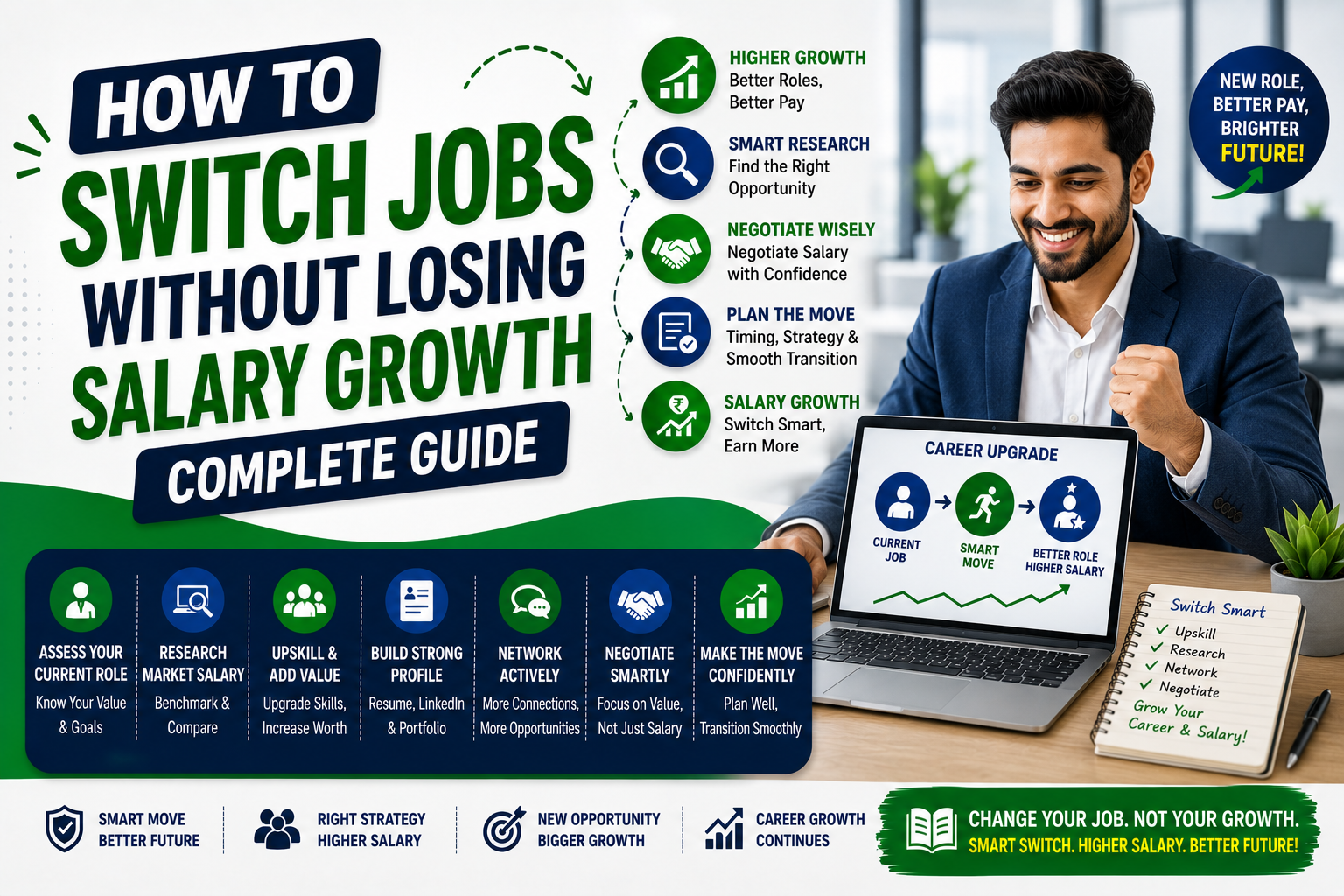
You’ve been at the same company for 3 years. Every year, you get a 7-8% hike. Your salary has moved from ₹4.5 LPA to ₹5.6 LPA. Meanwhile, your college batchmate switched jobs twice in the same period. His salary jumped from ₹4.5 LPA to ₹9 LPA. Same skills. Same starting point. Double the salary.
The difference? He knew when and how to switch. You stayed loyal.
In this article, I’ll show you exactly how much hike you should expect when switching, when the timing is right, how to negotiate your next offer, and how to avoid the mistakes that cost people lakhs.
How Much Salary Hike to Expect When Switching Jobs — Real Benchmarks
Let’s start with the numbers everyone wants to know.
According to a 2025 Naukri JobSpeak report, the average salary hike for job switchers in India is 20-35%. Compare that with internal annual hikes of 7-10%. In three years of staying at the same company, you might get a total increase of 25-30%. One well-planned job switch gives you that in a single move.
Here’s what the hike percentages look like across experience levels:
| Experience Level | Average Hike on Switching | Typical Range |
|---|---|---|
| Freshers (0-2 years) | 25-40% | ₹3.5 LPA → ₹4.5-5 LPA |
| Early career (2-5 years) | 30-50% | ₹6 LPA → ₹8-9 LPA |
| Mid career (5-10 years) | 25-40% | ₹12 LPA → ₹15-17 LPA |
| Senior (10+ years) | 20-35% | ₹20 LPA → ₹25-27 LPA |
Let me give you a real example. Neha, a software developer in Bangalore, earned ₹6.5 LPA after 3 years at a service-based IT company. Her annual hikes were 7%, 8%, and 9%. She switched to a product-based company at ₹10 LPA — a 54% jump. That one switch gave her more salary growth than her 3 years of annual hikes combined.
But here’s the thing — the hike depends on your leverage. If you’re switching with in-demand skills (cloud computing, data engineering, full-stack development), companies pay premiums. If you’re switching without upskilling, your hike will be lower.
A 2024 TeamLease survey found that professionals with updated certifications received 15-20% higher offers than those with the same experience but no recent certifications. Your skills directly determine your switching power.
What hike should you target? As a rule of thumb — never switch for less than 20% in the Indian market. If a company offers you only 10-15% more, it might not be worth the risk of a new environment, probation period, and lost relationships. The sweet spot is 30-40%. Anything above 50% means you were severely underpaid — or your new skills are in very high demand.
Is Job Hopping Bad for Your Career — And When Is the Right Time to Switch
This is India’s biggest career debate. Your parents say “Stay loyal.” LinkedIn influencers say “Switch every 2 years.” The truth is somewhere in between.
Here’s what the data says:
According to a 2024 LinkedIn India Workforce report, the average tenure at a company in India is 2.2 years for the IT sector and 3.1 years for non-IT sectors. So if you’re switching every 2-3 years, you’re not a job hopper — you’re average.
When does job switching become a problem?
| Pattern | How It Looks to Recruiters |
|---|---|
| 3-4 companies in 10 years | Normal, healthy career movement |
| 4-5 companies in 8 years | Slightly frequent, but acceptable with good reasons |
| 5+ companies in 5 years | Red flag — recruiters question loyalty and stability |
| Less than 1 year at every company | Serious concern — most companies will hesitate |
A hiring manager at an MNC in Gurgaon told me — “I don’t mind candidates who switched every 2-3 years with clear growth. But when I see someone who lasted 8 months, then 6 months, then 10 months — I assume they’ll leave us in 6 months too.”
The ideal timeline:
- First job: Stay 1.5-2 years minimum. Learn foundational skills. Build your base.
- Second job: Stay 2-3 years. Take on more responsibility. Get promoted.
- After that: Switch every 2-4 years based on growth, salary, and opportunity.
Real example. Arjun in Pune switched his first job after just 9 months. Then his second after 11 months. By his third interview, the HR asked — “Why should we invest in training you if you’ll leave in a year?” He didn’t get the offer. His technical skills were strong, but his resume pattern worked against him.
Signs it’s actually time to switch:
- No salary growth for 2+ years despite good performance
- No new responsibilities or learning opportunities
- Your market value is 30%+ higher than your current salary
- The company culture is affecting your mental health
- You’ve been passed over for promotion more than once without clear feedback
How to Plan a Job Switch for Maximum Salary Growth — Step by Step
Step 1: Upskill 3-6 months before you start applying.
Your hike depends on what you bring to the table. If you’re a Java developer, learn Spring Boot, microservices, or cloud (AWS/Azure). If you’re in marketing, get Google Ads or HubSpot certified. A backend developer in Chennai added AWS certification to his profile and his offer increased from the typical ₹9 LPA to ₹12.5 LPA. That one certification was worth ₹3.5 lakh per year.
Step 2: Research your market value before applying.
Check your current role’s salary range on AmbitionBox, Glassdoor, and PayScale. Filter by city, experience, and company type. If the market pays ₹10-₹13 LPA for your profile and you’re at ₹7 LPA — you’re significantly underpaid. That gap is your negotiation fuel.
Step 3: Apply selectively — not desperately.
Don’t apply to 200 jobs randomly. Target 20-30 companies that match your career direction. Research each one. Customize your resume for each application. A focused job search with 30 tailored applications beats a spray of 200 generic ones. A marketing professional in Mumbai applied to 25 companies over 6 weeks — got 7 interviews and 3 offers. His friend applied to 150 companies with the same resume — got 4 interviews and 1 offer.
Step 4: Negotiate using your current salary as a baseline — smartly.
When the new company asks for your current CTC, be honest. But frame your expectation around market value, not just a percentage increase. “My current CTC is ₹8 LPA. Based on my 4 years of experience and my AWS certification, the market range for this role in Bangalore is ₹11-₹13 LPA. I’m looking at ₹12 LPA.” This is stronger than saying “I want 40% hike.”
Step 5: Don’t resign until you have the offer letter in hand.
Verbal offers mean nothing. “We’ll send the letter by Monday” sometimes becomes silence. A developer in Hyderabad resigned on a verbal promise. The offer letter never came — the company had a hiring freeze. He was unemployed for 3 months. Never resign before holding a written, signed offer letter.
Common Job Switching Mistakes That Cost You Money and Career Growth
Mistake 1: Switching only for salary without checking growth potential.
A ₹3 LPA hike sounds great — until you realize the new company has no learning culture, no mentorship, and a dead-end role. Rahul in Delhi switched from a fast-growing startup (₹7 LPA) to a stagnant company (₹10 LPA). Two years later, his skills hadn’t grown. When he tried switching again, his market value had barely moved. The startup colleagues who stayed were now at ₹14-₹15 LPA. Short-term money cost him long-term growth.
Mistake 2: Accepting a counteroffer from your current employer.
You resign. Your current company suddenly offers ₹2 LPA more. You stay. This feels like a win — but it rarely is. According to a 2024 Harvard Business Review study, 80% of employees who accept counteroffers leave within 18 months anyway. Your loyalty is already questioned. The raise was reactive, not a reward for performance. And the reasons you wanted to leave — bad manager, limited growth, poor culture — haven’t changed.
Mistake 3: Not factoring in total compensation — only comparing CTC.
A ₹12 LPA offer with no insurance, no bonuses, and 90-day notice period might be worse than a ₹10.5 LPA offer with health insurance worth ₹50,000, guaranteed 1-month bonus, and 30-day notice. Always compare total value — base salary, variable pay, insurance, PF structure, notice period, work-life balance, and learning opportunities. A fresher in Pune accepted a higher CTC offer but later realized ₹1.2 lakh of it was “variable” that the company never paid.
Mistake 4: Burning bridges at your current company.
Don’t badmouth your manager during exit. Don’t slack off during your notice period. Don’t post rants on LinkedIn. The professional world in Indian tech and business is surprisingly small. A product manager in Bangalore left his company on bad terms — 2 years later, his old manager became the hiring manager at the company he was interviewing with. He didn’t get the job.
Frequently Asked Questions
Q1: How much salary hike is good when switching jobs?
In the Indian market, 25-40% is a healthy hike when switching. Below 20% may not justify the risks of a new environment and probation. Above 50% is rare and usually means you were underpaid or your skills are in exceptional demand. Target 30-40% and negotiate from a position of research and competing offers.
Q2: Is job hopping bad for your career in India?
Switching every 2-3 years is normal and expected in the Indian job market. It only becomes a problem when you have multiple stints of less than 1 year each. Recruiters worry about retention. If you’ve switched 5 times in 5 years, most companies will hesitate. Stay at least 1.5-2 years at each company to maintain a stable resume.
Q3: How to negotiate salary when switching to a new company?
Research the market range first on AmbitionBox or Glassdoor. Share your current CTC honestly. Frame your expectation around market value and your updated skills — not just a percentage. Have at least one competing offer if possible. Example: “My current CTC is ₹7 LPA. Based on market data and my recent certification, I’m targeting ₹10 LPA.” Data-backed asks get better results.
Q4: What is the ideal time to stay at a job before switching?
For your first job — minimum 1.5-2 years. For subsequent jobs — 2-3 years is the sweet spot. This gives you enough time to learn, deliver results, and build relationships. After 4-5 years at the same company without significant growth, you risk salary stagnation. The market rewards movement — but only when it’s strategic.
Q5: How to explain frequent job switches in an interview?
Be honest and frame each switch positively. Example: “My first switch was for a better technology stack. My second was for a leadership opportunity that wasn’t available internally.” Avoid blaming previous employers. Show that each move had a clear purpose — learning, growth, better role. If one was a bad decision, own it: “That role wasn’t the right fit, and I learned to evaluate companies more carefully.”
Switch Smart — Not Just Often
Here’s the one rule — every job switch should move you forward in skills, salary, and career trajectory. If a switch only gives you more money but no growth, you’ll stagnate. If it gives you growth but no fair salary, you’re being underpaid.
Check your market value tonight. Compare it to your current salary. If the gap is 30% or more — it’s time to plan your move. Upskill first. Apply selectively. Negotiate with data. And never resign without an offer letter in your hand.
The professionals across Delhi, Mumbai, Bangalore, and Pune who earn the most aren’t the most loyal — they’re the most strategic. They stay long enough to learn, leave soon enough to grow, and negotiate hard enough to get paid what they’re worth.
Your next switch is your biggest raise. Plan it well. 💪
