
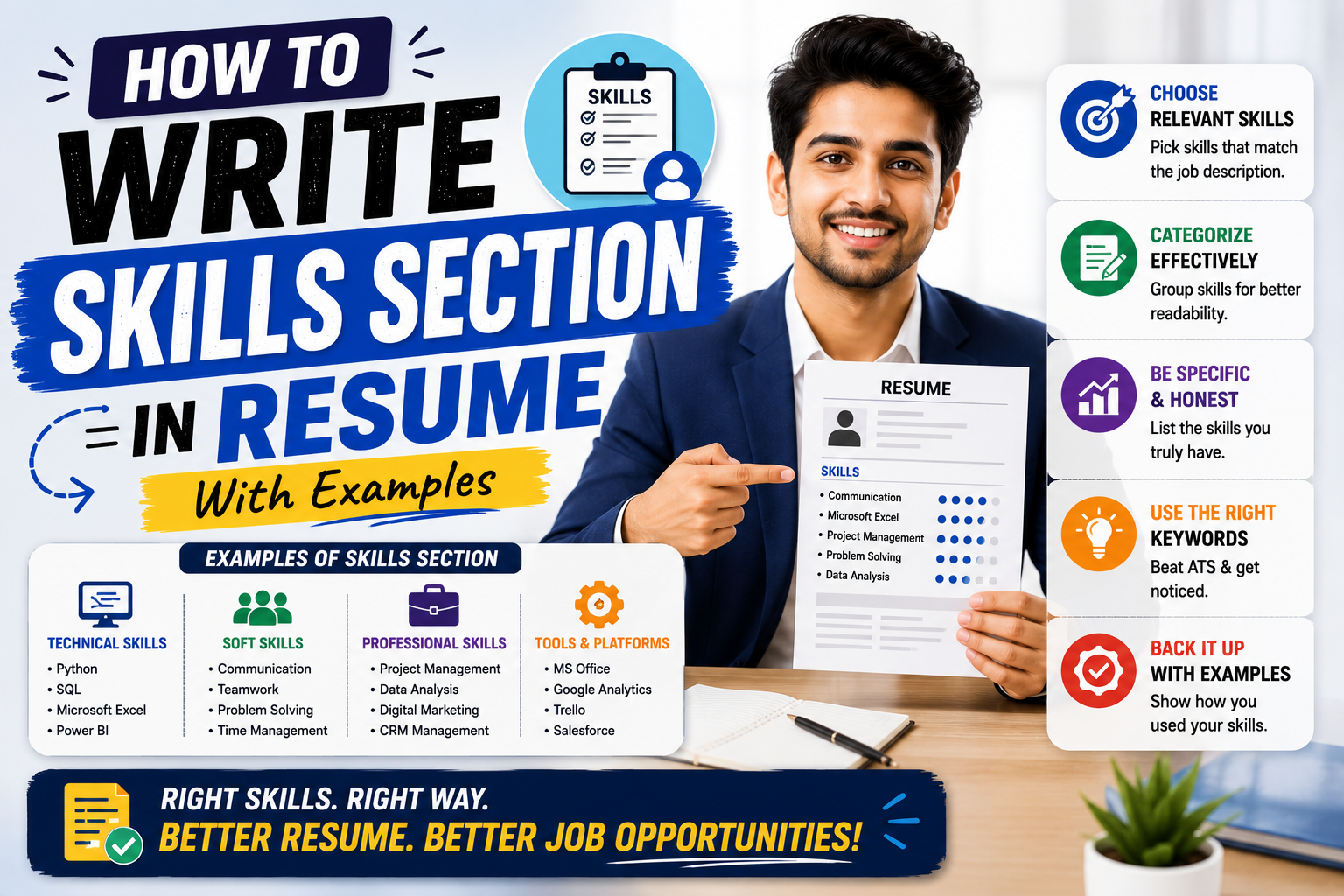
You sit down to build your resume. You reach the skills section. And you type the same thing every Indian candidate types — “Communication skills, team player, hard working, MS Office, leadership.”
Congratulations. Your skills section now looks exactly like 10 lakh other resumes. The recruiter skips right past it. Your resume lands in the reject pile — not because you lack skills, but because you listed them the wrong way.
The skills section is the most scanned part of your resume. ATS software reads it. Recruiters glance at it. And in 5 seconds, they decide if you’re a match.
In this article, I’ll show you exactly how to write a skills section that gets noticed — with real examples for freshers, experienced professionals, and every major field.
What Skills to Put on a Resume — Hard Skills vs Soft Skills Explained
Before you start listing skills randomly, understand the two types that belong on your resume.
Hard skills are technical, teachable abilities you can prove. You either know them or you don’t. Python, Excel, Tally, Photoshop, SQL, Google Ads — these are hard skills. An employer can test them in an interview. They’re specific to your job.
Soft skills are personal qualities that affect how you work. Communication, teamwork, problem-solving, time management, adaptability — these are soft skills. You can’t test them with a quiz, but they show up in how you handle work.
Here’s the golden rule most candidates miss — hard skills get you shortlisted, soft skills get you hired.
ATS software scans for hard skills first. If the job description says “proficiency in Java and SQL” and your resume doesn’t mention Java or SQL, the software rejects you before any human sees it. According to a 2024 Jobscan report, 75% of resumes are rejected by ATS before reaching a recruiter. The top reason — missing keywords in the skills section.
So which should you list? Both. But in the right proportion.
| Candidate Type | Hard Skills | Soft Skills |
|---|---|---|
| Freshers | 6-8 hard skills | 3-4 soft skills |
| Experienced (2-5 years) | 8-10 hard skills | 2-3 soft skills |
| Senior professionals (5+ years) | 10-12 hard skills | 2-3 soft skills |
A fresher in Delhi once listed 12 soft skills and zero hard skills. His resume said “good communicator, quick learner, team player, creative thinker, problem solver…” The recruiter told his placement officer — “I have no idea what this candidate actually knows how to do.” Always lead with hard skills. They’re measurable and concrete.
Resume Skills Section Examples — Field-Wise for Indian Job Seekers
Here are ready-to-use skills section examples. Pick your field. Customize with your actual skills.
For IT / Software Developer Freshers:
❌ Bad:
Skills: Computer knowledge, programming, good in coding, MS Office
✅ Good:
Technical Skills: Java, Python, SQL, HTML/CSS, Git, REST APIs, MySQL, VS Code
Tools: IntelliJ IDEA, Postman, GitHub, JIRA
Soft Skills: Analytical thinking, team collaboration
For Commerce / Accounting Freshers:
✅ Good:
Technical Skills: Tally Prime, Advanced Excel (VLOOKUP, Pivot Tables), GST Filing, TDS Returns, SAP FICO (Basic)
Tools: Zoho Books, Busy Accounting Software
Soft Skills: Attention to detail, numerical accuracy
For Marketing / MBA Freshers:
✅ Good:
Technical Skills: Google Ads, Meta Ads Manager, SEO (On-Page & Off-Page), Google Analytics, Canva, HubSpot, Email Marketing
Tools: Mailchimp, SEMrush, WordPress
Soft Skills: Creative thinking, data-driven decision making
For Mechanical Engineering Freshers:
✅ Good:
Technical Skills: AutoCAD, SolidWorks, CATIA, CNC Programming, Six Sigma (Yellow Belt), GD&T
Tools: ANSYS, MATLAB
Soft Skills: Process improvement, cross-functional coordination
For Customer Service / BPO Roles:
✅ Good:
Skills: CRM Software (Salesforce, Freshdesk), Voice Process, Email Support, Complaint Resolution, Multilingual (Hindi, English, Tamil)
Soft Skills: Active listening, conflict resolution, patience
For Experienced IT Professional (4 years):
✅ Good:
Technical Skills: Java, Spring Boot, Microservices, Docker, Kubernetes, AWS (EC2, S3, Lambda), PostgreSQL, MongoDB, CI/CD Pipelines
Tools: Jenkins, Terraform, Grafana, Confluence
Certifications: AWS Solutions Architect Associate
Notice how each example is specific, measurable, and relevant. No “hardworking.” No “passionate.” Just skills the recruiter can verify and the ATS can match.
How to Write Your Skills Section — Step by Step
Step 1: Read the job description carefully.
Open the job posting. Highlight every skill, tool, and technology mentioned. If the description says “Proficiency in Python, SQL, and Tableau” — those three words must appear in your skills section. This is how you beat ATS. A fresher in Bangalore applied for 30 data analyst roles with the same generic skills list. Zero calls. She started matching her skills to each job description — callbacks jumped to 5 in the next 15 applications.
Step 2: Separate hard skills from soft skills.
Create two clear subsections. Label them “Technical Skills” and “Soft Skills” — or “Core Skills” and “Professional Skills.” This helps both ATS and human readers find what they need instantly. Don’t mix “Python” with “teamwork” in the same bullet list. It looks messy and unstructured.
Step 3: List 8-12 skills total — no more, no less.
Too few skills (3-4) makes you look underqualified. Too many (20+) makes you look unfocused — or dishonest. According to a 2025 Indeed hiring study, resumes with 8-12 well-chosen skills receive 34% more interview calls than those with 20+ generic skills. Quality beats quantity.
Step 4: Add proficiency levels for technical skills (optional but effective).
Instead of just listing “Python,” write “Python (Intermediate)” or “Excel (Advanced — Pivot Tables, Macros, VLOOKUP).” This gives recruiters immediate context about your depth. But only do this if you’re honest — claiming “Advanced Java” when you can barely write a loop will backfire in the technical round.
Step 5: Place the skills section strategically.
For freshers — put skills right after your career objective, before work experience. You have limited experience, so skills need maximum visibility. For experienced professionals — put skills after work experience, where your achievements have already established credibility. Position matters. A fresher’s resume should lead with skills. An experienced professional’s resume should lead with results.
Common Skills Section Mistakes That Get Resumes Rejected
Mistake 1: Listing skills you can’t actually demonstrate.
A fresher in Hyderabad listed “Machine Learning” and “Deep Learning” on his resume because he watched a few YouTube videos. In the interview, when asked to explain gradient descent, he went blank. The interviewer noted — “Skills don’t match actual knowledge.” Only list skills you can confidently discuss or demonstrate. If you took one online tutorial, it’s not a resume skill yet.
Mistake 2: Using vague terms instead of specific tools.
“Computer skills” means nothing. “MS Excel, Google Sheets, Tally Prime” means everything. “Social media” tells the recruiter nothing. “Meta Ads Manager, Instagram Analytics, Hootsuite” tells them exactly what you can do. Replace every vague term with the specific tool or platform you’ve used. Recruiters search for tools — not categories.
Mistake 3: Copy-pasting the same skills section for every application.
The job description for a frontend developer mentions “React, TypeScript, Figma.” Your skills section lists “Java, Spring Boot, MySQL.” You’re qualified — but for a different role. Tailor your skills section to each application. Move the most relevant skills to the top. Add skills from the job description that you genuinely have. A generic skills section is an invisible skills section.
Mistake 4: Listing outdated or irrelevant skills.
“MS-DOS, FoxPro, Lotus Notes” on a 2026 resume signals that you haven’t updated your skills in 15 years. Similarly, a software developer listing “typing speed 40 WPM” is wasting precious resume space. A marketing graduate listing “C++ programming” is confusing the recruiter. Every skill on your resume should be relevant to the job you’re applying for right now — not skills from a different era or field.
Frequently Asked Questions
Q1: How many skills should I put on my resume?
8-12 skills is the sweet spot. This gives enough variety to show your range without overwhelming the recruiter. Freshers should aim for 6-8 hard skills and 3-4 soft skills. Experienced professionals should list 8-10 hard skills and 2-3 soft skills. Every skill listed should be one you can defend in an interview.
Q2: Should I have a separate skills section on my resume?
Yes — especially for freshers. A dedicated skills section makes it easy for ATS to scan and for recruiters to find your capabilities quickly. Place it near the top of your resume if you’re a fresher. Experienced professionals can also mention skills within work experience bullet points to show context — but a separate section is still recommended.
Q3: Should I list soft skills on my resume?
Yes, but sparingly — 2-4 maximum. And choose specific soft skills over generic ones. “Cross-functional team collaboration” is better than “teamwork.” “Client communication and stakeholder reporting” is better than “good communication.” If possible, demonstrate soft skills through your work experience bullet points rather than just listing them.
Q4: What are hard skills vs soft skills on a resume?
Hard skills are technical abilities you can prove — Python, Excel, Photoshop, GST filing, Google Ads. They’re learned through courses, training, or practice. Soft skills are personal qualities — communication, leadership, adaptability, critical thinking. They’re developed through experience and self-awareness. Both matter, but hard skills are what ATS and recruiters scan for first.
Q5: How do I write a skills section with no experience?
List skills from your coursework, college projects, online certifications, and personal projects. If you built a website using HTML and CSS for a college assignment — that’s a real skill. If you completed Google’s Data Analytics certification — list every tool covered (Sheets, SQL, Tableau, R). Freshers have more skills than they think. They just need to recognize and label them correctly.
Your Skills Section Is Your Resume’s Search Engine — Optimize It
Here’s the truth — your skills section isn’t a formality. It’s the engine that drives your resume through ATS filters and into recruiter hands. The right keywords in the right format can double your interview calls.
Open your resume tonight. Delete “hardworking, team player, MS Office.” Replace them with specific, job-relevant, honest skills that match what employers are actually searching for.
Read the job description. Match your skills. List tools by name. Put hard skills first. Keep it to 8-12 items. That’s your entire strategy.
Lakhs of candidates across Delhi, Mumbai, Bangalore, and Pune are applying to the same jobs. The ones whose skills sections speak the recruiter’s language get the call. The rest get filtered out silently.
Make your skills section work for you — not against you. Update it now.
