
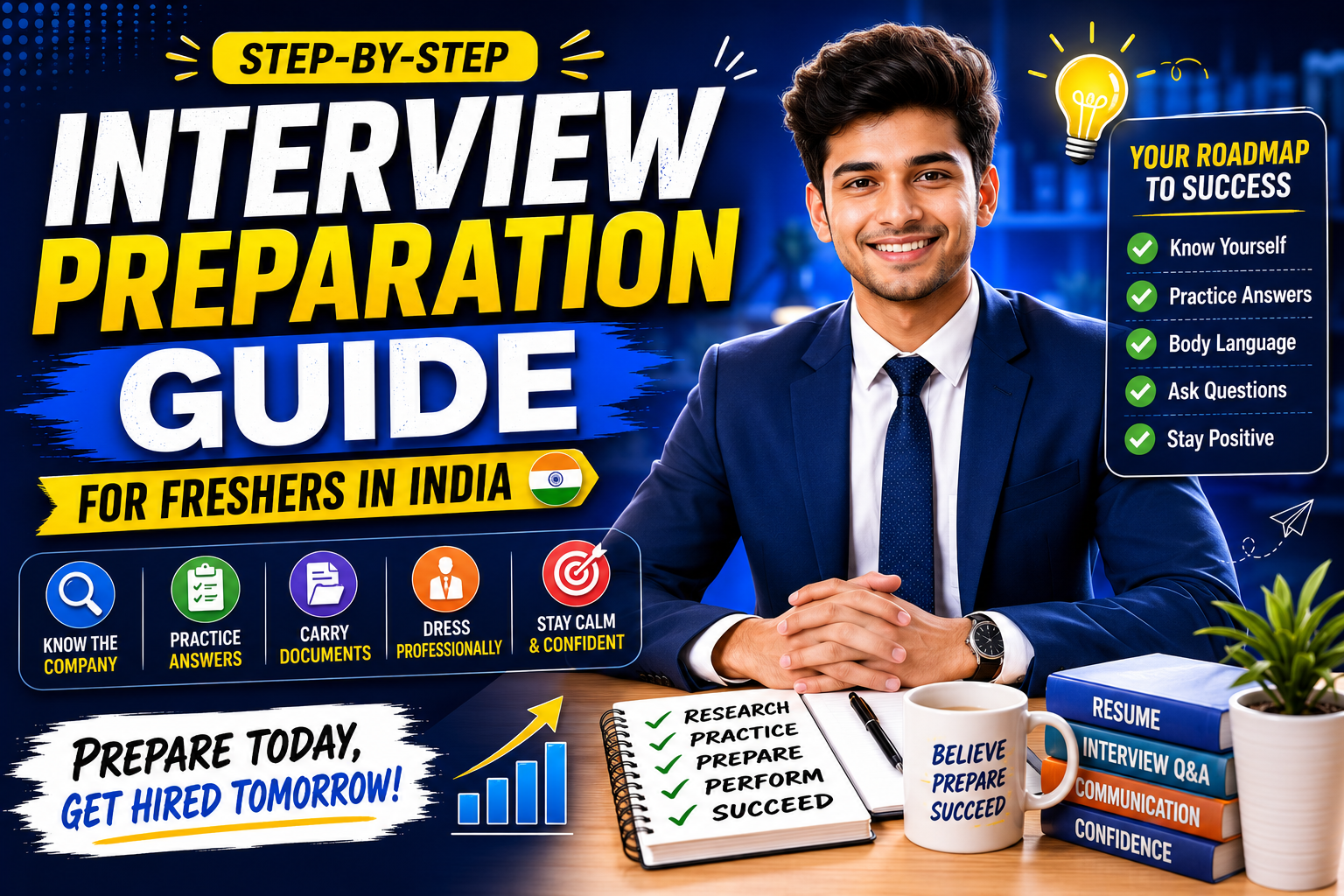
You’ve got the interview call. Your heart is racing. A hundred questions are running through your mind. What will they ask? What should I wear? What if I blank out? What do I say when they ask “Tell me about yourself?”
Every fresher in India goes through this exact panic before their first interview. You’re not alone.
In this article, I’ll walk you through everything — from how to prepare the night before, to exactly what to say when you’re sitting in that chair. No vague advice. Only real, practical steps you can follow today.
How to Prepare for Your First Job Interview — The Night Before
Most freshers start preparing 30 minutes before leaving for the interview. That’s too late. Real preparation starts at least one day before.
Research the company. Go to the company’s website. Read their “About Us” page. Check what they do, who their clients are, and what their recent news is. Then check their LinkedIn page — look at recent posts and employee count. If it’s a startup in Bangalore, check their Glassdoor reviews. If it’s an MNC in Gurgaon, look at their latest quarterly results.
Why does this matter? Because interviewers almost always ask — “What do you know about our company?” A fresher in Pune once answered, “I know your company does IT stuff.” He didn’t get the job. Another fresher said, “I read that you recently launched a healthcare product for rural India, and I found that really interesting.” She got hired. The difference was 20 minutes of research.
Prepare your documents. Print and carry these in a clear folder:
- 3-4 copies of your resume
- Original and photocopy of all mark sheets
- ID proof (Aadhaar/PAN)
- Passport size photos (3-4 copies)
- Any certifications or project reports
Plan your outfit. For men — formal shirt, trousers, polished shoes. For women — formal kurta or blouse with trousers, or a simple saree/salwar suit. Stick to neutral colours — white, light blue, beige, black. Avoid heavy perfume. Iron your clothes the night before, not the morning of.
According to a 2024 LinkedIn India survey, 63% of recruiters form a first impression within the first 5 minutes of the interview. Your appearance and confidence in those opening minutes matter more than you think.
How to Answer “Tell Me About Yourself” — With Real Examples
This is the most asked question in every fresher interview across India. And it’s where most candidates lose the interviewer’s attention.
Here’s what NOT to do — don’t recite your entire life story. Don’t start with “I was born in Lucknow in 2001…” The interviewer doesn’t want your biography.
Use this simple 3-part formula:
Part 1: Present — Who you are right now (1-2 lines)
Part 2: Past — What you studied or did that’s relevant (2-3 lines)
Part 3: Future — Why you’re here and what you’re looking for (1-2 lines)
Here’s a real example for a fresher applying for a software developer role in Hyderabad:
“I’m a recent B.Tech graduate in Computer Science from JNTU Hyderabad. During college, I built two projects — a student attendance app using React and a weather dashboard using Python and Flask. I also completed a 3-month internship at a local startup where I worked on backend API development. I’m now looking for a full-time role where I can apply my coding skills and grow as a developer, and that’s what drew me to this position at your company.”
That’s it. Under 60 seconds. Clear. Relevant. Confident.
Here’s another example for a fresher applying for a marketing role in Mumbai:
“I recently completed my MBA in Marketing from Mumbai University. During my studies, I managed the social media handles for our college fest, growing the Instagram page from 500 to 4,000 followers in two months. I also interned at a digital marketing agency where I handled Google Ads for three clients. I’m excited about this role because I want to work on larger brand campaigns and learn from an experienced marketing team.”
Notice — no childhood stories. No hobbies (unless asked). Straight to what matters.
Interview Day — Step by Step Guide to Stay Calm and Confident
Step 1: Arrive 15-20 minutes early.
Not 5 minutes. Not 45 minutes. Reaching too early is awkward. Reaching late is disqualifying. A fresher in Delhi missed his TCS interview because his auto got stuck in Rajiv Chowk traffic. Leave home with a 1-hour buffer for travel delays. Use Google Maps to check traffic the night before.
Step 2: Switch off your phone or put it on silent.
A ringing phone during the interview looks unprofessional. One candidate’s phone started playing a Bollywood ringtone mid-interview. He didn’t get a callback. Silent mode — no vibration.
Step 3: Greet with confidence.
Walk in. Make eye contact. Smile. Say “Good morning” or “Good afternoon.” Offer a firm handshake if they extend their hand. Sit only when offered a seat. These small things signal confidence.
Step 4: Listen before you speak.
Many freshers are so nervous that they start answering before the interviewer finishes the question. Take a 2-second pause after each question. It’s okay to say, “That’s a good question, let me think for a moment.” This shows maturity, not weakness.
Step 5: Ask at least one question at the end.
When they say “Do you have any questions?” — never say “No.” Ask something genuine: “What does a typical day look like for this role?” or “How is performance measured for freshers in the first 6 months?” This shows you’re serious about the job.
Common Interview Mistakes Freshers Make — And How to Avoid Them
Mistake 1: Memorizing answers word by word.
You rehearse “Tell me about yourself” 50 times. Then in the interview, you forget one line and your whole answer collapses. Don’t memorize scripts. Understand key points. Practice speaking naturally, like you’re explaining to a friend. Record yourself on your phone and play it back — you’ll hear where you sound robotic.
Mistake 2: Lying about skills or experience.
A fresher in Chennai listed “Advanced Excel” on his resume. The interviewer asked him to explain VLOOKUP. He couldn’t. Interview over in that moment. Only list skills you can actually demonstrate. If you know basics, say “basic” or “working knowledge.” Honesty builds trust. Lies destroy it instantly.
Mistake 3: Speaking negatively about previous experiences.
Even if your college was terrible or your internship manager was difficult — never say it in an interview. “My internship manager didn’t teach me anything” makes you sound like a complainer. Instead say, “I learned to work independently during my internship and became more self-reliant.” Same situation, completely different impression.
Mistake 4: Not preparing for “Why should we hire you?”
This question catches freshers off guard because they think — “I don’t have experience, what do I say?” Here’s a simple answer framework: mention 1 relevant skill + 1 quality + your eagerness to learn. Example: “I have strong skills in Java from my college projects, I’m a quick learner who adapts well to new environments, and I’m genuinely excited to contribute to your team from day one.”
Frequently Asked Questions
Q1: How to prepare for an interview in just one day?
Focus on three things — research the company (30 minutes), practice answers for “Tell me about yourself” and “Why should we hire you?” (1 hour), and prepare your documents and outfit (30 minutes). Skip trying to memorize 100 questions. Nail these basics and you’ll handle most fresher interviews confidently.
Q2: What questions are asked in fresher interviews?
The most common ones are — Tell me about yourself, Why should we hire you, What are your strengths and weaknesses, Where do you see yourself in 5 years, and Why do you want to join this company. Technical roles also include subject-specific questions. Prepare solid answers for these five and you’ll cover 70% of most interviews.
Q3: What should freshers say about salary expectations?
Research the market rate on Glassdoor or AmbitionBox before the interview. For example, if the average for your role in Bangalore is ₹3.5-₹4.5 LPA, say — “Based on my research, I believe ₹3.5 to ₹4.5 LPA is the standard range for this role. I’m flexible and open to discussing what works for both of us.”
Q4: How to reduce nervousness before an interview?
Reach early and sit quietly for 5 minutes. Take slow, deep breaths. Remind yourself — the interviewer wants you to succeed, not fail. They’re not your enemy. Also, remember that even if this one doesn’t work out, there will be more interviews. Reducing pressure on yourself is the fastest way to calm your nerves.
Q5: How early should I reach for the interview?
Reach the interview location 15-20 minutes before your scheduled time. This gives you time to find the office, use the washroom, settle down, and calm your nerves. Don’t arrive 45 minutes early — it puts unnecessary pressure on the reception team and makes you look anxious.
Go In Prepared, Come Out Confident
Here’s the truth — interviews are a skill. And like any skill, you get better with practice. Your first interview might be shaky. That’s completely normal.
Prepare your answers tonight. Practice in front of a mirror or with a friend. Lay out your clothes and documents. Set two alarms for the morning.
Thousands of freshers across Delhi, Mumbai, Bangalore, and Hyderabad crack their interviews every single week. They aren’t more talented than you — they’re just more prepared. And now, you have the same preparation playbook.
Walk in with confidence. You’ve done the work. Now show them what you’ve got.
