
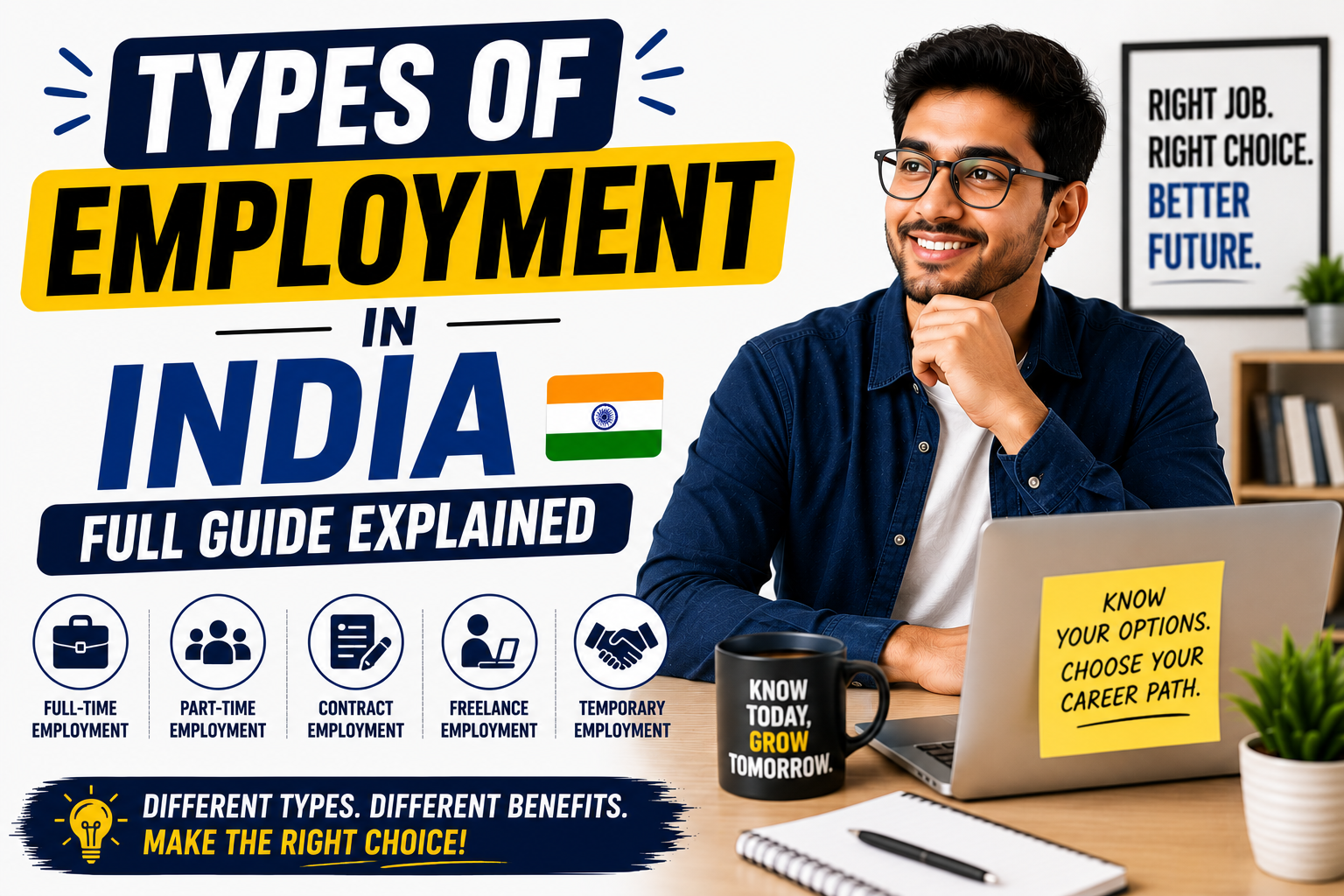
You’re scrolling through Naukri. One listing says “Full-time.” Another says “Contract — 12 months.” A third says “Freelance.” And then there’s “Part-time — 4 hours/day.” They all sound like jobs. But the salary, benefits, security, and rights are completely different for each one.
Most Indian job seekers don’t know these differences until they’ve already signed the offer. And by then, it’s too late.
In this article, I’ll break down every type of employment in India — full-time, part-time, contract, and freelance. You’ll learn what each one offers, what you lose, and which one fits your situation best.
Full Time vs Part Time vs Contract vs Freelance — What Each One Means
Let me explain all four types clearly. No jargon.
Full-Time (Permanent) Job — You work 8-9 hours a day, 5-6 days a week, with no fixed end date. You’re on the company’s payroll. You get salary, PF, insurance, paid leaves, bonuses — the full package. This is what most Indians mean when they say “I got a job.” A software developer at Infosys in Pune earning ₹6 LPA with health insurance, 24 paid leaves, and yearly appraisals — that’s a full-time role.
Part-Time Job — You work fewer hours than a full-timer. Usually 3-5 hours per day. Common among college students, homemakers, and retirees. A college student in Delhi working 4 hours at a café for ₹8,000/month — that’s part-time. Benefits are limited or absent. No PF. No insurance. But it gives flexibility.
Contract Job — You’re hired for a fixed period — 6 months, 1 year, or 2 years. Once the contract ends, the company either renews it or you leave. You work full hours like a permanent employee, but your employment has an expiry date. Many IT companies in Bangalore hire contract developers through staffing agencies at ₹4-₹8 LPA.
Freelance Work — You’re self-employed. No fixed employer. You find your own clients, set your own rates, and work on your own schedule. A graphic designer in Jaipur doing logo projects on Fiverr for ₹5,000-₹15,000 per project — that’s freelancing. No PF. No insurance. No leaves. But complete freedom.
According to a 2024 Nasscom report, India has over 1.5 crore freelancers — the second-largest freelance workforce in the world after the US. The way Indians work is changing fast.
Difference Between Contract and Permanent Job — Comparison with Benefits
This is where confusion runs deepest. From the outside, contract and permanent employees look the same — same office, same desk, same working hours. But the rights and benefits are vastly different.
Here’s a detailed comparison:
| Factor | Permanent (Full-Time) | Contract |
|---|---|---|
| Duration | No end date | Fixed (6 months to 2 years) |
| Job security | High | Low — ends when contract expires |
| Salary | Monthly, on company payroll | Monthly, often through staffing agency |
| PF (Provident Fund) | Mandatory | Depends on employer/agency |
| Health insurance | Usually provided | Rarely provided |
| Paid leaves | 15-24 days/year | Limited or none |
| Bonus & appraisal | Annual | Usually not applicable |
| Notice period | 30-90 days | As per contract (often 15-30 days) |
| Relieving letter | From the company directly | From the staffing agency |
| Growth/promotion | Clear career path | No promotions during contract |
Do contract employees get PF? This is one of the most searched questions — and the answer depends on how you’re hired.
If you’re hired directly by the company on contract, PF is mandatory if your basic salary is ₹15,000 or below and the company has 20+ employees. Same rules as permanent staff.
But here’s what happens in practice. Most contract employees in India are hired through third-party staffing agencies — Randstad, TeamLease, Quess, Adecco. In this case, the staffing agency is your legal employer, not the company where you work. The agency should deduct PF, but many smaller agencies skip it or deduct it irregularly.
Real example. Rohan worked as a contract developer at a major bank in Mumbai through a staffing agency. His monthly salary was ₹45,000. After 10 months, he checked his PF balance — it was zero. The agency had been deducting ₹1,800/month from his salary for PF but never deposited it with EPFO. He filed a complaint on the EPFO portal and eventually got his money. But it took 4 months of follow-up.
If you’re on a contract, check your PF passbook within the first 2 months. Don’t assume it’s being deposited just because it’s deducted from your salary.
How to Choose the Right Employment Type for You — Step by Step
Step 1: Assess your life stage.
If you’re a fresher looking for stability and learning — go for a full-time permanent role. If you’re a student needing pocket money — part-time works. If you’re experienced and want freedom — freelancing could be your path. If you need quick employment while searching for something permanent — a contract role bridges the gap.
Step 2: Calculate your financial needs honestly.
Full-time at ₹5 LPA gives you ₹35,000-₹40,000/month in hand, plus PF, insurance, and bonuses. A freelancer earning ₹5 lakh/year has no PF, no insurance, and must pay their own income tax. ₹5 LPA as a freelancer and ₹5 LPA as a full-timer are not equal. Always compare total compensation, not just the number.
Step 3: Check the benefits package, not just the salary.
A contract role at ₹50,000/month with no PF, no insurance, and no leaves is very different from a permanent role at ₹45,000/month with full benefits. That ₹5,000 “extra” in the contract role actually costs you more in the long run. Add up the value of PF, insurance, and paid leaves before comparing.
Step 4: Think about your 3-year career plan.
Contract roles don’t offer promotions. Freelancing doesn’t give you a corporate title or formal experience letter. If you want to build a structured corporate career in India, full-time permanent roles are still the fastest path. If you want flexibility and income diversity, freelancing wins.
Step 5: Read the contract before signing.
This sounds obvious, but most people don’t do it. Check — what happens when the contract ends? Is renewal guaranteed? Who provides PF? What’s the notice period? What about gratuity? A contract employee in Hyderabad assumed her 1-year contract would auto-renew. It didn’t. She was without a job overnight with no notice.
Common Mistakes People Make When Choosing Employment Type
Mistake 1: Joining a contract role thinking it’ll convert to permanent.
Recruiters often say — “It’s contract for now, but we’ll convert you to permanent in 6 months.” According to a 2024 Staffing Industry Analysts India report, only 23% of contract roles actually convert to permanent positions. Don’t join a contract role banking on conversion. Treat it as what it is — temporary work with a fixed end date.
Mistake 2: Freelancing without understanding taxes.
Freelancers in India must file income tax returns themselves. If your annual freelance income exceeds ₹20 lakh, GST registration is mandatory. Many new freelancers in India ignore this and get hit with penalties later. A content writer in Bangalore earned ₹22 lakh in her first year of freelancing — she didn’t register for GST and received a ₹15,000 penalty notice. Set up your tax structure from day one.
Mistake 3: Thinking part-time jobs have no value.
A part-time job at a retail store, coaching centre, or café still teaches you real skills — communication, customer handling, time management. A student in Chennai worked part-time at a Decathlon store for ₹6,000/month during college. That experience helped him crack an interview for a full-time sales role at ₹3.5 LPA — the interviewer valued his customer-facing experience.
Mistake 4: Not verifying the staffing agency for contract roles.
If you’re joining through a staffing agency, Google the agency name + “reviews” or “complaints.” Check if they’re registered. Ask previous contract employees about their experience. A legitimate agency like Randstad, TeamLease, or Quess will have proper documentation and regular PF deposits. An unknown agency might not.
Frequently Asked Questions
Q1: Which employment type is best in India?
For most people — full-time permanent is the safest choice. It offers job security, PF, insurance, paid leaves, and a clear career path. But “best” depends on your situation. Students benefit from part-time work. Experienced professionals with strong networks thrive as freelancers. Contract roles work well as stepping stones between permanent jobs.
Q2: Do contract employees get PF and benefits?
PF is mandatory if your basic salary is ₹15,000 or below — regardless of whether you’re permanent or contract. But many staffing agencies either skip PF or deposit it irregularly. Health insurance and paid leaves are usually not provided to contract employees. Always verify your PF deposits within the first 2 months of joining.
Q3: Is part-time work good for college students?
Yes — if it doesn’t affect your studies. A part-time job of 3-4 hours daily teaches practical skills, adds to your resume, and gives you financial independence. Popular options for Indian students include tutoring (₹5,000-₹15,000/month), retail store work, café jobs, content writing, and social media management. Balance is the key.
Q4: Can freelancers get home loans or credit cards easily?
It’s harder for freelancers compared to salaried employees. Banks prefer stable monthly income with salary slips. Freelancers need to show 2-3 years of ITR (Income Tax Returns) with consistent income. Some banks like ICICI and HDFC offer loans to freelancers with strong ITR history, but interest rates may be slightly higher and documentation is heavier.
Q5: What is the difference between freelance and contract work?
A contract worker has one employer for a fixed period, works set hours, and follows company rules — similar to a full-time employee with an end date. A freelancer has multiple clients, sets their own hours, works independently, and bills per project or hour. Contract workers are on someone’s payroll. Freelancers are self-employed and manage their own taxes.
Know What You’re Signing Up For
Here’s the one thing to remember — the type of employment you choose affects your salary, benefits, taxes, job security, and career growth. Not just the work you do.
Before you accept any offer, ask these three questions. Is this permanent or contract? What benefits are included? Who is my legal employer? These answers change everything.
Whether you’re a fresher in Delhi picking your first job, a homemaker in Pune exploring part-time work, or a designer in Bangalore considering freelancing — now you know exactly what each path offers and costs.
Choose with clarity. Sign with confidence. Build the career that fits your life.
