
You answered every question perfectly. Your resume was strong. Your technical skills were solid. But you didn’t get the job. Why? The interviewer later told your placement officer — “He seemed nervous and disinterested. He kept looking at the floor and slouching in his chair.”
Your words said “hire me.” Your body said “I’m not sure about this.”
A study by Albert Mehrabian found that 55% of communication is body language, 38% is tone of voice, and only 7% is the actual words. That means your body is speaking louder than your answers — whether you realize it or not.
In this article, I’ll show you exactly what confident body language looks like, what mistakes to avoid, and how to train yourself before your next interview.
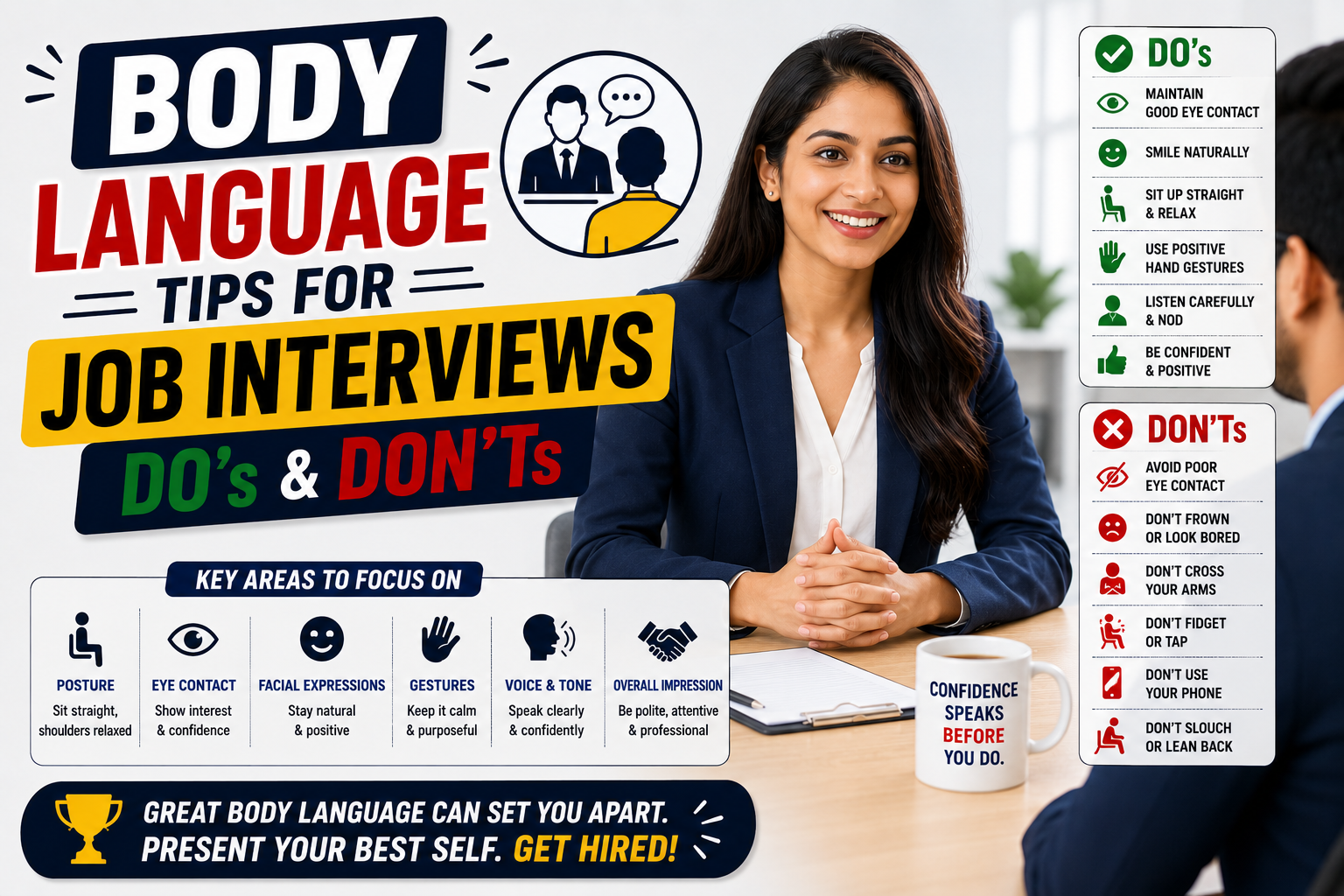
Body Language That Shows Confidence — The Do’s Every Candidate Must Know
Confident body language isn’t about being dramatic or theatrical. It’s about being calm, open, and present. Here’s what interviewers notice — and what they interpret.
Eye contact — the single biggest confidence signal.
When you maintain steady, natural eye contact, the interviewer reads it as — “This person is honest, confident, and engaged.” When you look at the floor, the ceiling, or your own hands — they read it as — “This person is nervous, hiding something, or unprepared.”
But here’s the key — eye contact doesn’t mean staring. That’s uncomfortable for everyone. The right balance is the 60-70% rule. Maintain eye contact for about 60-70% of the conversation. Look at the interviewer while they’re speaking and while you’re making key points. It’s natural to look away briefly while thinking. Then bring your eyes back.
A placement coordinator in Bangalore shared this with me — “I’ve seen two candidates with identical answers. The one who maintained eye contact got selected. The other, who kept looking down, didn’t. The interviewer said the first candidate ‘felt more trustworthy.'”
If there are multiple interviewers — a panel of three in Mumbai or a two-person interview in Gurgaon — look at the person who asked the question while answering. Occasionally shift your gaze to include the others. Don’t ping-pong your eyes rapidly. Smooth, natural shifts.
Posture — how you sit tells your story before you speak.
Sit upright with your back touching the chair’s backrest. Keep your shoulders relaxed — not hunched forward, not stiff like a soldier. Lean very slightly forward when the interviewer is speaking — it shows active interest. According to a 2024 study by the Journal of Nonverbal Behavior, candidates who leaned slightly forward during interviews received 23% higher engagement ratings from interviewers.
Handshake — your first physical impression.
In face-to-face interviews, the handshake happens in the first 3 seconds. Make it firm — not bone-crushing, not limp. Match the interviewer’s pressure. Make eye contact during the handshake. Smile. A fresher in Chennai extended a limp, sweaty handshake during a campus interview. The interviewer later noted — “First impression was weak.” That one moment coloured the entire 30-minute conversation.
Genuine smiling — it changes the entire room’s energy.
A natural smile — not a forced grin — makes you appear warm, approachable, and confident. Smile when you greet the interviewer. Smile when you’re listening to something interesting. Smile when you talk about projects you enjoyed. Don’t maintain a permanent smile — that looks forced. Let it come and go naturally.
Negative Body Language Signs — The Don’ts That Get You Rejected
Here are the body language mistakes that interviewers notice immediately — and what they silently conclude.
| What You Do | What the Interviewer Thinks |
|---|---|
| Avoiding eye contact | “Lacks confidence or hiding something” |
| Crossing arms tightly | “Defensive, closed off, uncomfortable” |
| Fidgeting with pen, hair, or clothes | “Nervous, unprepared, anxious” |
| Slouching in the chair | “Uninterested, lazy, low energy” |
| Tapping feet or bouncing legs | “Impatient, anxious, can’t sit still” |
| Touching face repeatedly | “Nervous, possibly dishonest” |
| Looking at phone or watch | “Disrespectful, wants to leave” |
| Over-using hand gestures | “Distracting, unfocused, trying too hard” |
Fidgeting is the most common killer.
When you’re nervous, your body looks for outlets — clicking a pen, twisting a ring, tapping fingers on the table, playing with your hair. You might not even notice you’re doing it. But the interviewer does.
Priya, a marketing fresher in Pune, clicked her pen throughout a 30-minute HR interview. She answered every question well. But the feedback said — “Candidate seemed very anxious.” She didn’t get the role. One small habit cost her an opportunity at a ₹5 LPA position.
Crossing arms — the invisible wall.
Your arms crossed over your chest might feel comfortable. But it signals to the interviewer that you’re closed off, defensive, or disagreeing. Keep your hands on your lap, on the table lightly, or use gentle hand gestures while speaking. Open palms signal honesty and openness.
The phone trap.
Even if your phone is on silent, don’t place it on the table. Don’t glance at it. Don’t touch it. A recruitment manager in Delhi told me — “If a candidate’s phone buzzes and they even glance at it, I mentally deduct points. It shows they’re not fully present.” Keep your phone in your bag. Out of sight, out of mind.
How to Improve Your Interview Body Language — Step by Step
Step 1: Record yourself in a mock interview.
Ask a friend to interview you for 10 minutes. Record it on your phone. Watch the video afterwards. You’ll be shocked at what you see — the fidgeting, the looking away, the slouching. You can’t fix what you can’t see. This one exercise is worth 10 articles about body language.
Step 2: Practice the power pose before the interview.
Stand in a private space — the washroom, your car, a quiet corner — for 2 minutes before the interview. Feet shoulder-width apart. Hands on your hips. Chin slightly up. A 2012 Harvard study by Amy Cuddy showed that power posing for 2 minutes increases testosterone (confidence hormone) by 20% and decreases cortisol (stress hormone) by 25%. Do this before every interview. It works.
Step 3: Train eye contact with daily conversations.
Most people struggle with eye contact because they never practice it. Start today — maintain eye contact during normal conversations with friends, family, or shopkeepers. Follow the 60-70% rule. Within a week, it’ll feel natural. A fresher in Lucknow practiced eye contact during chai conversations with his roommates for 5 days before his Infosys interview. He told me — “For the first time, the interviewer said I looked confident.”
Step 4: Sit in the interview chair position for 10 minutes daily.
Sit on a straight-backed chair at home. Feet flat on the floor. Back touching the chair. Hands on your thighs or table. Hold this position for 10 minutes while watching a YouTube video. Your body will memorize the posture. On interview day, you’ll sit correctly without thinking about it.
Step 5: Eliminate one fidgeting habit before each interview.
Don’t try to fix everything at once. Identify your worst habit from your mock interview recording. If it’s pen-clicking — don’t carry a pen into the interview room. If it’s hair-touching — tie your hair back. If it’s leg-bouncing — press your feet firmly into the floor. Remove one bad habit at a time.
Common Body Language Mistakes Specific to Indian Interviews
Mistake 1: Nodding too much to show agreement.
Many Indian candidates nod constantly while the interviewer speaks — almost like a reflex. Occasional nodding shows you’re listening. Continuous nodding makes you look like you’re just agreeing with everything without thinking. Nod 3-4 times per minute — not 30.
Mistake 2: Speaking with hands in pockets.
Some candidates, especially during walk-in interviews or standing interactions at job fairs in Mumbai or Pune, put their hands in their pockets while talking. This looks overly casual and closed off. Keep your hands visible and relaxed by your sides or use gentle gestures while speaking.
Mistake 3: Not adapting body language for video interviews.
Video interviews are common now — especially for remote roles and first-round screenings. But many candidates forget that body language matters on camera too. Sit straight. Look into the camera lens (not the screen) for eye contact. Keep your background clean. A candidate in Hyderabad did a Zoom interview lying on his bed with a messy room behind him. The recruiter shared the feedback — “Not professional.” Your webcam is your interview room. Treat it like one.
Mistake 4: Standing up or walking around while waiting in the lobby.
While waiting for your turn, sit calmly. Don’t pace around the lobby. Don’t stand near the reception and stare at employees. Don’t make phone calls loudly. The receptionist often shares observations with HR. A calm, seated, composed candidate in the lobby already looks like someone the company wants on their team.
Frequently Asked Questions
Q1: How to maintain eye contact without it feeling awkward?
Follow the 60-70% rule — look at the interviewer’s eyes while they speak and while you make key points. Look away naturally when you’re thinking or forming your next sentence. If direct eye contact feels too intense, look at the triangle between their eyes and nose — it feels the same to them but is easier for you. Practice with friends daily.
Q2: What body language shows confidence in an interview?
Five signals — steady eye contact (not staring), upright posture with slight forward lean, open hand gestures (no crossed arms), a firm handshake, and a natural smile. Together, these create an impression of calm confidence. You don’t need to be loud or dramatic. Quiet confidence — where your body is relaxed and open — is the most powerful signal.
Q3: How should I sit properly in a job interview?
Back touching the backrest. Feet flat on the floor. Hands resting on your lap or lightly on the table. Lean very slightly forward to show engagement. Don’t cross your legs in a casual figure-four position — keep both feet grounded. Don’t sink into the chair or sit on the edge. Find a balanced, upright position that you can hold comfortably for 30-45 minutes.
Q4: What are signs of bad body language that interviewers notice?
The top five — avoiding eye contact, fidgeting (pen-clicking, hair-touching, ring-twisting), slouching or leaning back too far, crossing arms tightly, and looking at your phone or watch. Any of these signals nervousness, disinterest, or lack of preparation. Interviewers are trained to notice these — even if they don’t mention it to you directly.
Q5: Does body language matter in video interviews?
Absolutely. Recruiters assess your professionalism through the camera. Sit in a well-lit space with a clean background. Look into the camera lens — not the screen — to simulate eye contact. Sit upright. Use subtle hand gestures. Dress formally from head to toe — not just the visible half. Over 60% of Indian companies now use video interviews for first rounds, according to a 2024 Naukri survey.
Your Body Speaks Before You Do — Make Sure It Says the Right Things
Here’s the one thing to remember — you can have the best answers in the world, but if your body says “I’m nervous and unsure,” the interviewer believes your body.
Record yourself tonight. Watch the video. Find your one worst habit and fix it this week. Practice eye contact in everyday conversations. Do the power pose before you walk in.
Thousands of candidates across Delhi, Mumbai, Bangalore, and Chennai walk into interviews every day. The ones who sit straight, look the interviewer in the eye, and stay calm with their hands — they get the callback. Not because they had better answers. Because their body said what their words couldn’t.
Your confidence is already in you. Let your body show it. 💪
