
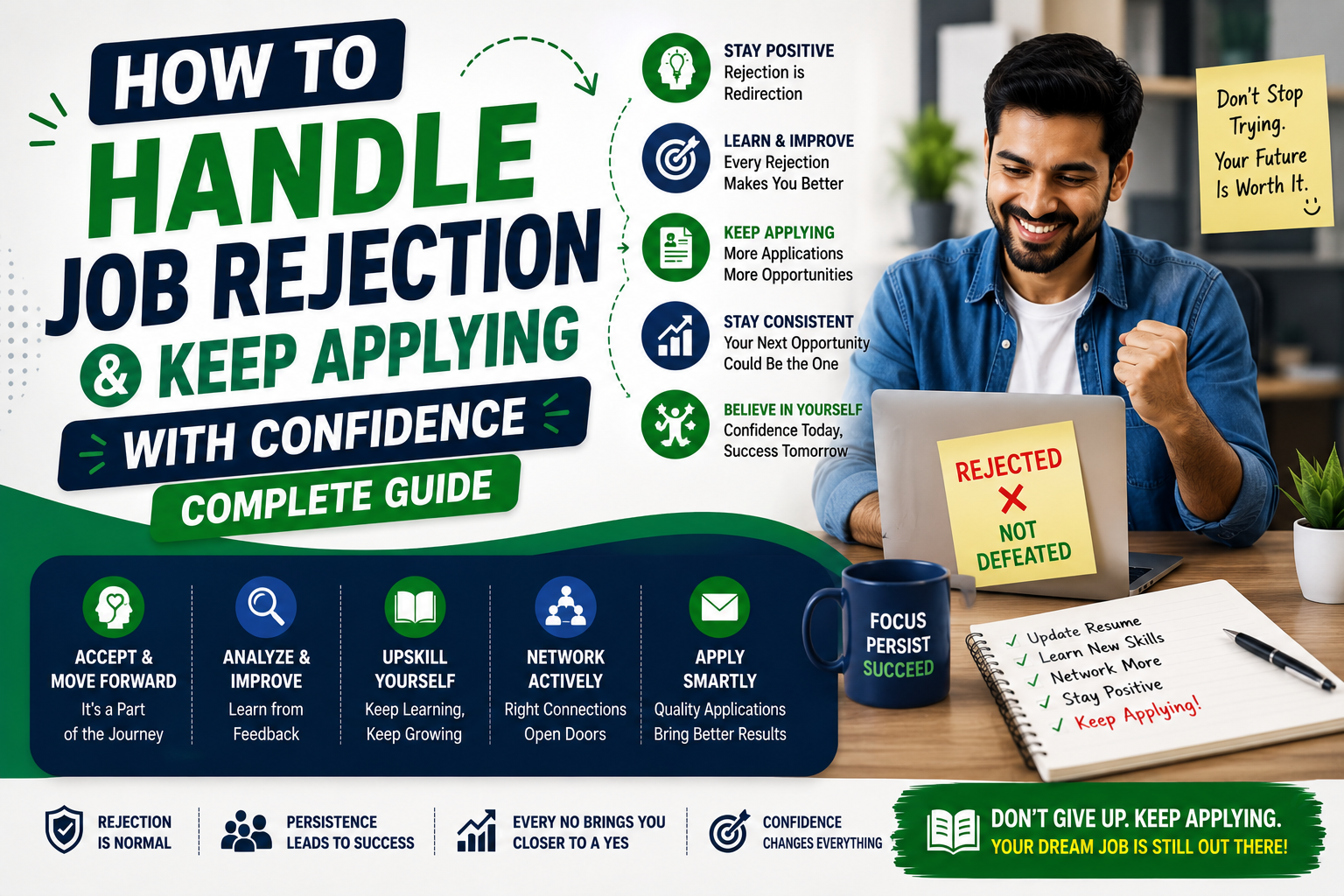
You applied to 47 jobs. Got 5 interview calls. Made it to the final round twice. And then — the email arrives. “We regret to inform you that we have decided to move forward with another candidate.” Your chest tightens. You close your laptop. You wonder if something is fundamentally wrong with you.
It hurts. I know. Every rejection feels personal — even when it isn’t.
But here’s what nobody tells you during the job search. Rejection isn’t the exception. It’s the process. And the candidates who eventually land great jobs aren’t the ones who never got rejected — they’re the ones who didn’t stop after rejection.
In this article, I’ll show you why rejection happens, how many rejections are actually normal, how to ask for feedback, and exactly how to turn each “no” into a better chance at “yes.”
How Many Job Rejections Are Normal Before Getting Hired
Let me give you a number that might surprise you — and also relieve you.
According to a 2024 Jobvite Recruiting Report, the average job seeker applies to 100-200 jobs before receiving one offer. In India, where competition is even fiercer — especially for freshers — that number can be higher.
Here’s what the typical funnel looks like:
| Stage | Numbers |
|---|---|
| Applications sent | 100-150 |
| Resume shortlisted | 15-20 |
| Interview calls received | 8-12 |
| Second/final round | 3-5 |
| Offers received | 1-2 |
That means even in the best case, 98 out of 100 applications end in rejection. This isn’t failure — it’s the standard conversion rate of job searching.
Ankit, a BCA graduate from Jaipur, applied to 120 companies over 4 months. He got 9 interview calls. Failed in 7. Got rejected after the final round in 1. And received 1 offer — at ₹4.8 LPA from a Bangalore startup. Today, he’s a senior developer earning ₹12 LPA. Those 119 rejections didn’t define his career. That 1 acceptance did.
Why do most rejections happen?
It’s rarely about you being “not good enough.” Here are the real reasons:
- The company already had an internal candidate — your interview was a formality
- Budget got cut after the job was posted — the role no longer exists
- Another candidate had one specific skill you didn’t — not better, just different
- ATS filtered your resume because of formatting — no human ever saw it
- Cultural fit — your personality didn’t match the team vibe, nothing personal
A hiring manager at an IT company in Pune told me — “I reject 9 out of 10 candidates. It doesn’t mean those 9 are bad. It means I can only hire 1. Most rejected candidates would do the job just fine at another company.”
That perspective matters. You’re not being rejected by the world. You’re being rejected by one company, for one role, on one day. Tomorrow’s application is a clean slate.
Should You Ask Why You Were Rejected — And How to Get Useful Feedback
Yes — you absolutely should. But how you ask determines whether you get a real answer or a polite brush-off.
Most companies won’t give detailed feedback unprompted. But when a candidate asks politely and professionally, about 30-40% of recruiters will share something useful, according to a 2024 LinkedIn Talent Solutions survey.
When to ask: Within 24-48 hours of receiving the rejection. Don’t wait a week — by then, the interviewer has forgotten the details.
How to ask — email template:
Subject: Thank You & Quick Request — [Your Name], [Job Title]
Dear [HR/Interviewer Name],
Thank you for considering me for the [Job Title] position. While I’m disappointed with the outcome, I respect the decision.
I’m actively working on improving my skills and interview performance. If possible, could you share any specific areas where I could improve? Even a brief note would be very helpful for my growth.
Thank you again for your time. I’d love to stay in touch for future opportunities.
Best regards,
[Your Name]
What kind of feedback you might get:
- “Your technical skills were good but we needed someone with cloud experience”
- “You seemed nervous and your answers were too brief”
- “We went with a candidate who had more relevant internship experience”
- “Your salary expectation was above our budget”
Each of these is gold. It tells you exactly what to fix before your next interview.
Priya, a marketing fresher in Mumbai, got rejected after a final round at a digital agency. She sent a feedback email. HR replied — “Your campaign knowledge was strong, but we felt your data analysis skills needed work.” Priya spent the next 3 weeks learning Google Analytics deeply. In her next interview — at a better agency — she nailed the analytics questions and got hired at ₹4.5 LPA.
That one rejection email taught her more than any coaching class could.
What if they don’t respond? That’s okay. Not every company will. Don’t send a follow-up asking again. Move on. Apply the general improvements from this article and keep going.
What to Do After a Job Rejection — Step by Step Recovery Plan
Step 1: Allow yourself 24 hours to feel the disappointment.
Don’t pretend you’re fine. Don’t immediately jump to “everything happens for a reason.” Rejection hurts. Let yourself feel it for a day. Talk to a friend. Go for a walk. Eat something nice. But after 24 hours — sit down and start working again. Grief has a time limit during job searches.
Step 2: Write down what went well and what didn’t.
Open your notes app. Write honestly — which questions did you answer confidently? Where did you hesitate? Did your resume match the job description? Were you prepared for the technical round? This 10-minute self-assessment after every rejection builds a pattern over time. After 3-4 rejections, you’ll see exactly which area needs the most work.
Step 3: Send a feedback request email.
Use the template above. Not every company will respond. But the ones that do will give you specific, actionable insights. This takes 5 minutes and can change your entire preparation approach.
Step 4: Fix one thing before your next application.
Don’t try to overhaul everything. Pick the weakest area from your self-assessment and improve it. If communication was the issue — do 3 mock interviews this week. If your resume got filtered — optimize it with an ATS checker. If technical skills were weak — take a focused online course on the specific topic. One improvement per rejection cycle compounds fast.
Step 5: Apply to 5 more jobs the same week.
Momentum is your best friend during job searches. Every day you stop applying, your confidence drops further. The antidote to rejection isn’t rest — it’s action. A fresher in Hyderabad made a rule — for every rejection, he applied to 5 new jobs within 48 hours. After 3 months and 14 rejections, he had 2 offers on the same day.
Common Mistakes People Make After Getting Rejected
Mistake 1: Taking it personally and questioning your worth.
“I’m not good enough.” “Nobody wants to hire me.” “There’s something wrong with me.” These thoughts are natural — but they’re lies your brain tells you under stress. You were one of hundreds of applicants. The company had one seat. The math was never in any single candidate’s favour. Your worth is not defined by a recruiter who spent 6 seconds on your resume.
Mistake 2: Stopping the job search after 2-3 rejections.
A fresher in Delhi applied to 15 companies, got rejected from 3 interviews, and stopped applying for 2 months. When he restarted, those same companies had filled their positions. The job market doesn’t wait. According to Naukri 2024 data, fresh job postings in India have an average active life of just 21 days. If you pause for 2 months, you miss hundreds of openings that won’t come back.
Mistake 3: Applying to the same types of roles without changing your approach.
If you’ve applied to 50 similar jobs with the same resume and gotten zero calls — the problem isn’t luck. It’s your resume, your skills targeting, or both. Change something. Tailor your resume to each role. Add a missing skill. Apply to a slightly different role that matches your profile better. Doing the same thing and expecting different results leads nowhere.
Mistake 4: Badmouthing the company or interviewer on social media.
“Company X rejected me, their HR is useless.” “Worst interview experience ever.” Posting this on LinkedIn or Twitter feels satisfying for 5 minutes — and damages your reputation permanently. Recruiters check social media. Other companies see these posts. A candidate in Bangalore posted a rant about a “biased interviewer.” A recruiter from a different company saw the post and quietly removed his application. Keep your frustration offline.
Frequently Asked Questions
Q1: Why do I keep getting rejected for jobs?
Common reasons — your resume doesn’t match the job description (ATS filters you out), you’re applying to roles above your current skill level, your interview answers lack specific examples, or the market is highly competitive right now. Audit your resume with an ATS checker. Practice interviews with a friend. Apply to roles that match your exact skills. One targeted change often breaks the rejection cycle.
Q2: How many rejections is normal before getting a job?
For freshers in India, 50-100 applications before landing an offer is completely normal. Even experienced professionals face 20-40 rejections per job search cycle. A 2024 Indeed study found that the global average is 1 offer per 100 applications. You’re not failing — you’re participating in a numbers game. Keep applying consistently.
Q3: Should I ask the company why I was rejected?
Yes — within 24-48 hours. Send a polite email thanking them and requesting brief feedback. About 30-40% of recruiters will share useful insights. The feedback might reveal a specific skill gap, an interview weakness, or a resume issue you can fix immediately. Even if they don’t reply, asking shows professionalism.
Q4: How to improve my resume after rejection?
Compare your resume against the job descriptions that rejected you. Identify missing keywords and skills. Run your resume through a free ATS checker like Jobscan. Remove generic phrases. Add specific tools, technologies, and certifications. Tailor your skills section for each application. One round of resume optimization can increase your callback rate by 2-3x.
Q5: How long should I wait before reapplying to the same company?
Wait at least 6 months — ideally 12 months. Use that time to genuinely improve the skill or area that led to rejection. When you reapply, your resume should look noticeably different — new certification, new project, or new experience. Many Indian companies are open to reconsidering candidates who show measurable growth between applications.
Every “No” Brings You Closer to Your “Yes”
Here’s what I want you to remember on your toughest day — the job that’s meant for you hasn’t seen your resume yet. Every rejection is redirecting you, not defining you.
Feel the disappointment. Then get back up. Send that feedback email. Fix one weakness. Apply to 5 more jobs this week. Keep your momentum alive even when your confidence is shaking.
Lakhs of professionals across Mumbai, Delhi, Bangalore, and Pune have sat exactly where you’re sitting right now — rejected, frustrated, doubting themselves. They kept going. They got hired. And six months later, they couldn’t even remember the name of the company that rejected them.
Your job is out there. It just hasn’t found you yet. Keep showing up. Keep applying. You’re closer than you think. 💪
