
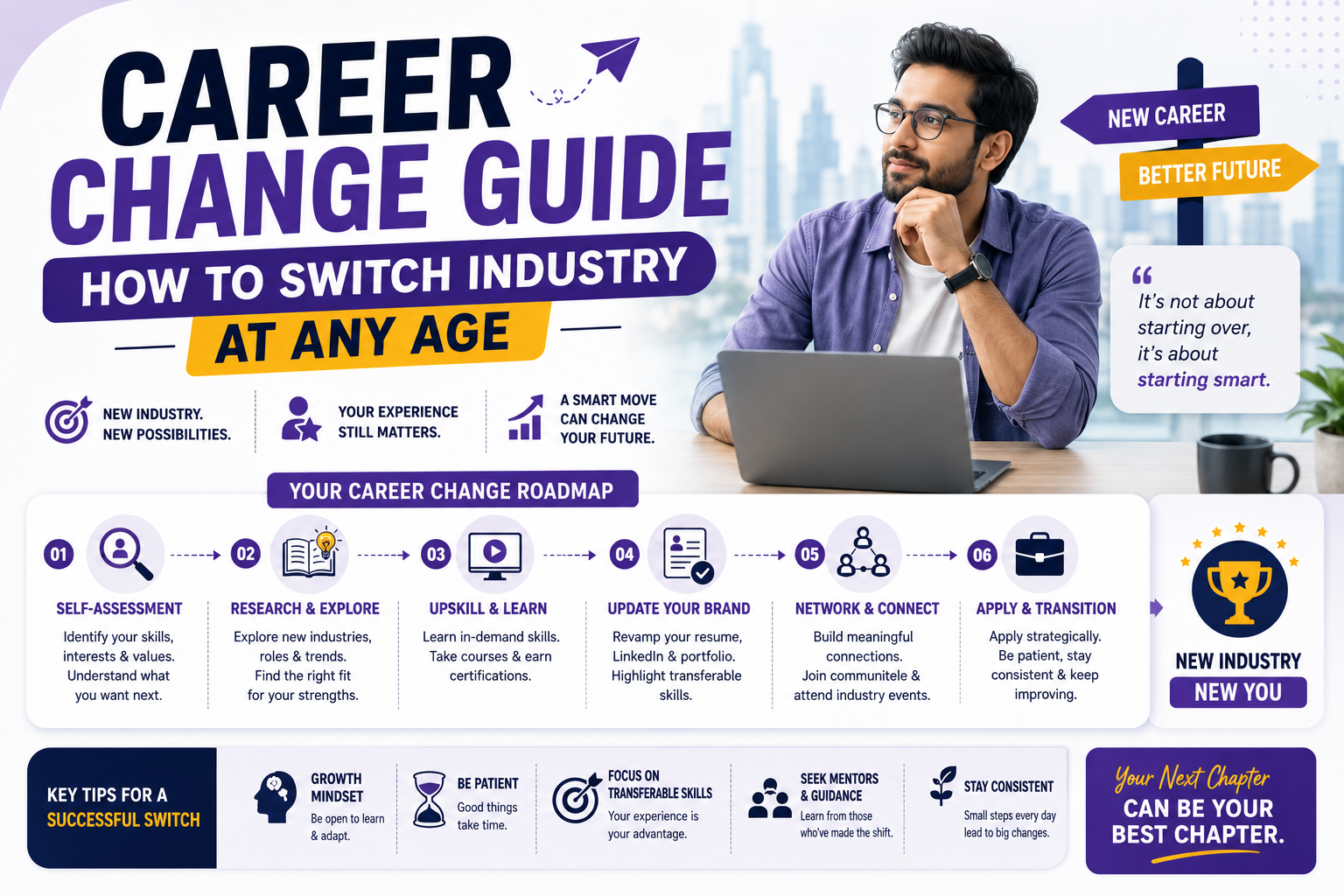
You’re 32. You’ve spent 8 years in IT. Your salary is good. Your career is “stable.” But every morning, you drag yourself to your laptop wondering — is this really what I want to do for the next 30 years?
You want to switch to product management. Or maybe marketing. Or education. But the voice in your head says — “It’s too late. You’ve invested 8 years. Starting over means starting from zero. People will think you’re confused.”
So you stay. And 5 years later, you’re 37, asking the same question — but now feeling even more stuck.
In this article, I’ll show you that career change is not only possible at any age — it’s happening every day across India. With real examples, transferable skills mapping, and a step-by-step plan to switch industries without burning your finances.
Is It Too Late to Change Career — Honest Answer by Age
Let me say this clearly. It is never too late to change your career. But how you change depends on where you are in life.
Here’s what career change looks like at different ages — and what’s realistic at each stage.
Career change at 25-28:
This is the easiest window. You have limited experience, so there’s less to “lose.” Employers don’t expect deep expertise from someone with 2-4 years of experience. You can switch with a short course, an internship, or even a strong personal project.
Ankit, 26, was a mechanical engineer in Pune working at a manufacturing plant earning ₹4.5 LPA. He hated the factory floor. He took a 4-month digital marketing course, did a 2-month internship at an agency, and landed a marketing role at a Bangalore startup at ₹5 LPA. Total transition time — 6 months.
Career change at 29-35:
This is the most common window — and the most feared. You have a decent salary, maybe an EMI, maybe a family. Starting over feels expensive. But here’s what the data says — according to a 2024 LinkedIn India Workforce Report, 48% of professionals who switched industries in India were between 28-35 years old. This is the peak career change age group, not a late one.
Priya, 31, worked in HR at an MNC in Gurgaon for 7 years earning ₹9 LPA. She wanted to move into learning and development (L&D). She took a certification in instructional design, started creating training content as a side project at her company, and after 8 months, switched to an L&D role at another company at ₹10.5 LPA. She didn’t start from zero — she repositioned her existing skills.
Career change at 36-45:
Harder — but absolutely doable. At this age, you can’t afford to take an entry-level salary cut. The strategy shifts — instead of applying for junior roles, you find positions where your previous experience adds value to the new field.
Suresh, 40, was an IT project manager in Chennai earning ₹18 LPA. He wanted to move into education technology. Instead of becoming a junior employee at an EdTech company, he positioned himself as “IT project manager with 15 years of tech experience — now focused on building education products.” He joined an EdTech startup as Head of Product Operations at ₹20 LPA. His IT experience was his advantage, not his baggage.
Career change after 45:
This requires the most strategic approach. Full industry switches at this stage are rare but consulting, advisory, and mentoring roles let you use your decades of experience in a new context. A 48-year-old banking VP in Mumbai transitioned into financial literacy content creation — coaching, YouTube, and corporate workshops. His banking knowledge became his content. His income matched his VP salary within 18 months.
| Age Group | Difficulty Level | Best Approach | Salary Expectation |
|---|---|---|---|
| 25-28 | Low | Course + internship + direct switch | May take temporary 10-15% cut |
| 29-35 | Medium | Upskill + internal pivot + targeted switch | Lateral or 5-10% increase |
| 36-45 | Medium-High | Reposition experience + strategic networking | Target equal or higher salary |
| 45+ | High | Consulting, advisory, mentoring, content | Variable — build over 12-18 months |
Transferable Skills — The Hidden Advantage Career Changers Don’t Realize
Here’s the biggest misconception about career change — “I have to start from scratch.” You don’t. You have skills from your current career that are valuable in the new one. You just need to identify and reframe them.
If you’re switching from IT to any field, you already have:
- Project management and deadline handling
- Analytical and data-driven thinking
- Stakeholder communication
- Problem-solving under pressure
- Technical documentation skills
If you’re switching from sales/marketing, you already have:
- Client relationship management
- Persuasion and negotiation
- Market research and competitive analysis
- Data interpretation (campaign metrics, ROI)
- Presentation and public speaking
If you’re switching from teaching/education, you already have:
- Communication and simplification of complex topics
- Patience and mentoring ability
- Content creation and curriculum design
- Public speaking and audience management
- Assessment and feedback skills
A 2025 World Economic Forum report found that 40% of the skills needed in a new role are transferable from previous experience. That means nearly half your career change work is already done — you just need to recognize it.
Deepa, a 33-year-old software tester in Hyderabad, wanted to move into UX research. She mapped her existing skills — attention to detail, user scenario creation, bug documentation, analytical thinking — all directly applicable to UX. She took a 3-month UX research course and framed her resume around transferable skills. She got hired at a Bangalore product company at ₹11 LPA — higher than her testing salary.
The key is framing. Your resume should say “8 years of analyzing user behavior patterns and identifying system gaps” — not “8 years of software testing.” Same experience. Different packaging. Completely different response from recruiters.
How to Switch Industries Without Starting From Zero — Step by Step
Step 1: Get clarity on what you’re moving toward — not just away from.
“I hate my current job” is not a career plan. “I want to move into product management because I enjoy understanding user needs and coordinating between teams” is a plan. Talk to 5 people already working in your target field. Ask them — what does a typical day look like? What skills do you use most? What do you wish you’d known before entering? These conversations save you from switching to another wrong field.
Step 2: Map your transferable skills to the new field.
Write down every skill you use in your current job. Then check job descriptions in your target field. Highlight the overlaps. You’ll find more matches than you expect. An IT professional switching to consulting already has client handling, data analysis, and presentation skills. A teacher switching to corporate L&D already has curriculum design and training delivery experience.
Step 3: Fill the gap with one focused course or certification.
You don’t need a second degree. One targeted certification bridges the gap. If you’re moving into product management — take a Coursera or Udemy product management course. If you’re moving into data analytics — get Google’s Data Analytics certificate. If you’re moving into UX — complete Google’s UX Design certificate. These take 3-6 months and cost under ₹5,000.
Step 4: Create proof of work in your new field — before applying.
Don’t just list a course on your resume. Build something. A product management aspirant should write a product teardown blog. A UX switch should create 2-3 case studies. A marketing switch should run a small campaign or build a content portfolio. Proof of work beats certificates every time. Rahul, an IT professional in Pune switching to content strategy, published 15 LinkedIn articles about tech content. Employers saw his writing ability without him saying a single word about his IT background.
Step 5: Target companies and roles that value career changers.
Startups and growing companies are more open to career changers than large corporates. They value diverse experience. Search job descriptions for phrases like “non-traditional background welcome” or “diverse experience valued.” Use LinkedIn to find hiring managers in your target field and connect with them directly.
Common Career Change Mistakes That Cost Time and Money
Mistake 1: Going back to college for a full degree.
A 32-year-old IT professional enrolling in a 2-year MBA to switch to marketing is usually overkill — unless it’s from a top-20 B-school. A 3-month certification, a portfolio of real projects, and strategic networking can achieve the same career switch in less time and at a fraction of the cost. Save the ₹10-₹20 lakh MBA fee for situations where the degree itself opens specific doors.
Mistake 2: Taking a massive salary cut “to get a foot in the door.”
You’re earning ₹12 LPA. You switch to a new field at ₹5 LPA because “beggars can’t be choosers.” That’s a ₹7 lakh annual hit — and it takes years to recover. Instead, negotiate from strength. Highlight your transferable skills. Target mid-level roles, not entry-level. A 34-year-old HR professional in Mumbai switching to L&D shouldn’t accept a junior trainer salary. She should target a senior L&D specialist role that values her 10 years of people management experience.
Mistake 3: Not telling a consistent career story.
Interviewers will ask — “Why are you switching?” If your answer is vague (“I want a change”), they’ll worry you’ll change again in a year. Craft a clear narrative — “I’ve spent 8 years solving technical problems. I realized the problems I enjoy most are user-facing. That’s why I’m moving into product management — to work closer to the customer.” Clarity builds trust.
Mistake 4: Quitting before having a transition plan.
Resigning with “I’ll figure out my new career while job searching” is dangerous. You’ll burn savings, lose confidence, and potentially accept a worse role out of desperation. Plan the transition while employed. Upskill in evenings. Network on weekends. Apply strategically. Quit only when you have a clear path forward.
Frequently Asked Questions
Q1: Is career change risky after 30 in India?
It feels risky — but the data says otherwise. Nearly half of all industry switches in India happen between ages 28-35. At 30, you have enough experience to transfer skills and enough time to build a second career. The real risk isn’t switching at 30 — it’s staying in the wrong career until 45 and having fewer options.
Q2: How to convince an employer to hire you for a career change?
Three things — transferable skills, relevant certification, and proof of work. Show how your previous experience adds unique value. Example: “My 6 years in IT taught me data analysis, stakeholder management, and deadline-driven delivery — all directly applicable to this product manager role. I’ve also completed a Google PM certification and published 3 product teardowns.” Evidence removes doubt.
Q3: How long does a career transition take?
Typically 6-12 months — 3-4 months for upskilling and portfolio building, 2-4 months for job searching and interviewing. If you start while still employed, the financial pressure is minimal. Some people switch faster (3-4 months) if they have strong networks or in-demand transferable skills. Don’t rush — a well-planned switch beats a panicked jump.
Q4: Can I switch from IT to a non-IT career?
Yes. IT professionals successfully switch to product management, consulting, content strategy, education technology, finance, and entrepreneurship. Your analytical thinking, project management, and technical communication skills are valuable across industries. The key is identifying which non-IT field values your IT experience — and framing your skills accordingly.
Q5: What skills are needed to switch industries?
You need two types — transferable skills (communication, project management, analytical thinking — which you likely already have) and domain-specific skills (the technical knowledge of your new field). A 3-6 month certification course typically covers the domain gap. Combine that with your transferable skills, and you’re a competitive candidate in the new field.
Your Career Doesn’t Have an Expiry Date — Only Your Patience Does
Here’s the truth — nobody gets to the end of their career and says “I’m glad I stayed in a job I hated for 25 years.” They regret not switching earlier.
You’re not starting over. You’re starting with 5, 10, or 15 years of skills, relationships, and knowledge that nobody can take away. You’re adding a new direction — not erasing the old one.
Talk to 3 people in your target field this week. Map your transferable skills tonight. Enrol in one certification course this month. Start building proof of work.
Thousands of professionals across Delhi, Mumbai, Bangalore, and Pune have made this exact transition — from IT to marketing, from finance to education, from sales to product management. At 28. At 35. At 42. They didn’t have a different brain. They had a clear plan.
Your plan starts now. Make the move.
