
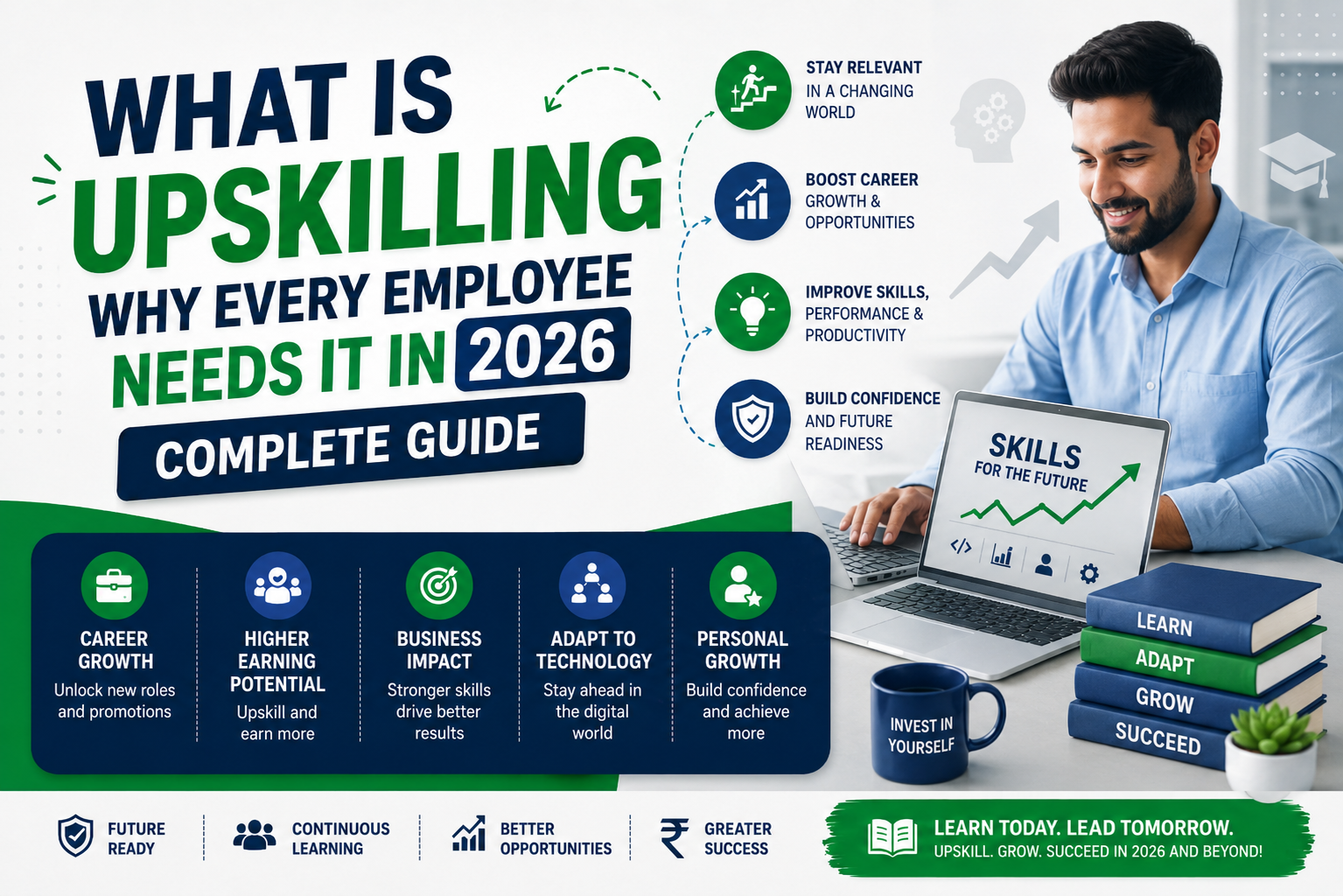
You’ve been doing the same job for 3 years. You’re comfortable. Your work gets done. Your appraisals are “meets expectations.” Then one Monday morning, your company announces a new AI tool that automates 40% of your daily tasks. Suddenly, the skills that made you valuable yesterday aren’t enough for tomorrow.
This isn’t a hypothetical scenario. It’s happening right now across Indian companies — in IT, banking, marketing, manufacturing, and every sector in between.
In this article, I’ll explain what upskilling means, which skills are most in demand in 2026, how upskilling directly impacts your salary and promotions, and exactly how to start — even if you’re busy with a full-time job.
Upskilling Meaning — And How It’s Different From Reskilling
Upskilling means learning new or advanced skills within your current field to do your existing job better — or to qualify for a higher role.
You’re a data analyst who knows Excel. You learn Python and Power BI. That’s upskilling — you’re building on top of what you already know.
Reskilling is different. It means learning an entirely new skill set to switch to a different role or field. You’re an accountant who learns web development to become a developer. That’s reskilling — you’re starting fresh in a new direction.
Here’s a clear comparison:
| Factor | Upskilling | Reskilling |
|---|---|---|
| Goal | Grow in your current field | Switch to a new field |
| Skills | Advanced or adjacent skills | Completely new skills |
| Time required | 2-6 months | 6-12 months |
| Risk level | Low | Higher |
| Example | Marketing executive learns Google Analytics | Accountant learns Python to become data analyst |
Both are valuable. But upskilling is faster, lower-risk, and gives you immediate returns in your current job.
According to the World Economic Forum’s 2025 Future of Jobs report, 44% of workers’ core skills will change by 2027. That means nearly half of what you do today might look completely different in 2 years. The skills you were hired for 3 years ago are already depreciating.
A software developer in Pune told me — “I was a strong Java developer. For 4 years, I didn’t learn anything new. Then my company moved to cloud-native microservices. My teammates who had learned AWS and Kubernetes got promoted. I got put on a legacy maintenance project with no growth.” He spent the next 6 months upskilling in AWS. Within a year, he switched teams and got a 25% hike.
The employees who stay relevant are the ones who keep learning. The ones who stop learning become replaceable.
In-Demand Skills in 2026 — What the Indian Job Market Actually Wants Right Now
Let me give you a clear picture of which skills are driving hiring and salary growth in India this year.
Tier 1: Highest Demand, Highest Salary Impact
| Skill | Why It’s In Demand | Salary Boost |
|---|---|---|
| AI & Machine Learning | Every company is integrating AI into products and processes | 30-60% higher than non-AI roles |
| Generative AI (Prompt Engineering, LLM APIs) | ChatGPT, Gemini, and AI tools are transforming every industry | 25-40% premium for AI-skilled employees |
| Cloud Computing (AWS, Azure, GCP) | 85% of Indian enterprises are on cloud migration journeys | 20-40% higher than non-cloud peers |
| Data Analytics & Data Science | Data-driven decision making is now mandatory, not optional | 25-35% salary premium |
| Cybersecurity | With rising digital fraud, India needs 1.5 million cybersecurity professionals by 2027 (NASSCOM) | 30-50% premium |
Tier 2: Growing Demand, Strong Career Impact
| Skill | Best For | Salary Boost |
|---|---|---|
| Full Stack Development (React, Node.js) | IT professionals, BCA/BTech graduates | 20-30% |
| DevOps & CI/CD | Software engineers, system administrators | 25-35% |
| Digital Marketing (AI-powered) | Marketing professionals, MBA graduates | 15-25% |
| Product Management | Tech professionals moving to business roles | 30-50% |
| Power BI / Tableau | Any professional dealing with data reporting | 15-20% |
Tier 3: Essential Soft Skills (Often Overlooked)
| Skill | Why It Matters |
|---|---|
| AI collaboration (working alongside AI tools) | Every role now involves AI-assisted workflows |
| Critical thinking & problem solving | Automation handles routine tasks — humans handle complex decisions |
| Communication & storytelling | Remote and hybrid work demands better written and verbal skills |
| Adaptability | The only constant in 2026 is change |
A 2025 LinkedIn India Workforce Report found that professionals who added at least one new skill to their profile every 12 months received 25% more recruiter messages than those who didn’t update their skills. The market is literally rewarding learners.
Here’s a real example. Rohit, a marketing executive in Gurgaon earning ₹6 LPA, learned AI-powered marketing tools — ChatGPT for content, Jasper for ad copy, and Google’s AI-driven Performance Max campaigns. Within 8 months, he was managing AI-integrated campaigns for his company’s biggest clients. His next appraisal — 22% hike and a promotion to Senior Executive. His colleagues who stuck to traditional marketing methods got the standard 8%.
How to Start Upskilling With a Full-Time Job — Step by Step
Step 1: Identify the skill gap between you and the next level.
Look at job postings for the role you want next — whether it’s a promotion or a switch. What skills do they list that you don’t have? A senior developer role might need Kubernetes and system design. A senior analyst role might need Python and Tableau. That gap is your upskilling roadmap.
Step 2: Pick one skill — not five.
The biggest upskilling mistake is trying to learn everything at once. You have a full-time job. You have limited hours. Pick the single skill that gives you the most impact and focus on it for 2-3 months. A data analyst in Bangalore decided to learn only Power BI for 3 months. She became the team’s dashboard expert. That one skill got her promoted 6 months later.
Step 3: Dedicate 30-45 minutes daily — not weekends only.
Weekend-only learning doesn’t stick. Daily practice — even 30 minutes — builds momentum. Watch one video lesson during lunch. Practice one exercise after dinner. Do one small project over the weekend. An AWS certification needs about 80-100 hours of study. At 30 minutes daily, that’s done in under 7 months. At 45 minutes daily — under 5 months.
Step 4: Build a project, not just complete a course.
Certificates prove you enrolled. Projects prove you learned. If you’re learning SQL — analyze a real dataset and publish findings on LinkedIn. If you’re learning AI tools — create a case study of how AI improved a business process at your company. A marketing professional in Mumbai built a personal portfolio website using AI tools she was learning. Her manager saw it and assigned her the company’s AI marketing initiative.
Step 5: Make your upskilling visible.
Update your LinkedIn headline — “Marketing Manager | Learning AI & Data Analytics.” Add new certifications to your profile. Post about your learning journey once a week. When promotion time comes, your manager already sees the effort. When you’re job hunting, recruiters see a profile that’s growing — not stagnant.
Common Upskilling Mistakes That Waste Time and Money
Mistake 1: Learning trending skills that don’t connect to your career.
A finance professional spending 6 months learning React.js because “coding is the future” — that’s wasted effort if you’re not switching to development. Learn skills that advance your current career path. If you’re in finance — learn Python for financial modeling, not web development. Relevance beats trendiness.
Mistake 2: Paying ₹1-₹2 lakh for courses available cheaply or free.
Google’s AI Essentials course costs under ₹3,000 on Coursera. AWS Cloud Practitioner training is free on AWS Skill Builder. Power BI learning is free on Microsoft Learn. Before paying any bootcamp ₹80,000+, check if the same content exists on Coursera, YouTube, or the platform’s official free resources. A developer in Chennai paid ₹1.5 lakh for an AI bootcamp. His colleague learned the same content for ₹5,000 on Coursera and got the same certification.
Mistake 3: Collecting certificates without applying skills at work.
You have 8 Coursera certificates on your LinkedIn. But you’ve never used any of those skills in a real project. Recruiters and managers see through certificate hoarding. After every course, apply the skill at work — volunteer for a project, automate a report, build a dashboard. Application proves competence. Certificates prove enrollment.
Mistake 4: Waiting for your company to provide training.
Some companies offer excellent learning programs. Many don’t. If you wait for your employer to train you, you could wait forever. A 2024 NASSCOM report found that only 35% of Indian companies have formal upskilling programs. The other 65% expect employees to learn on their own. Take ownership of your growth. Don’t outsource your career development to your employer.
Frequently Asked Questions
Q1: What is the difference between upskilling and reskilling?
Upskilling is learning advanced skills in your current field — like a developer learning cloud computing. Reskilling is learning entirely new skills to switch fields — like an accountant learning coding. Upskilling takes 2-6 months and is lower risk. Reskilling takes 6-12 months and involves a career change. Most professionals benefit more from consistent upskilling.
Q2: Which skills are most in demand in 2026 in India?
AI and machine learning top the list, followed by cloud computing (AWS/Azure), data analytics, cybersecurity, and generative AI tools. In non-tech fields — AI-powered digital marketing, product management, and data visualization (Power BI/Tableau) are growing fast. Soft skills like critical thinking, adaptability, and AI collaboration are essential across every role.
Q3: How does upskilling help in getting a promotion?
Upskilling shows initiative and readiness for higher responsibility. When managers decide promotions, they pick employees who already demonstrate next-level skills. A 2025 Mercer India study found that employees who upskilled received promotions 40% faster than those who didn’t. Learning a new tool or technology also makes you the go-to person on your team — and that visibility drives promotion decisions.
Q4: Can upskilling help protect against job loss?
Yes. Roles that involve routine, repetitive tasks are most at risk from AI and automation. By learning skills that complement AI — data analysis, strategic thinking, creative problem-solving — you make yourself harder to replace. Companies retain employees who can work alongside new technologies. A 2025 McKinsey report estimated that 12 million Indian workers will need to transition to new roles by 2030 — upskilling is the safety net.
Q5: What are the best platforms for upskilling in India?
For tech skills — Coursera (Google/IBM certificates), AWS Skill Builder (free), Microsoft Learn (free), and Udemy. For data and analytics — DataCamp and Khan Academy. For marketing — Google Skillshop (free) and HubSpot Academy (free). For general professional development — LinkedIn Learning. For AI — Google AI Essentials and DeepLearning.AI on Coursera. Most high-quality learning is available for under ₹5,000 or completely free.
The Skills You Learn Today Pay Your Salary Tomorrow
Here’s the one truth about careers in 2026 — what you know today has an expiry date. The tools change. The technologies evolve. The market moves forward. And the professionals who keep learning keep earning.
You don’t need to go back to college. You don’t need to spend lakhs. You need 30 minutes a day, one focused skill, and the discipline to stick with it for 3 months.
Pick one skill from the in-demand list tonight. Open Coursera or YouTube. Start your first lesson this weekend. In 90 days, you’ll have a new certification, a new project, and a resume that looks noticeably stronger than it does today.
Lakhs of professionals across Delhi, Mumbai, Bangalore, and Hyderabad are upskilling right now — during lunch breaks, after dinner, on weekend mornings. They’re not working harder than you. They’re just learning smarter.
Your future self will thank you for the 30 minutes you invest today. Start now. 💪
