
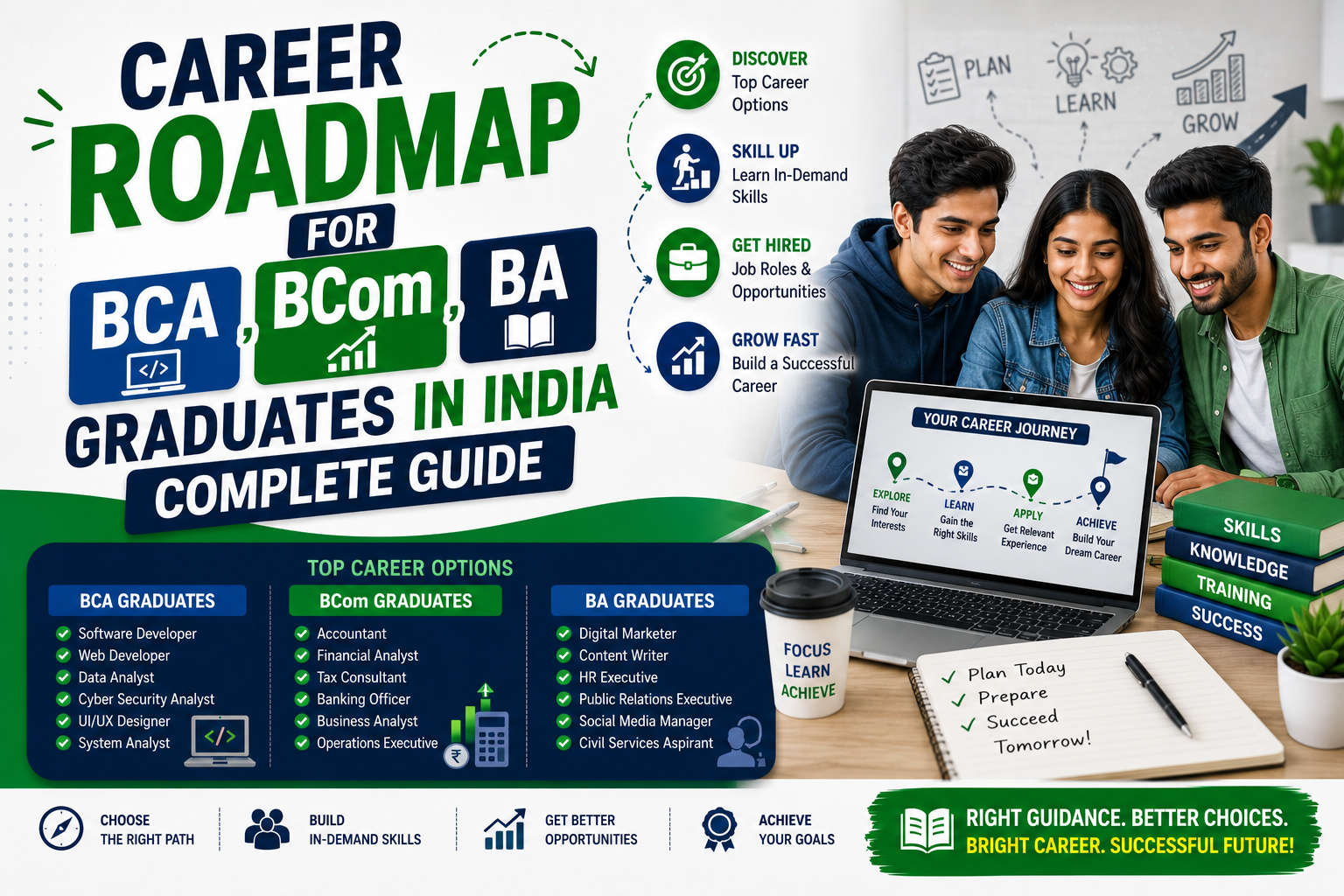
You just finished your graduation. Everyone around you is giving advice. “Do MBA.” “Prepare for government exams.” “Learn coding.” “Do CA.” Your parents want stability. Your friends are confused too. And you’re sitting there wondering — what can I actually do with my BCA, BCom, or BA degree?
This confusion hits lakhs of Indian graduates every single year. The degree is done, but the career roadmap was never given.
In this article, I’ll lay out clear career paths for BCA, BCom, and BA graduates — with real job roles, salary ranges, higher study options, and which path fits which situation.
Career Options After BCA — Jobs, Higher Studies, and Salary Expectations
BCA (Bachelor of Computer Applications) is one of the most versatile degrees in India right now. If you’ve completed BCA, you have direct entry into the tech industry — without needing a B.Tech.
Job options after BCA:
| Job Role | Average Starting Salary | Top Hiring Cities |
|---|---|---|
| Junior Software Developer | ₹3-₹5 LPA | Bangalore, Pune, Hyderabad |
| Web Developer | ₹2.5-₹4.5 LPA | Delhi-NCR, Mumbai, Chennai |
| Database Administrator | ₹3-₹4.5 LPA | Pune, Bangalore, Noida |
| Technical Support Engineer | ₹2.5-₹3.5 LPA | All major cities |
| QA/Testing Engineer | ₹3-₹4 LPA | Hyderabad, Pune, Chennai |
| IT Business Analyst | ₹4-₹6 LPA | Bangalore, Gurgaon |
The BCA vs B.Tech debate is real. But here’s the truth — in 2025 India, most product and service companies care about your skills, not your degree title. A BCA graduate who knows Java, Python, SQL, and cloud basics competes directly with B.Tech candidates for the same roles.
Vikram from Jaipur completed BCA and learned full-stack development through online courses. He got hired at a Bangalore startup at ₹5.5 LPA — higher than many B.Tech freshers from the same company. His GitHub projects and a 3-month internship mattered more than his degree name.
Higher studies after BCA:
- MCA — The natural next step. Opens doors to senior developer, architect, and management roles. 2-year program at NITs and top universities. Average salary after MCA: ₹5-₹9 LPA.
- MBA in IT/Systems — If you want to move into tech management, product management, or consulting. IIMs and top B-schools accept BCA graduates.
- Specialized certifications — AWS, Azure, Google Cloud, Data Science, Cybersecurity. These often give better ROI than a full master’s degree in terms of immediate salary impact.
Career Options After BCom — Jobs, Finance Paths, and Growth Potential
BCom is India’s most popular graduation degree — over 30 lakh students graduate with a BCom every year, according to UGC 2024 data. But most BCom graduates feel stuck because they don’t know what specific jobs exist beyond “accountant.”
Job options after BCom:
| Job Role | Average Starting Salary | Key Skills Needed |
|---|---|---|
| Accounts Executive | ₹2.5-₹4 LPA | Tally, GST, Excel |
| Tax Associate | ₹3-₹4.5 LPA | Income Tax, TDS, ITR Filing |
| Banking Associate (PO/Clerk) | ₹3.5-₹5 LPA | Exam clearing + aptitude |
| Audit Assistant | ₹2.5-₹3.5 LPA | Accounting standards, Excel |
| Financial Analyst (entry) | ₹4-₹6 LPA | Excel, financial modeling, SQL |
| Insurance Advisor | ₹2.5-₹4 LPA (+ commission) | Sales, product knowledge |
Priya completed BCom from Mumbai University. She didn’t want to do CA — the 4-5 year commitment felt too long. Instead, she learned Advanced Excel, Tally Prime, and basic GST filing in 3 months. She got an accounts executive role at a Navi Mumbai firm at ₹3.2 LPA. After 2 years and one job switch, she’s at ₹5.5 LPA.
Higher studies after BCom:
- CA (Chartered Accountancy) — The gold standard for commerce graduates. High difficulty but highest reward. Average starting salary: ₹7-₹10 LPA. But the pass rate for CA Final is only about 10-15%. It demands serious commitment.
- MBA in Finance — Faster path to corporate finance, banking, and consulting roles. 2 years. Average salary: ₹6-₹12 LPA depending on the B-school.
- CMA (Cost Management Accountant) — Focused on cost accounting and management. Less popular than CA but growing demand. Average salary: ₹5-₹8 LPA.
- CS (Company Secretary) — Specializes in corporate law, compliance, and governance. Demand is steady in listed companies. Average salary: ₹5-₹7 LPA.
- Stock Market Certifications (NISM, CFA) — If you want to enter trading, wealth management, or equity research. CFA is global and highly respected.
Career Options After BA — Government Jobs, Competitive Exams, and Private Sector Paths
BA graduates in India often hear — “BA karke kya hoga?” This is outdated thinking. BA graduates have access to some of the most stable and respected career paths in the country — including government services.
Job options after BA:
| Job Role | Average Starting Salary | Path |
|---|---|---|
| Government services (IAS/IPS/IFS) | ₹6-₹10 LPA + benefits | UPSC CSE exam |
| SSC CGL posts | ₹4-₹6 LPA | SSC exam |
| State government jobs | ₹3-₹5 LPA | State PSC exams |
| Bank PO/Clerk | ₹3.5-₹5 LPA | IBPS/SBI exams |
| Content Writer | ₹2.5-₹4.5 LPA | Writing skills, SEO basics |
| HR Executive | ₹3-₹4.5 LPA | Communication, recruitment tools |
| Journalist/Media | ₹2.5-₹4 LPA | Mass communication, writing |
Here’s a fact most people miss. BA graduates are eligible for UPSC Civil Services — the same exam that IIT and IIM graduates attempt. And BA students with humanities backgrounds (History, Political Science, Sociology) often have an advantage in the optional paper and essay rounds.
Aditya, a BA History graduate from Lucknow University, cleared UPSC CSE in his third attempt. He’s now an IPS officer. His starting salary with allowances exceeds ₹10 LPA — plus housing, vehicle, and lifelong job security. No MBA or engineering degree was required.
Higher studies after BA:
- MA — Deepens subject knowledge. Useful for NET/JRF if you want to teach at the university level. Also strengthens UPSC preparation.
- MBA — Yes, BA graduates can do MBA. IIMs accept graduates from any stream. An MBA after BA opens corporate careers in HR, marketing, operations, and consulting.
- LLB — 3-year law degree after graduation. High demand for corporate lawyers. Average starting salary: ₹4-₹8 LPA at law firms.
- B.Ed — If you want to become a school teacher. Government school teachers in India earn ₹4-₹6 LPA with excellent job security and pension.
- Diploma courses — Digital marketing, graphic design, data entry, journalism. Short-term courses that add practical skills to your BA degree.
Common Mistakes Graduates Make When Choosing a Career Path
Mistake 1: Doing MBA just because everyone else is doing it.
“MBA kar lo, acha salary milega.” This advice ignores a critical question — MBA from where? An MBA from a top-20 B-school (IIM, XLRI, FMS) offers ₹12-₹25 LPA placements. An MBA from a local unknown college often gives ₹3-₹4 LPA — the same salary you’d get without MBA, but after spending ₹3-₹8 lakh on fees and losing 2 years. According to AICTE 2024 data, over 40% of MBA graduates from Tier-3 colleges remain unplaced. MBA is worth it only from a good institution — or if your employer sponsors it.
Mistake 2: Ignoring skill-based certifications because they’re “not a degree.”
A 3-month Google Data Analytics certification costs under ₹3,000 and teaches you skills companies actually hire for. A 2-year degree might cost ₹2-₹5 lakh and teach outdated theory. A BCom graduate in Pune learned Tally, GST, and Advanced Excel in 4 months — got hired at ₹3.5 LPA before her classmates who enrolled in MBA even started their first semester.
Mistake 3: Following crowd advice instead of personal assessment.
Your friend is preparing for UPSC, so you start too — without checking if you have the patience for 2-3 years of intensive preparation. Your cousin did CA, so you enroll — without knowing that CA requires deep love for numbers and a 10-15% pass rate. Choose based on your strengths, financial situation, and patience threshold — not what worked for someone else.
Mistake 4: Waiting for the “perfect” path instead of starting somewhere.
Many graduates spend 1-2 years at home “deciding” what to do. Meanwhile, their peers gain work experience, build skills, and earn money. Any start is better than no start. Take a job. Learn skills. Earn. Then course-correct. A BA graduate in Delhi spent 18 months at home preparing for government exams. He didn’t clear any. Had he taken any job for ₹15,000-₹20,000/month while preparing, he’d have earned ₹3+ lakh and gained real experience.
Frequently Asked Questions
Q1: What is the best career option after BCA?
Software development is the highest-paying path. Learn Java/Python, build projects, and apply to IT companies. Starting salary: ₹3-₹6 LPA. If you want higher studies, MCA opens senior tech roles. If you prefer management, MBA in IT/Systems is a strong choice. The best option depends on whether you enjoy coding or prefer business roles.
Q2: Which field is best after BCom for a high salary?
CA offers the highest starting salary (₹7-₹10 LPA) but has the toughest exam. MBA in Finance from a good B-school gives ₹8-₹15 LPA. For quicker results without long courses, learn financial modeling, Advanced Excel, and Tally — these skills get you started at ₹3-₹5 LPA within months. CFA certification opens global finance careers.
Q3: Can BA graduates get good jobs in India?
Absolutely. BA graduates are eligible for UPSC (IAS/IPS starting at ₹10 LPA+), SSC CGL (₹4-₹6 LPA), bank exams (₹3.5-₹5 LPA), and private sector roles in HR, content writing, and media. Many top civil servants in India are BA graduates. The degree opens doors — your preparation and skills determine the salary.
Q4: Is MBA good after BCA or BCom?
Yes — but only from a reputed institution. MBA from IIMs, XLRI, FMS, or top-50 B-schools gives excellent placements. MBA from unknown colleges often offers poor ROI. BCA graduates can pursue MBA in IT Management or Systems. BCom graduates fit well in Finance, Marketing, or HR specializations. Always check the college’s placement record before enrolling.
Q5: What courses should I do after BCom for a better salary?
If you want immediate employability — learn Tally Prime, Advanced Excel, and GST filing (3-4 months, under ₹5,000). For finance careers — pursue CFA Level 1 or Financial Modeling courses. For corporate roles — prepare for MBA entrance exams (CAT/XAT). For stable government jobs — prepare for SSC CGL or bank exams while working part-time.
Your Degree Opened the Door — Now Walk Through It
Here’s the truth — BCA, BCom, and BA are not dead-end degrees. They’re starting points. What you do after graduation matters ten times more than the degree itself.
Pick one direction tonight. Not three. Not five. One. Research it for a week. Talk to someone already on that path. Start preparing — whether it’s a certification, an exam, or a job application.
Lakhs of BCA, BCom, and BA graduates across Delhi, Mumbai, Bangalore, Lucknow, and Jaipur are building successful careers right now — in tech, finance, government, media, and business. They didn’t have a different degree. They had a clear plan.
Your degree is done. Your career is just starting. Pick your path and move. 💪
