
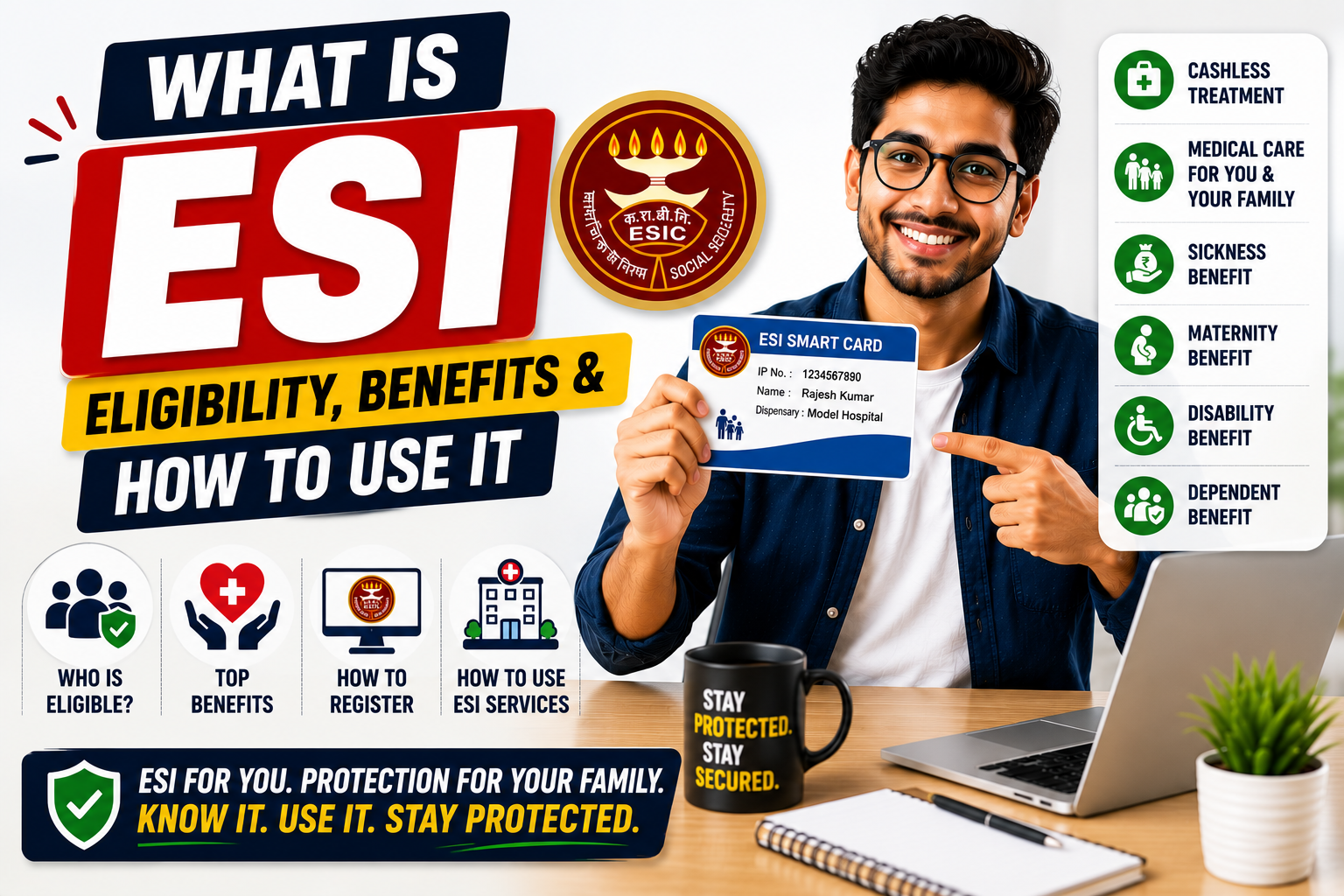
Your salary slip shows a small deduction — ₹158. It says “ESI.” You’ve been ignoring it for months. You have no idea what it covers. Then one day, you fracture your wrist. A colleague says — “Use your ESI card. Treatment is free.” You stare back and ask — “I have an ESI card?”
This happens to lakhs of Indian employees every year. ESI gives you free medical treatment, but most people don’t know they have it — or how to use it.
In this article, I’ll explain what ESI means, who is eligible, what benefits you get, and exactly how to use your ESI card at hospitals — step by step.
ESI Full Form and Eligibility — Salary Limit Explained Clearly
ESI stands for Employee State Insurance. It’s a social security scheme run by ESIC (Employee State Insurance Corporation) under the Ministry of Labour and Employment. The scheme is governed by the ESI Act, 1948.
In simple words — ESI is government-backed health insurance for low-to-mid income salaried workers. Your employer deducts a small amount from your salary, adds their own contribution, and you get free medical treatment at ESI hospitals and dispensaries.
Who is eligible?
ESI applies to employees earning a gross salary of ₹21,000 or less per month. If your monthly gross salary is ₹21,000 or below, ESI is mandatory — not optional.
Here’s the eligibility breakdown:
| Criteria | Requirement |
|---|---|
| Salary limit | Gross salary ≤ ₹21,000/month |
| Salary limit for disabled employees | Gross salary ≤ ₹25,000/month |
| Company size | 10 or more employees (some states: 20+) |
| Employee type | Permanent, temporary, contract — all covered |
| Family coverage | Spouse, children, and dependent parents included |
How much is deducted?
| Contribution | Percentage | On ₹18,000 salary |
|---|---|---|
| Employee contribution | 0.75% of gross salary | ₹135/month |
| Employer contribution | 3.25% of gross salary | ₹585/month |
| Total | 4% | ₹720/month |
Notice the split — you pay only ₹135 and your employer pays ₹585. For that ₹135, you and your entire family get free healthcare. That’s the best deal most employees never realize they have.
Here’s a real example. Arun works at a textile factory in Surat. His gross salary is ₹17,000/month. Every month, ₹128 is deducted from his salary as ESI. His wife, two children, and dependent mother are all covered. When his son needed surgery for a hernia, the entire procedure at the ESI hospital cost them ₹0. The same surgery at a private hospital would have cost ₹60,000-₹80,000.
According to ESIC’s 2024 annual report, over 14 crore beneficiaries (employees + family members) are covered under the ESI scheme across India. That makes it one of the largest social health insurance systems in the world.
Does ESI apply to contract employees? Yes — if the contract employee earns ₹21,000 or less and works at an ESI-covered establishment. The staffing agency or the principal employer must register them. Many contract workers in factories across Noida, Gurgaon, and Chennai are ESI-eligible but aren’t registered. If you’re a contract employee and ESI isn’t being deducted — ask your agency.
ESI Benefits — What’s Covered and How to Use Your ESI Card
Most people think ESI only covers basic doctor visits. It covers far more than that.
Here are all the benefits under ESI:
| Benefit | What It Covers |
|---|---|
| Medical benefit | Free treatment at ESI hospitals — OPD, IPD, medicines, surgery, diagnostics |
| Sickness benefit | 70% of daily wages for up to 91 days during certified illness |
| Maternity benefit | Full wages for 26 weeks (about 6 months) for women employees |
| Disability benefit | 90% of wages for temporary disability; pension for permanent disability |
| Dependent benefit | Monthly pension to family if employee dies due to work injury |
| Funeral expenses | ₹15,000 lump sum to the family |
| Super specialty treatment | Coverage for surgeries like cardiac, neuro, cancer — at empanelled hospitals |
The maternity benefit alone is worth understanding. Women employees covered under ESI get 26 weeks of paid maternity leave at 100% wages. This is paid by ESIC, not the employer. A woman working at a garment factory in Bangalore earning ₹15,000/month would receive ₹90,000 during her maternity leave — fully funded by ESI contributions.
How to use your ESI card for treatment:
Your ESI card (Pehchan Card) is your access pass to free healthcare. Here’s how it works.
For OPD (outpatient) treatment:
Walk into any ESI dispensary or hospital in your city. Show your ESI card or Pehchan Card at the registration counter. See the doctor. Get medicines from the ESI pharmacy — all free. No bills. No co-pay.
For IPD (hospitalization):
Get admitted at an ESI hospital with your card. Surgeries, tests, bed charges, medicines — all covered. If the ESI hospital doesn’t have the required specialty, they refer you to an empanelled private hospital. Even the private hospital treatment is cashless under ESI.
For super specialty treatment:
Need a heart surgery or cancer treatment? ESI covers that too through its tie-up hospitals. Your ESI hospital doctor provides a referral. You get treated at top hospitals — and ESIC pays the bill directly.
A delivery supervisor in Pune needed knee replacement surgery. Private hospital quote — ₹3.5 lakh. His ESI doctor referred him to an empanelled hospital. Total cost to him — ₹0. The entire surgery, rehabilitation, and follow-up were covered.
To find ESI hospitals near you, visit esic.gov.in → “Hospitals/Dispensaries” → Search by state and city.
How to Get and Activate Your ESI Card — Step by Step
Step 1: Check if you’re registered.
Your employer registers you with ESIC when you join. You receive an IP (Insured Person) number. Ask HR for your IP number. If they haven’t registered you — that’s a legal violation. Insist on it.
Step 2: Collect your Pehchan Card.
Your employer submits your details and family information to ESIC. ESIC issues a Pehchan Card — a biometric smart card with your photo, IP number, and family member details. Your employer should hand this to you. If they haven’t, ask HR or visit the nearest ESIC branch office with your ID proof.
Step 3: Register your family members.
ESI covers your spouse, children (up to 2), and dependent parents. Submit their Aadhaar copies and photos through your employer. Once added, your family can use ESI hospitals independently — they don’t need you present.
Step 4: Find ESI hospitals in your area.
Visit esic.gov.in → Click “Hospitals & Dispensaries” → Select your state → Get the full list with addresses. Save the nearest dispensary and hospital addresses on your phone. In emergencies, knowing the nearest ESI facility saves critical time.
Step 5: Carry your Pehchan Card always.
Keep a photo of your ESI card on your phone. Carry the physical card in your wallet. In an emergency, you can walk into any ESI hospital across India — your card works nationwide, not just in your registration city.
Common Mistakes Employees Make with ESI
Mistake 1: Not knowing they’re ESI-eligible.
Many employees earning under ₹21,000 don’t even know ESI is being deducted from their salary. A warehouse worker in Gurgaon had ESI deducted for 3 years — ₹4,500 in total contributions — but never used it once. He paid ₹8,000 at a private clinic for a dental issue that ESI would have covered for free. Check your salary slip today.
Mistake 2: Not collecting the Pehchan Card from the employer.
Some employers register employees but never distribute the Pehchan Cards. Without the card, you can’t access ESI hospitals. If your employer hasn’t given you the card, visit the nearest ESIC branch office with your IP number and Aadhaar — they’ll issue a duplicate.
Mistake 3: Thinking ESI stops when salary crosses ₹21,000.
Here’s an important rule. Once you’re registered under ESI, coverage continues until the end of the contribution period — even if your salary increases above ₹21,000 during that period. The contribution period runs in 6-month cycles (April-September and October-March). You remain covered for the full cycle plus a benefit period.
Mistake 4: Using private hospitals without ESI referral.
If you go to a private hospital directly without a referral from your ESI doctor, ESIC won’t reimburse it. Always visit the ESI dispensary first. If they can’t handle your case, they’ll give a formal referral to an empanelled private hospital — and then it’s cashless. Skip the referral, and you pay everything yourself.
Frequently Asked Questions
Q1: What is the salary limit for ESI in India?
ESI applies to employees with a gross monthly salary of ₹21,000 or less. For employees with disabilities, the limit is ₹25,000. Gross salary includes basic + DA + HRA + all allowances before deductions. If your salary exceeds this limit, ESI deduction stops — but you remain covered until the current contribution period ends.
Q2: Can family members use ESI benefits?
Yes. ESI covers your spouse, up to two children, and dependent parents. They can visit ESI hospitals independently using the family Pehchan Card. All benefits — OPD, hospitalization, surgery, medicines — are available to registered family members at no cost. Make sure your employer has added your family details to your ESI registration.
Q3: Is ESI mandatory for all employees?
ESI is mandatory for employees earning ₹21,000 or less per month in establishments with 10 or more employees (20 in some states). Neither the employer nor the employee can opt out. If your employer is not deducting ESI despite meeting these criteria, they’re violating the ESI Act and can face penalties.
Q4: What happens to ESI if my salary increases above ₹21,000?
Your ESI coverage continues until the end of the current contribution period. Contribution periods are April to September and October to March. If your salary crosses ₹21,000 mid-cycle, contributions stop from the next cycle. You also get a benefit period after the contribution period ends — so coverage extends further by a few months.
Q5: How to use ESI card at a private hospital?
You cannot walk into any private hospital directly. First, visit your nearest ESI dispensary or hospital. If the ESI doctor determines that your treatment requires a facility not available at the ESI hospital, they issue a referral to an empanelled private hospital. With this referral, treatment at the private hospital is cashless. Without it, you’ll have to pay out of pocket.
You’re Paying for It — Make Sure You Use It
Here’s the bottom line — if ₹100-₹200 is being deducted from your salary every month as ESI, you’re already paying for health insurance. You and your entire family have free access to doctors, medicines, surgeries, and even maternity benefits.
Check your salary slip right now. If ESI is being deducted, ask HR for your Pehchan Card tomorrow. Find the nearest ESI hospital on esic.gov.in. Save the address.
Thousands of Indian workers — in factories, offices, shops, and warehouses across Delhi, Mumbai, Chennai, and Pune — use ESI every day and save lakhs on medical bills. Stop paying for private clinics when your ESI card gives you treatment for free.
Your health is covered. Use what’s already yours.
