
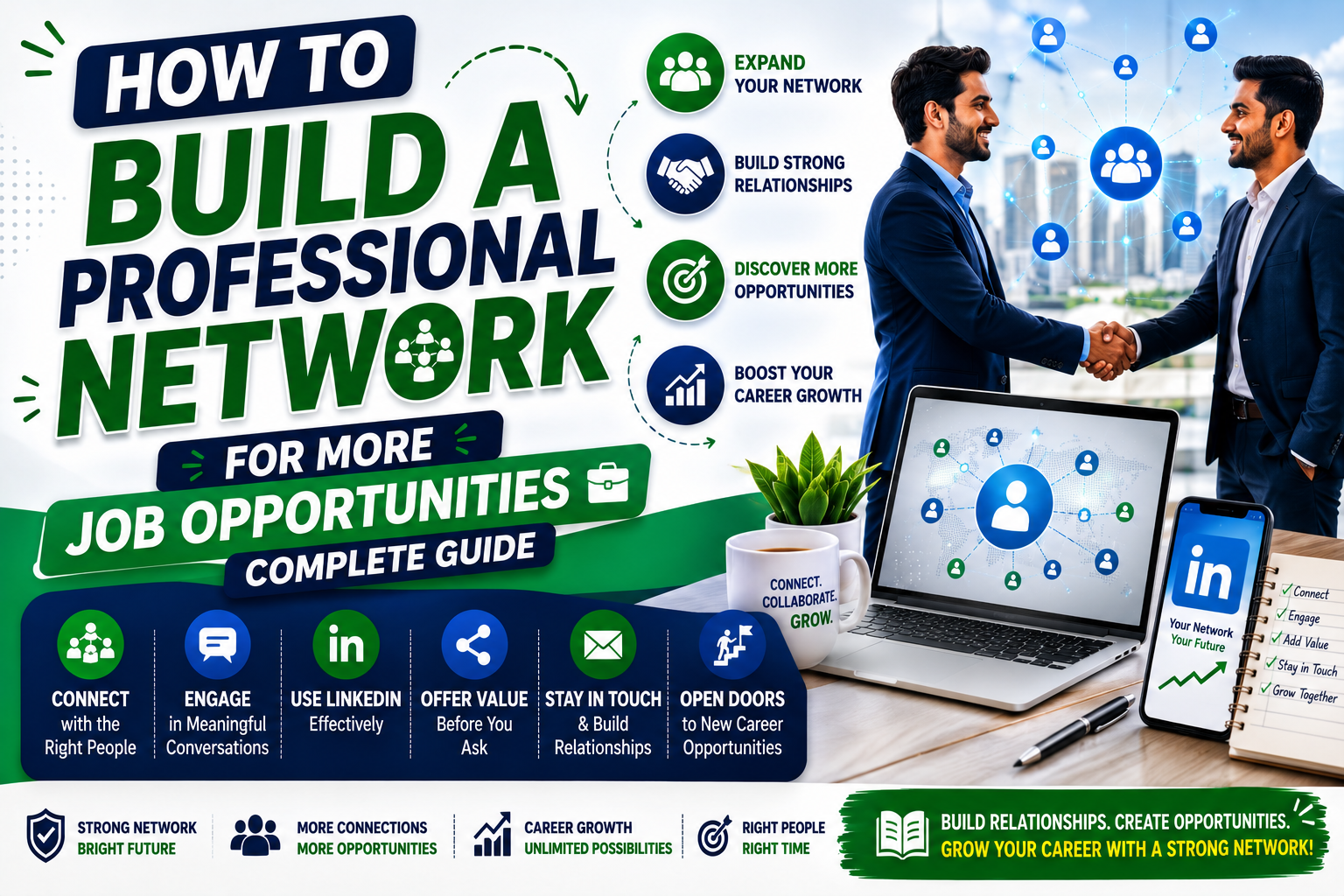
You see a job posting on LinkedIn. 500+ applicants in 2 days. You apply anyway. Two weeks later — silence. Meanwhile, your college senior messages you — “Hey, my company is hiring. I referred you to HR. You’ll get a call tomorrow.” You get the call. You get the interview. You get the job.
That’s networking. And it works better than any job portal.
According to a 2024 LinkedIn Hiring Report, nearly 70% of jobs in India are filled through referrals and professional connections — not online applications. If you’re only applying through Naukri and Indeed, you’re competing for just 30% of the market.
In this article, I’ll show you exactly how to build a professional network from scratch — even if you’re a fresher with zero contacts.
Can Networking Help Freshers Get Jobs — The Honest Answer
Yes. And it helps freshers more than anyone else.
Here’s why. When a company posts a job opening, they receive 200-500 applications. The recruiter has 15 minutes to shortlist 10 resumes. Your resume — no matter how good — is competing with 499 others. The odds are terrible.
But when someone inside the company refers you, your resume lands directly on the hiring manager’s desk — skipping the entire pile. You’re no longer candidate #347. You’re “Rahul, referred by Sneha from the dev team.”
A 2024 Jobvite study found that referred candidates are 4x more likely to be hired than non-referred applicants. And they get hired 55% faster.
Real example. Meera, a BCom fresher in Pune, had no connections in the corporate world. Zero. She started commenting on LinkedIn posts by HR professionals. She connected with 3 HRs from Pune-based companies with personalized notes. One of them posted about an opening 6 weeks later. Meera messaged her — “I’d love to apply for this role. Could you guide me on the process?” That HR forwarded her resume to the hiring manager directly. Meera got hired at ₹3.5 LPA. No job portal. No mass application. Just one meaningful connection.
Another example. Vikram, a BCA fresher in Bangalore, reconnected with his college alumni on LinkedIn. An alumnus working at a mid-size IT company mentioned a team expansion. Vikram asked for a referral. The alumnus submitted his resume internally. Vikram cleared 2 rounds and joined at ₹5 LPA. His classmates who applied through Naukri for the same role didn’t even get a call.
Networking doesn’t require a fancy background or years of experience. It requires showing up, being genuine, and asking the right people the right questions at the right time.
How to Connect With Recruiters on LinkedIn — With Message Templates
LinkedIn is the single most powerful networking tool for Indian job seekers. But most people use it wrong — they send blank connection requests to 100 recruiters and wonder why nobody responds.
Rule 1: Always send a personalized connection note.
LinkedIn gives you 300 characters in the connection request. Use them. A personalized note has a 40% higher acceptance rate than a blank request, according to LinkedIn’s own data.
Template 1: Connecting with a recruiter in your target industry
“Hi [Name], I’m a B.Tech CSE fresher actively looking for software developer roles. I’ve been following your posts about hiring at [Company Name] and found them very helpful. I’d love to connect and stay updated on opportunities. Thank you!”
Template 2: Connecting with an HR professional after seeing a job post
“Hi [Name], I came across the [Job Title] opening at [Company]. I’ve applied through the portal, but I wanted to connect with you directly. I have relevant skills in [2 specific skills]. Would love to discuss how I might be a fit. Thank you for your time!”
Template 3: Reconnecting with a college alumni
“Hi [Name], I’m a fellow alumnus from [College Name], batch of 2024. I’m currently exploring opportunities in [field]. Would love to connect and learn from your experience at [Company]. Thank you!”
After they accept — don’t immediately ask for a job. Send a follow-up message within 2-3 days:
“Thank you for connecting, [Name]. I really appreciate it. I’m currently building my skills in [area] and exploring [type of] roles. If any opportunities come up that you think might be a fit, I’d be grateful for a heads-up. Meanwhile, I’d love to learn from your content here. Thanks again!”
This approach is warm, professional, and non-pushy. It plants a seed without pressuring anyone.
A marketing fresher in Delhi connected with 40 HR professionals over 2 months using personalized notes. She didn’t ask anyone for a job directly. She engaged with their posts — liked, commented thoughtfully. Three months later, one recruiter remembered her and messaged — “We have an opening. Are you interested?” She got hired at ₹4 LPA without ever formally applying.
How to Build a Professional Network From Scratch — Step by Step
Step 1: Start with people you already know.
You have a network — you just don’t realize it. College batchmates, seniors, professors, internship colleagues, relatives who work in companies, neighbours in professional jobs. List 20 people you already know who are employed. Connect with all of them on LinkedIn this week. These are your first-degree connections — and their networks become accessible to you.
Step 2: Engage on LinkedIn daily — 15 minutes is enough.
Don’t just scroll. Comment on 3-5 posts every day in your target industry. Write thoughtful, specific comments — not “Great post!” Say something like “This point about resume keywords really resonated with me. I’ve started tailoring my skills section to each job description and already seeing better results.” People notice consistent, thoughtful commenters. Recruiters check who’s engaging with their content.
Step 3: Post your own content once a week.
Share what you’re learning. “Just completed Google’s Data Analytics certification. Here are 3 things I found most useful…” or “Attended a webinar on cloud computing today. Key takeaway: AWS is hiring more certified freshers than ever.” You don’t need to be an expert. Sharing your learning journey attracts connections naturally. According to LinkedIn 2024 data, users who post weekly receive 5x more profile views than those who don’t.
Step 4: Attend online and offline networking events.
Search for events on platforms like Meetup, Eventbrite, or LinkedIn Events. Tech meetups in Bangalore, startup events in Mumbai, marketing workshops in Delhi — these are goldmines for building real connections. Introduce yourself to 3-5 people at each event. Exchange LinkedIn profiles, not just business cards.
Step 5: Follow the “give first” principle.
Networking isn’t just about asking for jobs. Share useful articles with your connections. Congratulate them on achievements. Recommend someone’s post. Help a junior with their resume. When you give value consistently, people remember you — and help you when your time comes. A senior developer in Hyderabad told me — “I referred a junior I barely knew because he consistently shared helpful content and once helped me debug an issue in a LinkedIn comment. That goodwill earned him a referral.”
Common Networking Mistakes That Push People Away
Mistake 1: Sending “Hi, I need a job” as your first message.
This is the fastest way to get ignored. You’re asking a stranger to do you a favour with zero context. Build a relationship first. Connect. Engage with their content. Learn about their company. Then, after a few interactions, ask for guidance — not a job. A fresher in Noida sent “Please refer me to your company” to 50 professionals. Zero responses. He changed his approach to personalized notes and thoughtful engagement. Within 3 months, he had 3 referral offers.
Mistake 2: Treating networking as a one-time activity.
Networking isn’t a task you complete before an interview and forget about. It’s a continuous practice. The connections you build during your job search become the referrals you give and receive for the rest of your career. A marketing manager in Mumbai got her third job through a connection she made during her first job search — 6 years earlier. Long-term relationships win.
Mistake 3: Only connecting with senior people and ignoring peers.
Everyone chases VPs, Directors, and CEOs on LinkedIn. Very few connect with fellow freshers, junior employees, or peers. But your batch mates and peers are the ones who’ll rise through companies alongside you. In 5 years, your college friend could be a team lead who refers you. A fellow fresher could become an HR manager at a company you want to join. Invest in peer relationships — they compound over time.
Mistake 4: Not maintaining connections after getting hired.
You got the job. You stop posting. You stop engaging. You forget everyone who helped. Then 3 years later, you want to switch — and your network is cold. Stay active. Congratulate connections on milestones. Share industry updates occasionally. Keep the relationship warm. A 2-minute “Congratulations on the new role!” message once a year keeps a connection alive for a decade.
Frequently Asked Questions
Q1: How important is networking for getting a job in India?
Extremely important. According to LinkedIn, 70% of jobs are filled through connections and referrals. Networking doesn’t replace skills — but it gets your skills seen by the right people. Two equally qualified candidates — one applies through a portal, another gets referred internally. The referred candidate gets the interview first almost every time.
Q2: How to start networking when you have zero contacts?
Start with who you know — college classmates, seniors, professors, family friends who work. Connect with them on LinkedIn. Then expand — follow HR professionals in your industry, comment on their posts, attend free webinars and meetups. Within 30 days of consistent activity, you’ll have 50-100 meaningful connections. Everyone starts from zero.
Q3: What should I say when messaging a recruiter on LinkedIn?
Be specific and brief. Mention who you are, what role you’re interested in, and one relevant skill. Example: “Hi, I’m a BCA fresher skilled in Python and SQL. I saw the analyst opening at your company and I’ve applied through the portal. I’d love to connect and learn more about the team.” Keep it under 4 sentences. Don’t write an essay.
Q4: How to network as an introvert who finds it uncomfortable?
Start online — LinkedIn lets you network from your room without face-to-face pressure. Comment on posts instead of messaging directly. Write your own posts about what you’re learning. When you’re comfortable, attend small meetups with 10-20 people, not 500-person conferences. Introverts often build deeper connections because they listen more and talk less — that’s actually a networking strength.
Q5: How to maintain a professional network long term?
Engage on LinkedIn for 10-15 minutes daily. Congratulate connections on promotions and work anniversaries. Share useful content occasionally. Reach out to 2-3 connections every month — not to ask for anything, just to check in. Send a “Happy New Year” or festival message once a year to dormant connections. Small, consistent gestures keep relationships alive effortlessly.
Your Network Is Your Net Worth — Start Building It Today
Here’s the simple truth — the best job you’ll ever get probably won’t come from a job portal. It’ll come from someone who knows you, trusts you, and puts your name forward when an opportunity opens up.
You don’t need 5,000 LinkedIn connections. You need 20 real ones who know your name, your skills, and your character. Start with those 20 this week.
Connect with 5 people today. Comment on 3 posts tomorrow. Share one thing you’re learning by Sunday. Keep doing this every week.
Thousands of professionals across Delhi, Mumbai, Bangalore, and Pune got their best jobs not by applying — but by knowing the right person at the right time. That “right person” didn’t appear by luck. They appeared because someone showed up, stayed consistent, and built a genuine connection.
That someone can be you. Start today. 💪
