
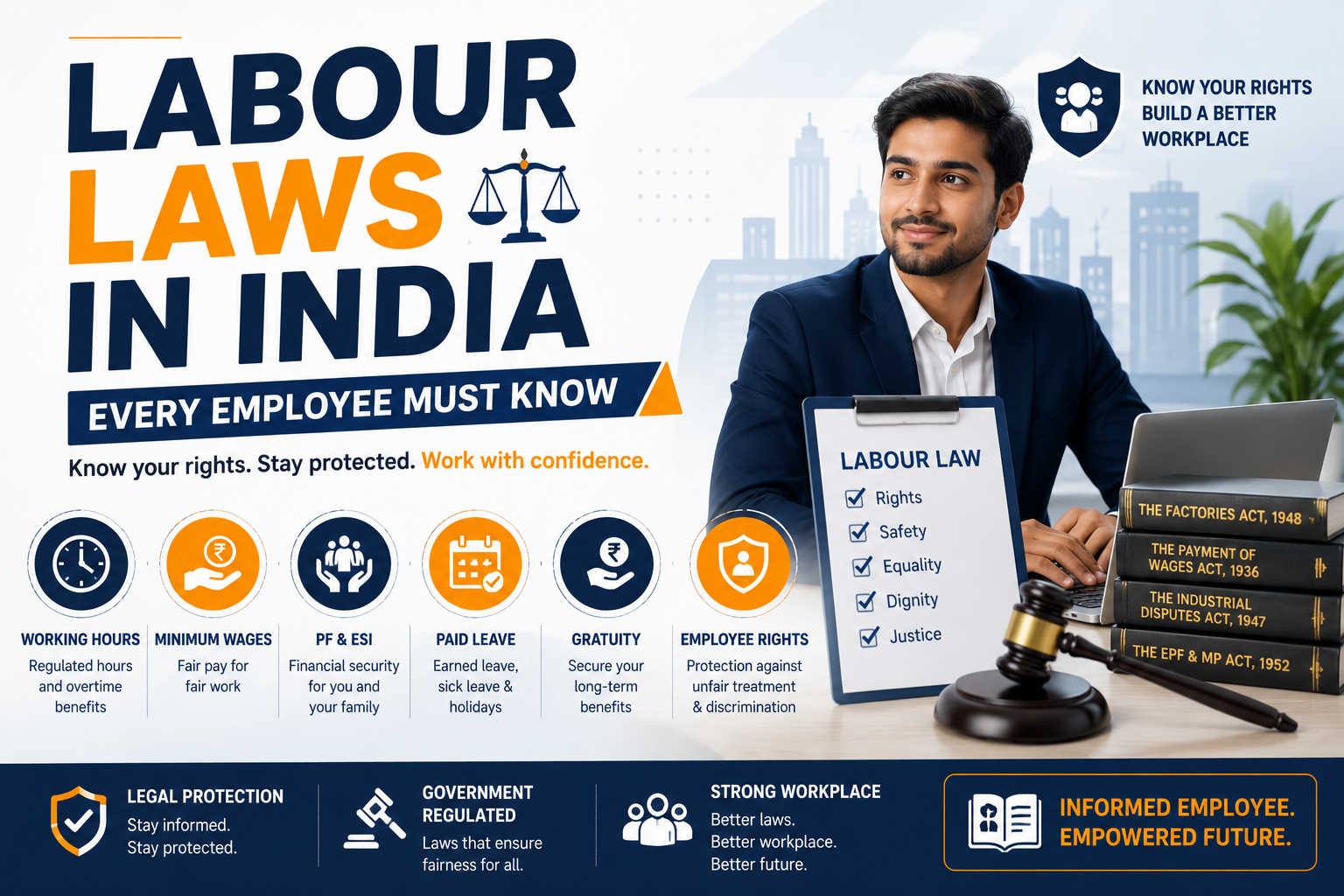
Your company makes you work 12 hours a day. No overtime pay. Your colleague was fired over a phone call — no notice, no reason given. A woman in your office was harassed by a senior — she didn’t report it because she didn’t know she could.
These things happen every day in Indian workplaces. Not because the law allows them — but because employees don’t know the law exists.
India has some of the strongest employee protection laws in the world. But they only protect you if you know what they say. Most employees — freshers, experienced, private sector, government — have never read a single labour law in their life.
In this article, I’ll explain the labour laws every Indian employee must know — in simple language, with real examples, so you know your rights before someone violates them.
Key Labour Laws Every Indian Employee Must Know — At a Glance
India has over 40 central labour laws and 100+ state laws. You don’t need to know all of them. But these 8 laws directly affect your daily work life.
| Law | What It Protects | Applies To |
|---|---|---|
| Payment of Wages Act, 1936 | Timely salary, no illegal deductions | All employees earning up to ₹24,000/month |
| Minimum Wages Act, 1948 | Minimum salary floor | All scheduled employment |
| Factories Act, 1948 | Working hours, overtime, safety | Factory workers |
| Shops & Establishments Act (State-wise) | Working hours, leaves, holidays | Office and shop workers |
| Industrial Disputes Act, 1947 | Wrongful termination, layoff protection | All workmen |
| Maternity Benefit Act, 1961 | Paid maternity leave | Women employees |
| POSH Act, 2013 | Protection from sexual harassment | All women at workplace |
| Equal Remuneration Act, 1976 | Equal pay for equal work | All employees |
Let me break down the most important ones that affect you directly.
Working Hours — What the Law Actually Says
Under the Factories Act and most state Shops & Establishments Acts, an employee cannot be made to work more than 9 hours a day and 48 hours a week. Any work beyond this is legally overtime — and the employer must pay double the normal wage for overtime hours.
A software developer in Bangalore working 11 hours daily, 6 days a week — that’s 66 hours. The law says 48 hours maximum. Those extra 18 hours per week should be compensated at 2x the hourly rate. Most IT companies avoid this by classifying employees under exemptions — but the fundamental right to overtime pay exists.
Payment of Wages — When and How You Must Be Paid
Your salary must be paid before the 7th of the following month (for companies with fewer than 1,000 employees) or before the 10th (for larger companies). No exceptions.
Illegal deductions — like fines for being late, deductions without written explanation, or holding salary for “performance” — are prohibited. Your employer can only deduct PF, ESI, TDS, and amounts authorized by law. Any other deduction without your written consent is illegal.
A retail worker in Pune had ₹2,000 deducted from his salary for “breaking a glass.” The Payment of Wages Act says fines for damage can only be imposed after a proper hearing — not just deducted silently. He complained to the Labour Inspector. The amount was refunded.
Termination Rules — Your Employer Can’t Just Fire You
Under the Industrial Disputes Act, an employer cannot terminate an employee who has worked for more than 240 days without:
- Giving a valid reason in writing
- Providing at least 1 month’s notice or 1 month’s salary in lieu
- Following a proper inquiry procedure
“You’re fired” over a phone call is not legal termination. A worker in Noida was dismissed via WhatsApp message — no notice, no reason, no compensation. He filed a complaint with the Labour Court. The court ordered the company to pay 6 months’ salary as compensation.
For companies with 100+ workers, prior government permission is required before retrenchment or layoff. This is one of the strongest employee protections in Indian law.
POSH Act and Maternity Benefit Act — Laws Every Woman Employee Must Know
POSH Act, 2013 — Protection from Sexual Harassment at Workplace
The Sexual Harassment of Women at Workplace (Prevention, Prohibition and Redressal) Act — commonly called the POSH Act — is one of the most important laws for women in India. And one of the least understood.
What counts as sexual harassment under POSH?
It’s not just physical contact. The law covers five categories:
- Physical contact and advances — unwanted touching, blocking path
- Demand or request for sexual favours — direct or implied
- Sexually coloured remarks — inappropriate comments about appearance, body
- Showing pornography — sharing explicit content in person or digitally
- Any unwelcome physical, verbal, or non-verbal conduct of sexual nature — staring, gestures, suggestive messages
A senior manager sending “You look hot today” on Slack is sexual harassment under POSH. A colleague repeatedly asking a woman out despite her saying no is harassment. A team lead implying “be nice to me and I’ll give you a good appraisal” is quid pro quo harassment.
What is the employer legally required to do?
Every company with 10 or more employees must:
- Set up an Internal Complaints Committee (ICC) with a presiding female officer
- Include an external member from an NGO or women’s rights organization
- Display the POSH policy visibly in the workplace
- Conduct POSH awareness training for all employees
If your company has 10+ employees and no ICC — the company itself is violating the law. The penalty for non-compliance is up to ₹50,000 for the first offence, and the company’s registration can be cancelled for repeated non-compliance.
How to file a complaint:
Submit a written complaint to the ICC within 3 months of the incident (extendable to 6 months in certain cases). The ICC must complete the inquiry within 90 days. During the investigation, the complainant can request transfer, leave, or change of work conditions. Retaliation against the complainant is illegal.
A marketing executive in Gurgaon was receiving inappropriate messages from her manager for months. She didn’t report it because “nothing physical happened.” When she finally learned about POSH, she filed a complaint. The ICC investigated, found the manager guilty, and he was terminated. She was given counselling support and continued in her role.
Maternity Benefit Act, 1961 (Amended 2017) — Full Rights Explained
This law guarantees paid maternity leave to every woman employee in India — regardless of whether she works in the government, private sector, or informal sector.
Key provisions:
| Benefit | Details |
|---|---|
| Paid maternity leave | 26 weeks (approx. 6 months) for the first two children |
| Leave for third child onwards | 12 weeks |
| Adoptive and commissioning mothers | 12 weeks from the date of receiving the child |
| Pre-delivery leave | Up to 8 weeks can be taken before the expected delivery date |
| Pay during leave | Full salary — average of last 3 months’ daily wage |
| Work from home option | Employer may allow WFH after 26 weeks, if the nature of work permits |
| Crèche facility | Mandatory for companies with 50+ employees |
| No termination during leave | Employer cannot fire or reduce salary during maternity leave |
Who is eligible? Any woman who has worked for at least 80 days in the 12 months immediately before the expected delivery date. This includes contract workers, part-time workers, and employees on probation.
A teacher at a private school in Jaipur was told “We don’t give maternity leave — you can take unpaid leave.” This is illegal. The Maternity Benefit Act applies to all establishments with 10 or more employees. She filed a complaint. The school was directed to pay full salary for 26 weeks.
For miscarriage or medical termination: A woman is entitled to 6 weeks of paid leave immediately after the miscarriage. This is a right — not a favour from the employer.
What to Do If Your Workplace Rights Are Being Violated — Step by Step
Step 1: Document everything.
Save emails, messages, salary slips, attendance records, and any written communication. Screenshots, photos, and witness names strengthen your case. A verbal complaint without evidence is hard to prove. A written trail is your strongest weapon.
Step 2: Raise the issue internally first.
Write to your HR department or manager — via email, not verbal conversation. Email creates a timestamp and proof. “I’d like to bring to your attention that my overtime hours are not being compensated as per the Shops & Establishments Act.” Many companies resolve issues once they realize the employee knows the law.
Step 3: File a complaint with the Labour Commissioner.
If internal resolution fails, visit your district Labour Commissioner’s office. Bring documentation — salary slips, employment letter, communication proof. Alternatively, file online through your state’s labour portal. You can also call Shram Suvidha at 14434.
Step 4: For POSH complaints — go to the ICC.
Submit a written complaint to the Internal Complaints Committee. If your company doesn’t have an ICC, file with the Local Complaints Committee (LCC) set up by the District Officer. Don’t let the absence of an ICC stop you — the law provides an alternative mechanism.
Step 5: Seek legal help if needed.
Labour courts handle disputes about wrongful termination, unpaid wages, and workplace rights violations. Many labour lawyers offer free first consultations. Legal aid is also available through District Legal Services Authorities for employees who can’t afford a lawyer.
Common Workplace Myths That Cost Employees Their Rights
Myth 1: “Private companies don’t have to follow labour laws.”
Every labour law in India applies to private companies that meet the threshold criteria. The POSH Act applies to every company with 10+ employees. The Maternity Benefit Act applies to establishments with 10+ employees. The Payment of Wages Act applies across all sectors. “We’re a private company, we make our own rules” is not a legal defense.
Myth 2: “Contract employees have no rights.”
Contract workers are entitled to minimum wage, safe working conditions, and protection under the POSH Act. The Contract Labour (Regulation and Abolition) Act, 1970 specifically protects contract employees. A contract worker at a Hyderabad IT park being paid ₹6,000/month while the minimum wage is ₹11,000+ is being exploited — regardless of their “contract” status.
Myth 3: “Maternity leave is a company benefit, not a legal right.”
It’s a legal right. The employer cannot deny it, reduce it, or replace it with unpaid leave. They also cannot terminate a pregnant employee or reduce her responsibilities as punishment for taking leave. If your company says “We offer only 12 weeks” — they’re violating the Maternity Benefit (Amendment) Act, 2017.
Myth 4: “If there’s no written contract, I have no rights.”
Even without a written employment contract, your rights exist. Salary slips, bank transfer records, ID cards, email communication — all serve as proof of employment. Many informal sector workers assume they have no legal protection. They do.
Frequently Asked Questions
Q1: What are the basic labour rights every employee should know?
Five fundamental rights — right to minimum wage, right to timely salary payment, right to safe working conditions, right to regulated working hours (9 hours/day, 48 hours/week), and right to be free from discrimination and harassment. These are protected by law regardless of whether you’re in the private sector, government, permanent, or contract.
Q2: What is the POSH Act and who does it protect?
The POSH Act (2013) protects women from sexual harassment at the workplace. It covers physical advances, verbal remarks, inappropriate messages, and any unwelcome sexual conduct. Every company with 10+ employees must have an Internal Complaints Committee. Complaints must be resolved within 90 days. The law covers all women — permanent, contract, intern, or visiting.
Q3: How many working hours are legal in India?
Under the Factories Act and most state Shops & Establishments Acts — maximum 9 hours per day and 48 hours per week. Overtime beyond these limits must be compensated at double the normal wage. Employees cannot be forced to work more than 48 hours without overtime pay, regardless of what the employment contract says.
Q4: Can an employer terminate an employee without notice?
For employees who have worked 240+ days — no. The employer must provide 1 month’s written notice or 1 month’s salary in lieu, along with a valid reason. Termination without due process can be challenged in Labour Court. During probation, shorter notice periods may apply, but termination must still follow the employment contract terms.
Q5: What is the law for maternity leave in India?
The Maternity Benefit (Amendment) Act, 2017 provides 26 weeks of paid maternity leave for the first two children and 12 weeks for the third child onwards. The employee must have worked at least 80 days in the preceding 12 months. Full salary is paid during the leave. The employer cannot terminate or penalize an employee for taking maternity leave. Companies with 50+ employees must also provide a crèche facility.
The Law Is Already on Your Side — You Just Need to Know It
Here’s the truth — India’s labour laws were written to protect you. Every right in this article is backed by an Act of Parliament. Every violation has a penalty. Every complaint has a process.
The problem isn’t that the law doesn’t exist. The problem is that most employees never read it. And employers rely on that ignorance.
Save this article. Share it with your colleagues. The next time your employer says “This is just how it works” — check what the law actually says. You might be surprised at how much power you already have.
Your rights aren’t a favour. They’re the law. Know them. Use them. 💪
