
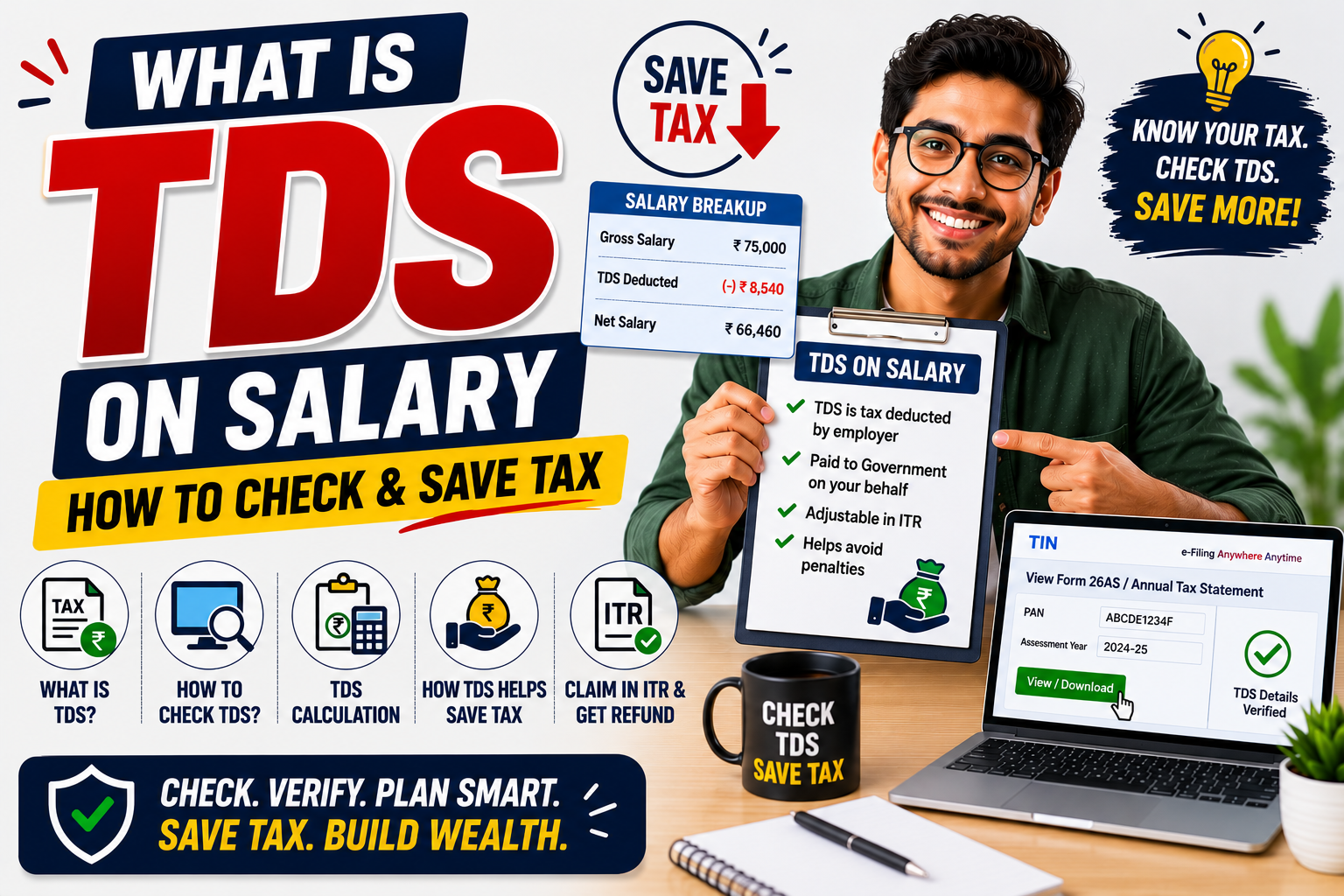
Your salary is ₹60,000 per month. But every month, ₹5,000 disappears before the money hits your account. Your salary slip says “TDS Deduction.” You’re confused. Why is the government taking your money before you even get it? And more importantly — can you reduce it?
Most salaried employees in India see TDS as an unavoidable cut. But what they don’t know is that you can legally bring your TDS to zero — if you plan your investments right.
In this article, I’ll explain what TDS on salary means, how it’s calculated, how to check if it’s correct, and exactly how to save tax legally so less money leaves your salary.
TDS Meaning on Salary — How Your Employer Calculates It
TDS stands for Tax Deducted at Source. It means your employer deducts income tax from your salary every month and deposits it directly with the government on your behalf.
Think of it this way. Instead of you paying the full year’s tax in one shot while filing ITR, your employer collects it in small monthly installments throughout the year. That’s TDS.
How does your employer calculate TDS?
Your employer estimates your total annual taxable income at the start of the financial year. They apply the income tax slab rates. Then they divide the total tax by 12 and deduct that amount every month.
Here’s a real example. Ankur works at a tech company in Bangalore. His annual CTC is ₹8 LPA. After removing employer PF, insurance, and non-taxable allowances, his estimated taxable income is ₹6.5 lakh.
Under the new tax regime (FY 2024-25):
| Income Slab | Tax Rate | Tax Amount |
|---|---|---|
| Up to ₹3,00,000 | 0% | ₹0 |
| ₹3,00,001 – ₹7,00,000 | 5% | ₹17,500 |
| Total tax before rebate | ₹17,500 | |
| Section 87A rebate (income ≤ ₹7 lakh) | -₹17,500 | |
| Final tax | ₹0 |
Ankur pays zero TDS because his taxable income is under ₹7 lakh in the new regime. His employer deducts nothing.
But if his taxable income was ₹9 lakh, the calculation changes:
| Income Slab | Tax Rate | Tax Amount |
|---|---|---|
| Up to ₹3,00,000 | 0% | ₹0 |
| ₹3,00,001 – ₹7,00,000 | 5% | ₹20,000 |
| ₹7,00,001 – ₹9,00,000 | 10% | ₹20,000 |
| Total tax | ₹40,000 | |
| Add: 4% Health & Education Cess | ₹1,600 | |
| Total TDS for the year | ₹41,600 | |
| Monthly TDS | ₹3,467 |
According to the Income Tax Department’s 2024 data, over ₹8.8 lakh crore was collected as TDS in India — making it the single largest source of tax revenue. Your monthly TDS deduction contributes to this massive collection.
Is TDS deducted on bonus? Yes. Bonus, incentives, and performance pay are all part of your salary income. Your employer adds these to your annual income estimate and calculates TDS accordingly. If you receive a ₹50,000 bonus in December, your TDS for that month will be higher.
Old vs New Tax Regime — Which One Saves More TDS
This is the decision that confuses every salaried Indian. Let me make it simple.
India has two tax regimes. You choose one at the start of each financial year. Your choice directly affects how much TDS is deducted.
| Feature | Old Regime | New Regime (Default from FY 2023-24) |
|---|---|---|
| Tax slabs | Higher rates, more deductions allowed | Lower rates, fewer deductions |
| Section 80C (₹1.5 lakh) | Available | Not available |
| HRA exemption | Available | Not available |
| Section 80D (health insurance) | Available | Not available |
| Standard deduction | ₹75,000 | ₹75,000 |
| Tax rebate under 87A | Income ≤ ₹5 lakh | Income ≤ ₹7 lakh |
When does the OLD regime save more TDS?
If you have heavy deductions — ₹1.5 lakh in 80C (PPF, ELSS, LIC), ₹50,000 in NPS (80CCD), ₹25,000 in health insurance (80D), and HRA exemption — the old regime can reduce your taxable income significantly. This works best for employees with CTC above ₹10 LPA who actively invest.
When does the NEW regime save more TDS?
If you don’t have many investments or deductions, the new regime’s lower tax rates give you a smaller tax bill automatically. This works best for freshers and employees earning ₹7-₹10 LPA who haven’t started heavy investing.
Real comparison. Priya in Mumbai earns ₹12 LPA gross. She invests ₹1.5 lakh in PPF, pays ₹20,000 in health insurance, and claims ₹1.2 lakh HRA exemption.
- Old regime taxable income: ₹12 lakh – ₹75,000 – ₹1.5 lakh – ₹20,000 – ₹1.2 lakh = ₹8.55 lakh → Tax: ~₹62,400
- New regime taxable income: ₹12 lakh – ₹75,000 = ₹11.25 lakh → Tax: ~₹68,400
For Priya, old regime saves ₹6,000 more. But for someone with no investments, the new regime wins.
Ask your employer’s payroll team to calculate both before you choose. This one decision saves or costs you thousands each year.
How to Reduce TDS on Salary Legally — Step by Step
Step 1: Submit your investment declaration at the start of the year.
Every April, your HR sends an “investment declaration form.” This is where you declare what tax-saving investments you plan to make that year. The more you declare, the lower your monthly TDS. Don’t skip this form — it directly controls your take-home salary for the next 12 months.
Step 2: Maximize Section 80C investments (₹1.5 lakh limit).
If you’re on the old regime, invest in PPF, ELSS mutual funds, EPF (already deducted), life insurance premiums, children’s tuition fees, or 5-year bank FD. A fresher in Delhi who simply directed ₹12,500/month into ELSS reduced his annual TDS by ₹46,800. That’s nearly ₹4,000 extra per month in hand.
Step 3: Claim HRA exemption if you pay rent.
If you live in a rented house, submit rent receipts and your landlord’s PAN (if rent exceeds ₹1 lakh/year). HRA exemption can save significant tax — especially in metros. An employee paying ₹18,000 rent in Pune can claim roughly ₹1.5-₹2 lakh HRA exemption, reducing taxable income substantially.
Step 4: Claim Section 80D for health insurance premiums.
Premiums for your health insurance (up to ₹25,000) and parents’ health insurance (up to ₹50,000 if senior citizens) are deductible. This alone can save ₹5,000-₹15,000 in TDS annually.
Step 5: Submit actual proofs before February.
Your employer asks for investment proofs in January-February. If you declared investments but didn’t actually make them, your March salary will see a massive TDS deduction to compensate. Don’t just declare — actually invest. And submit receipts on time.
Common Mistakes Salaried Employees Make with TDS
Mistake 1: Not submitting investment declarations and losing take-home salary.
If you don’t submit the declaration form, your employer assumes zero deductions and deducts maximum TDS from month one. A software engineer in Hyderabad ignored the form for 6 months. His employer deducted ₹8,000/month as TDS. After he submitted his declarations, TDS dropped to ₹3,500. He lost ₹27,000 unnecessarily in those 6 months. Yes, he’d get a refund while filing ITR — but why give the government an interest-free loan?
Mistake 2: Not checking Form 26AS or AIS to verify TDS deposits.
Your employer deducts TDS from your salary — but is it actually being deposited with the government? Log into incometax.gov.in → Download your AIS (Annual Information Statement). Check if the TDS amounts match your salary slips. Mismatches cause ITR processing issues and delays.
Mistake 3: Choosing the wrong tax regime.
Many employees stick with the default new regime without comparing. Others choose the old regime without having enough deductions to justify it. Run the numbers for both regimes every year. Your situation changes — new rent, new investments, salary hike — and the better regime might flip.
Mistake 4: Thinking TDS refund happens automatically.
If excess TDS was deducted, you only get it back when you file your ITR. No ITR filed means no refund — ever. A fresher in Chennai had ₹28,000 excess TDS deducted but didn’t file her ITR. That money sat with the government for 2 years until a friend told her to file. She got ₹28,000 + interest back within 3 weeks of filing. Always file your ITR — even if just for the refund.
Frequently Asked Questions
Q1: How much TDS is deducted from salary?
TDS depends on your taxable income and chosen tax regime. Under the new regime, income up to ₹7 lakh has zero tax (after rebate). Above ₹7 lakh, tax is calculated slab-wise — 5% up to ₹7 lakh, 10% up to ₹10 lakh, 15% up to ₹12 lakh, and so on. Your employer divides the annual tax by 12 and deducts monthly.
Q2: Can TDS be refunded?
Yes. If your employer deducted more TDS than your actual tax liability, you get the excess back as a refund. File your ITR on incometax.gov.in before July 31. The Income Tax Department processes refunds within 15-45 days usually. The refund is credited directly to your bank account linked with your PAN.
Q3: How to check if TDS is correctly deducted and deposited?
Log into incometax.gov.in → Go to AIS (Annual Information Statement) or Form 26AS. These show every TDS transaction deposited against your PAN — salary TDS, bank FD TDS, everything. Compare these figures with your Form 16 and monthly salary slips. If they don’t match, raise it with your employer immediately.
Q4: What happens if excess TDS is deducted from my salary?
Your money isn’t lost. File your ITR, report all income and deductions accurately, and the system automatically calculates if you’ve overpaid. The excess amount shows as “Refund Due.” After e-verification, the refund is processed within 15-45 days. Always file your ITR to claim excess TDS back.
Q5: Is TDS applicable on salary bonus and incentives?
Yes. Bonus, performance incentives, and any special payments from your employer are part of your salary income under the Income Tax Act. Your employer adds these to your total annual income estimate and calculates TDS accordingly. Months when bonus is paid usually have higher TDS deduction.
Your Tax is in Your Hands — Plan Early, Keep More
Here’s the one thing to remember — TDS is not a punishment. It’s advance tax. And you have full legal power to reduce it by making smart investments and choosing the right regime.
Submit your investment declaration in April — not January. Compare old vs new regime every single year. Invest in 80C instruments. Claim HRA if you pay rent. And always file your ITR to get excess TDS back.
The difference between employees who lose ₹50,000+ in unnecessary TDS and those who keep their money — is just 2 hours of planning at the start of the financial year.
Open your salary slip tonight. Check your TDS. Do the math. Start saving. 💪
Interview Knowledge — Types, Rounds & Skills Guide
You applied for a job. Got a call from HR. She says — “There will be four rounds.” You hang up and panic. Four rounds? What kind of rounds? Will they test coding? Will there be a group discussion? What if there’s a presentation?
Most job seekers in India prepare for “the interview” as if it’s one single event. It’s not. Different companies have different types of interviews — and each round tests something different.
In this article, I’ll walk you through the types of job interviews in India, what each round tests, and exactly which skills you need to crack them.
Types of Job Interviews — What Indian Companies Actually Conduct
Not all interviews are the same. Here are the most common types you’ll face in India.
Telephonic / Phone Screening.
This is usually the first round. An HR executive calls you for 10-15 minutes. They verify basic details — your location, current salary, notice period, and interest in the role. No deep technical questions. A recruiter from an MNC in Gurgaon told me — “I reject 40% of candidates in the phone screen because they can’t clearly state what role they’re applying for.” Know the job title and company name before you answer.
Technical Interview.
This is where your subject knowledge is tested. For IT roles — expect coding problems, system design questions, and technology-specific questions (Java, Python, SQL). For finance roles — expect accounting scenarios and Excel problems. For marketing — expect campaign strategy questions. An engineering fresher in Bangalore will typically face 1-2 technical rounds lasting 45-60 minutes each.
HR / Behavioral Interview.
This round tests your personality, communication, and cultural fit. Common questions: “Tell me about yourself,” “Why should we hire you,” “Describe a challenging situation.” HR evaluates your attitude, not your skills. According to a 2024 LinkedIn India survey, 89% of hiring failures happen due to poor cultural fit — not lack of technical ability.
Group Discussion (GD).
Common for MBA roles, bank recruitment, and mass hiring drives. You sit with 6-10 candidates and discuss a topic for 15-20 minutes. The evaluator watches who communicates clearly, listens to others, and leads without dominating.
Case Study / Assignment Round.
Some companies give you a take-home assignment — design a marketing plan, write a code module, create a financial model. You get 2-7 days. This tests real work ability, not just interview performance.
| Round | What It Tests | Duration |
|---|---|---|
| Phone Screen | Basic fit, communication | 10-15 mins |
| Technical Round | Subject knowledge, problem solving | 45-60 mins |
| HR Round | Personality, attitude, cultural fit | 30-45 mins |
| GD | Communication, leadership, listening | 15-20 mins |
| Assignment | Real-world work ability | 2-7 days |
Key Skills Tested in Interviews — And How to Build Them
Every interview round tests a specific set of skills. Once you know what’s being measured, you can prepare with focus.
Communication skills — This is the number one skill across all rounds. You don’t need perfect English. You need clear thoughts expressed in simple sentences. Practice explaining your projects in 2 minutes. If you can explain a complex concept simply, you pass.
A fresher from Lucknow had average English. But he structured his answers so clearly — point by point — that the interviewer gave him the highest feedback score. Clarity beats fluency every time.
Body language — In face-to-face interviews, your non-verbal communication matters as much as your words. Sit upright. Make natural eye contact — don’t stare. Smile when appropriate. Don’t cross your arms. Don’t tap your feet. A study by UCLA found that 55% of communication is body language, 38% is tone, and only 7% is actual words. Your body speaks louder than your answers.
Problem-solving — Technical rounds test this directly. Don’t just memorize answers. Understand how to approach a problem step by step. Talk through your thought process out loud. Interviewers often care more about how you think than whether you get the perfect answer.
Confidence without arrogance — There’s a thin line. Saying “I know Java very well and I’m the best in my batch” sounds arrogant. Saying “I’ve built two projects in Java and I’m comfortable solving medium-level problems” sounds confident. One gets rejected. The other gets hired.
How to Prepare for Multiple Interview Rounds — Step by Step
Step 1: Research the company’s interview process.
Search “[Company name] interview experience” on Glassdoor or AmbitionBox. You’ll find real experiences from candidates who interviewed there — including exact questions asked, number of rounds, and difficulty level. A candidate in Pune found 3 out of 5 questions from Glassdoor reviews that were actually asked in her TCS interview.
Step 2: Prepare differently for each round.
Phone screen — rehearse your 30-second introduction and salary expectation answer. Technical round — practice problems on platforms like LeetCode, HackerRank, or InterviewBit. HR round — prepare answers for the top 10 behavioral questions. Don’t prepare everything the same way.
Step 3: Do at least 3 mock interviews.
Practice with a friend, senior, or use free platforms like Pramp or InterviewBuddy. Record yourself. Watch the recording. You’ll notice fillers (“umm,” “basically”), nervous hand movements, and unclear answers that you can fix before the real interview. One mock interview is worth 10 hours of reading tips online.
Step 4: Prepare smart questions for the end of each round.
When the interviewer asks “Any questions?” — ask something relevant to that specific round. After a technical round: “What tech stack does the team currently use?” After an HR round: “How is performance measured for freshers in the first year?” Thoughtful questions show genuine interest.
Step 5: Follow up after each round.
Send a short thank-you email within 24 hours. “Thank you for your time today. I enjoyed learning about [something specific discussed]. Looking forward to the next steps.” This simple gesture sets you apart — less than 10% of Indian candidates send follow-up emails.
Common Interview Mistakes That Cost You the Job
Mistake 1: Preparing only for the technical round.
You ace the coding test but bomb the HR round because you can’t explain why you want the job. Or worse — you clear everything but fail the phone screen because you sounded uninterested. Prepare for every round. Each one is an elimination gate.
Mistake 2: Not understanding what “HR round” actually tests.
The HR round isn’t casual. It’s where your salary negotiation happens, your cultural fit is assessed, and your career goals are evaluated. A candidate in Chennai lost an ₹8 LPA offer because he said “I just want money” when asked about motivation. Honesty is good — but framing matters.
Mistake 3: Talking too much or too little.
In GD rounds, speaking for 5 minutes straight without letting others talk gets you rejected — even if your points are good. In technical rounds, giving one-word answers without explaining your logic gets you rejected too. Find the balance. Listen. Contribute. Explain. Then stop.
Mistake 4: Not asking about next steps.
Many candidates leave the interview room without knowing what happens next. “When can I expect to hear back? What’s the next round?” Asking these shows professionalism and helps you plan. Don’t just walk out and wait indefinitely.
Frequently Asked Questions
Q1: What are the different types of job interviews in India?
The most common types are — phone screening, technical interview, HR/behavioral interview, group discussion, and assignment/case study round. IT companies typically have 2-3 rounds. MNCs and banks may have 4-5 rounds. Startups often keep it to 1-2 rounds. The number and type vary by company and role.
Q2: How many interview rounds are normal?
For freshers, 2-3 rounds is standard — usually one technical and one HR. For experienced roles, 3-5 rounds are common, including managerial and leadership rounds. Some companies like Amazon have 5-6 rounds for senior roles. Ask the recruiter upfront how many rounds to expect so you can prepare accordingly.
Q3: What is the HR round in an interview?
The HR round evaluates your personality, communication, salary expectations, and cultural fit. Common questions include — Tell me about yourself, Why do you want to join us, Where do you see yourself in 5 years, and What are your salary expectations. This round is often the final decision-maker, not just a formality.
Q4: What skills are tested in a job interview?
Technical knowledge, communication skills, problem-solving ability, body language, confidence, teamwork, and cultural fit. The weightage varies by round — technical rounds focus on subject knowledge while HR rounds focus on personality and attitude. Soft skills matter as much as hard skills — sometimes more for fresher-level roles.
Q5: How to improve interview performance quickly?
Three things make the biggest difference fastest — mock interviews with a friend (fixes nervousness), reading Glassdoor reviews of your target company (gives you real questions), and recording yourself answering “Tell me about yourself” (reveals bad habits you didn’t know you had). Start with these three, and your confidence will jump noticeably within a week.
Every Round Is a Chance — Show Up Prepared
Here’s the truth — interviews aren’t about being perfect. They’re about being prepared. The candidate who researches the company, practices their answers, and walks in with calm confidence beats the candidate with a better degree every single time.
Know your interview format before you walk in. Prepare for each round separately. Practice with real people, not just in your head. And always follow up with a thank-you email.
Thousands of freshers and professionals across Mumbai, Delhi, Bangalore, and Hyderabad crack their interviews every month — not because they’re smarter, but because they prepared smarter.
Your next interview is your next opportunity. Walk in ready.
