
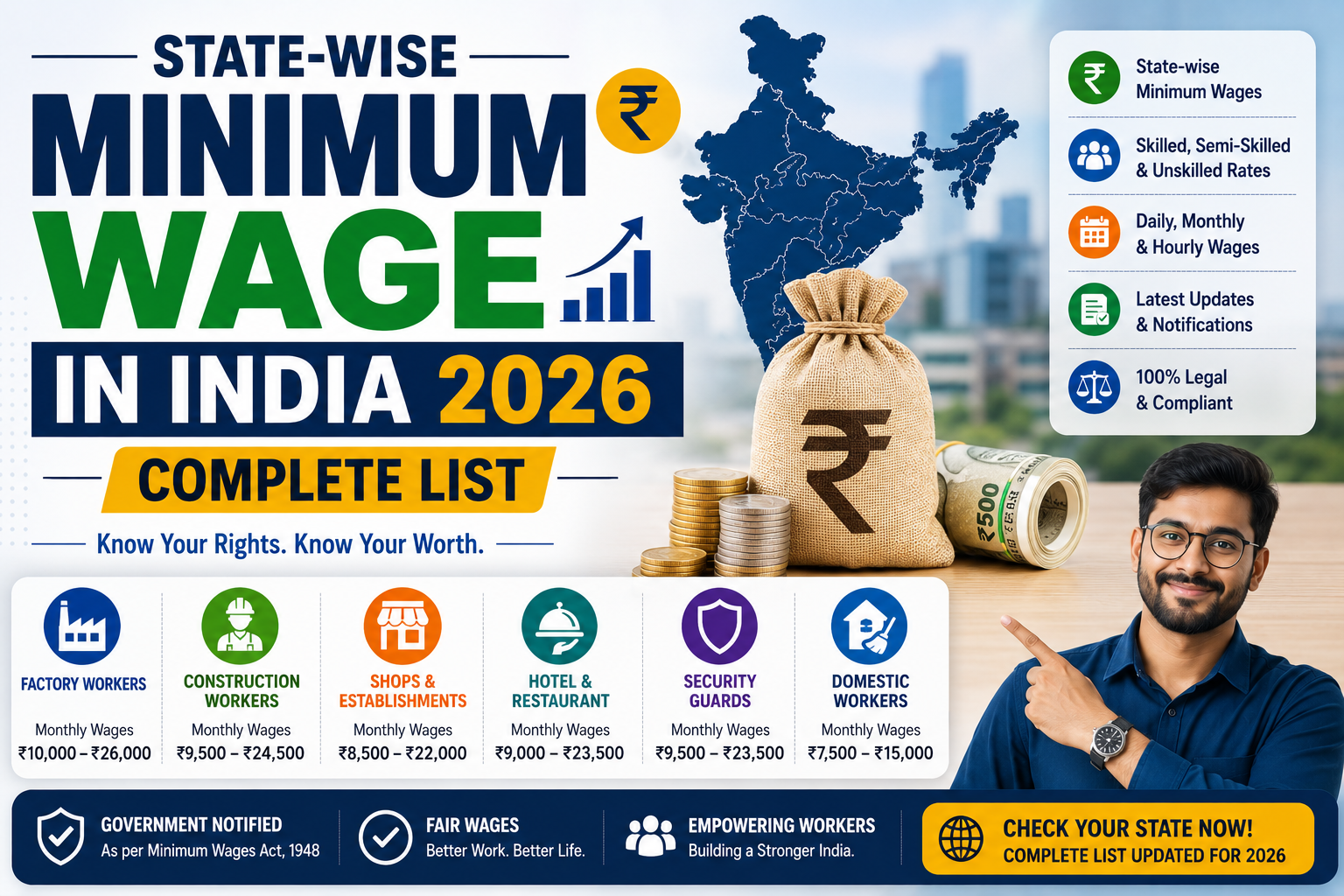
You’re working at a small shop in Lucknow. You earn ₹9,000 per month. You work 10 hours a day, 6 days a week. Your employer says “This is normal.” You believe him because you don’t know what the law says.
But here’s the truth — the government of Uttar Pradesh has set a minimum wage that your employer is legally required to pay you. If he’s paying less, he’s breaking the law.
Lakhs of workers across India — in shops, factories, offices, and construction sites — are paid below minimum wage simply because they don’t know the rules. This article gives you the complete state-wise minimum wage list for 2026 so you can check if you’re being paid fairly.
Note: Minimum wages are revised periodically by state governments — some every 6 months. The rates in this article are based on the latest available notifications as of mid-2026. Always verify the current rates from your state’s Labour Department website for the most accurate figures.
How Minimum Wage Works in India — And Why It’s Different in Every State
India does not have one single national minimum wage. Under the Minimum Wages Act, 1948, both the Central Government and State Governments set minimum wages — and the rates vary based on three factors:
- State — Each state sets its own rates. Delhi pays the highest. Bihar and Jharkhand pay among the lowest.
- Skill level — Unskilled, semi-skilled, skilled, and highly skilled workers have different minimum wages.
- Industry/Sector — Construction workers, shop employees, factory workers, and agricultural labourers may have different rates even within the same state.
The Code on Wages, 2019 was passed to unify and simplify wage laws across India. It proposed a national floor wage — a minimum below which no state can go. As of 2026, the Central Government’s floor wage stands at approximately ₹178-₹200 per day. But most states pay above this — some significantly higher.
Here’s the key thing to understand — minimum wage is not optional. It’s a legal obligation. If your employer pays less than the minimum wage for your category, you can file a complaint with the Labour Commissioner of your district. The employer can face fines and penalties.
State-wise Minimum Wage List 2026 — Major States
Here are the minimum wage rates for major Indian states. I’m listing rates for unskilled workers (the base category) as daily and approximate monthly equivalents (26 working days).
| State | Daily Wage (Unskilled) | Monthly Approx. | Revision Frequency |
|---|---|---|---|
| Delhi | ₹750-₹810 | ₹19,500-₹21,060 | Every 6 months |
| Maharashtra | ₹430-₹540 | ₹11,180-₹14,040 | Annual |
| Karnataka | ₹440-₹545 | ₹11,440-₹14,170 | Annual |
| Tamil Nadu | ₹430-₹520 | ₹11,180-₹13,520 | Annual |
| Uttar Pradesh | ₹370-₹445 | ₹9,620-₹11,570 | Annual |
| Bihar | ₹350-₹420 | ₹9,100-₹10,920 | Annual |
| Rajasthan | ₹365-₹425 | ₹9,490-₹11,050 | Annual |
| Madhya Pradesh | ₹365-₹415 | ₹9,490-₹10,790 | Annual |
| Gujarat | ₹400-₹465 | ₹10,400-₹12,090 | Annual |
| West Bengal | ₹365-₹412 | ₹9,490-₹10,712 | Annual |
| Telangana | ₹430-₹500 | ₹11,180-₹13,000 | Annual |
| Andhra Pradesh | ₹400-₹465 | ₹10,400-₹12,090 | Annual |
| Punjab | ₹410-₹465 | ₹10,660-₹12,090 | Annual |
| Haryana | ₹430-₹485 | ₹11,180-₹12,610 | Annual |
| Kerala | ₹430-₹650 | ₹11,180-₹16,900 | Annual |
| Jharkhand | ₹350-₹405 | ₹9,100-₹10,530 | Annual |
| Odisha | ₹355-₹410 | ₹9,230-₹10,660 | Annual |
| Assam | ₹360-₹405 | ₹9,360-₹10,530 | Annual |
| Chhattisgarh | ₹365-₹415 | ₹9,490-₹10,790 | Annual |
The range in daily wage reflects zone-based differences (Zone A = metro areas, Zone C = rural areas) and industry category variations within each state.
Disclaimer: These figures are approximate and based on the latest available government notifications and CPI-linked revisions. Rates vary by specific industry and employment category. For exact rates applicable to your situation, visit your state Labour Department’s official website or the Central Government’s Labour Ministry portal. You can also call the Shram Suvidha Helpline at 14434 for updated information.
Key States Explained in Detail — Delhi, UP, Bihar, Maharashtra, Karnataka
Delhi — Highest Minimum Wage in India
Delhi consistently pays the highest minimum wages in the country. The Delhi government revises rates every 6 months based on the Consumer Price Index (CPI).
| Category | Monthly Wage (2026 Estimate) |
|---|---|
| Unskilled | ₹19,500-₹21,060 |
| Semi-skilled | ₹21,400-₹23,100 |
| Skilled | ₹23,500-₹25,400 |
| Highly skilled | ₹25,800-₹27,900 |
A shop worker in Lajpat Nagar earning ₹13,000/month from his employer is being underpaid by nearly ₹7,000-₹8,000. He has every legal right to demand the difference. Yet most workers don’t know this because they’ve never seen these numbers.
Delhi’s wages have risen steadily — from roughly ₹15,900 in 2022 to over ₹19,500 in 2026 for unskilled workers. If your Delhi employer hasn’t revised your salary in 2 years, you might already be below the current minimum.
Uttar Pradesh — Most Workers, Least Awareness
UP has the largest workforce in India — but minimum wage awareness is among the lowest. Wages are set by industry and zone.
For general unskilled workers in UP, the rate is approximately ₹370-₹445 per day in 2026. For shop and commercial establishment employees, rates may differ. A helper at a Lucknow shop earning ₹7,500/month is clearly being paid below the legal minimum — and this happens across thousands of shops in UP’s smaller cities.
Bihar — Among the Lowest, But Still Mandatory
Bihar’s minimum wages for unskilled workers are around ₹350-₹420 per day in 2026. Many small employers in Bihar still pay ₹200-₹280 per day — clearly below the legal floor. Workers in construction, brick kilns, and agricultural settings are most affected.
A construction helper in Patna earning ₹250/day should be earning at least ₹350. That ₹100/day gap adds up to ₹2,600/month — over ₹31,000/year stolen from a worker who likely cannot afford the loss.
Maharashtra — Industrial State, Complex Structure
Maharashtra has one of the most detailed minimum wage structures — different rates for Mumbai, Pune, Nagpur, and rural areas. Mumbai naturally has higher rates. An unskilled factory worker in Mumbai should earn roughly ₹14,000+/month in 2026. In rural Maharashtra, the minimum is lower but still mandated.
Maharashtra revised rates in 2025, and further CPI-linked adjustments are expected in late 2026. If you’re a worker in Maharashtra, check the latest notification from the Maharashtra Labour Department website.
Karnataka — IT Hub, But Minimum Wage Applies to All
Bangalore’s tech sector pays well above minimum wage. But Karnataka’s minimum wage law applies to all workers — including housekeeping staff, shop helpers, security guards, and delivery workers. An unskilled worker in Bangalore should earn at least ₹11,440-₹14,170/month in 2026.
A security guard at a Bangalore apartment complex earning ₹10,000/month is being underpaid. The residents’ welfare association employing him is legally obligated to pay at least the state minimum.
How to Check If Your Employer Is Paying You Fairly — Step by Step
Step 1: Identify your worker category.
Are you unskilled, semi-skilled, skilled, or highly skilled? This is defined by your job role — not your education. A helper or peon is unskilled. A machine operator is semi-skilled. An electrician or plumber is skilled. A supervisor with technical expertise is highly skilled.
Step 2: Check your state’s latest minimum wage notification.
Visit your state’s Labour Department website. Search for “minimum wage notification [State Name] 2026.” Every state publishes official gazette notifications with exact rates by category and zone. You can also call the Shram Suvidha helpline at 14434 for current rates.
Step 3: Compare your actual monthly payment with the legal minimum.
Calculate your daily rate — divide your monthly salary by the number of working days. If it’s below the state minimum for your category, your employer is violating the law.
Step 4: Talk to your employer first.
Many small business owners genuinely don’t know the latest rates. A polite conversation — “I checked the government minimum wage for our state and it seems my current payment is below the official rate” — often resolves the issue.
Step 5: File a complaint if the employer refuses to comply.
If your employer knowingly pays below minimum wage and refuses to correct it, file a complaint with the Labour Commissioner of your district. Complaints can be filed in person or through your state’s online labour portal. Under the Minimum Wages Act, employers paying below minimum wage can face fines up to ₹50,000 and imprisonment for repeat offences.
Common Minimum Wage Myths That Hurt Workers
Myth 1: “Minimum wage only applies to factories and construction.”
Wrong. Minimum wage applies to shops, offices, restaurants, domestic work, agriculture, and every scheduled employment. A shop assistant in a clothing store in Noida, a delivery helper in Chennai, a housekeeping staff in a Pune hotel — all are covered. If your work falls under any scheduled employment category in your state, minimum wage is your legal right.
Myth 2: “Small businesses are exempt from minimum wage.”
No exemption exists based on business size. Whether the employer has 5 employees or 500, minimum wage rules apply equally. A chaiwala employing two helpers in Patna must pay at least the Bihar minimum wage.
Myth 3: “Probation period means employer can pay less.”
During probation, the employer can evaluate your performance. But they cannot pay you below minimum wage — even during probation or training. A new joinee at a Jaipur export house earning ₹6,500/month during “training period” is being underpaid if the Rajasthan minimum for that category exceeds that amount.
Myth 4: “If I agreed to the salary, I can’t complain later.”
Consent doesn’t override the law. Even if you signed an offer letter accepting ₹8,000/month, and the state minimum is ₹10,000 — the employer is legally required to pay ₹10,000. An agreement that violates minimum wage law is void.
Frequently Asked Questions
Q1: What is the current minimum wage in India in 2026?
India has no single national minimum wage. The Central floor wage is approximately ₹178-₹200/day, but each state sets its own — ranging from ₹350/day in Bihar to ₹810/day in Delhi for unskilled workers. Your applicable rate depends on your state, skill category, and industry. Always check your specific state’s latest notification or call 14434.
Q2: Is minimum wage the same across all states?
No. Each state government sets its own minimum wage rates based on local cost of living, industry demands, and economic conditions. Metro cities like Delhi and Mumbai have the highest rates. States like Bihar, Jharkhand, and Odisha have the lowest. Even within a state, urban and rural zones may have different rates.
Q3: How often is minimum wage revised in India?
Most states revise minimum wages every 6 months to 1 year, linked to the Consumer Price Index (CPI) for inflation adjustment. Delhi revises every 6 months — typically in January and July. Some states take longer. Always check the revision date along with the rate — a rate from 2024 may no longer be current in 2026.
Q4: Can an employer legally pay less than minimum wage?
No. Paying below minimum wage is a criminal offence under the Minimum Wages Act, 1948. Employers can face fines up to ₹50,000 and imprisonment for repeat violations. Workers can file complaints with the district Labour Commissioner. The law protects every worker — regardless of whether they signed an agreement accepting lower pay.
Q5: How to file a complaint if my employer pays below minimum wage?
Visit your district Labour Commissioner’s office with your salary slips, employment proof, and the applicable minimum wage notification. Many states now have online complaint portals — search “[Your State] labour complaint online.” You can also call the national labour helpline — Shram Suvidha at 14434. Complaints can be filed anonymously in some states to protect the worker’s identity.
Your Wage Is Your Right — Know the Number, Demand the Number
Here’s the one thing every worker in India should know — the government has already decided the minimum you should earn. It’s written in an official gazette. It’s backed by law. And your employer is legally bound to pay it.
Check your state’s rate tonight. Compare it with your salary. If there’s a gap — speak up. Talk to your employer. If that doesn’t work, the Labour Commissioner’s office exists specifically to help you.
Crores of workers across Delhi, UP, Bihar, Maharashtra, and every state deserve to earn at least what the law guarantees. The first step is knowing the number. Now you know it.
Your labour has value. Make sure you’re paid for it.
