
Your interview just ended. You walk out of the office in Bangalore — or close your laptop after a Zoom call. It went well. You answered everything confidently. Now what? You go home. You wait. One day passes. Three days. A week. Nothing. You start overthinking — “Did I say something wrong? Should I call HR? Will they think I’m desperate?”
This silence drives Indian job seekers crazy. But most of them sit and wait when they should be sending one simple email.
In this article, I’ll tell you exactly what to do after a job interview — when to send a follow-up email, what to write, and how to check your result without sounding pushy. With real email templates you can copy and send today.
Thank You Email After Interview — When to Send and What to Write
Here’s a fact that surprises most Indian candidates. According to a 2024 LinkedIn India hiring survey, only 12% of Indian candidates send a thank-you email after the interview. In the US, it’s over 60%. That means sending one simple email already puts you ahead of 88% of your competition.
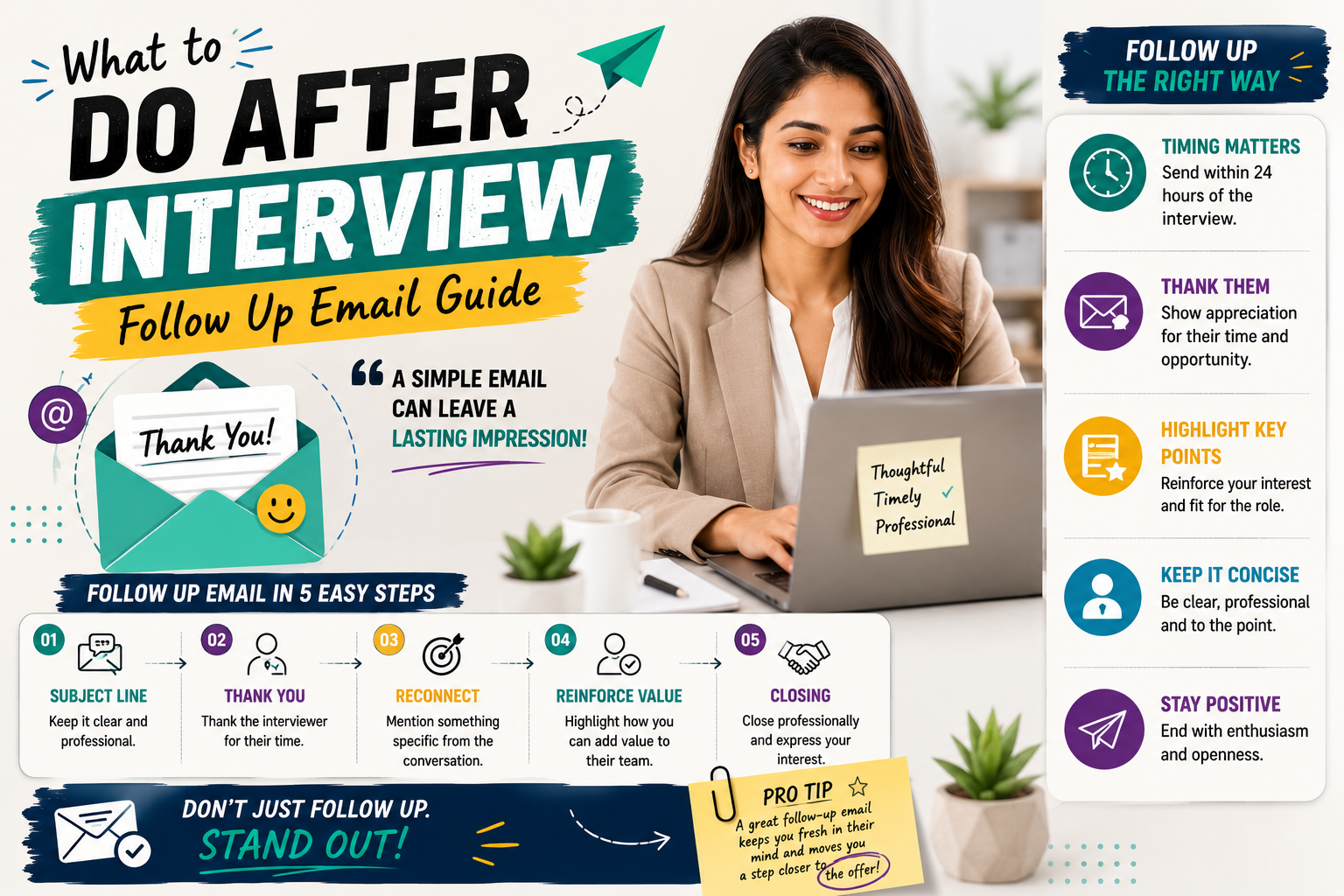
When to send it? Within 24 hours of the interview. Same day evening is best. The interviewer still remembers you. Your answers are fresh in their mind. Your email reinforces the positive impression.
Don’t wait 3 days. Don’t wait until they contact you. Send it the same evening or the next morning.
What should the email contain? Three things — gratitude, a specific detail from the interview, and your enthusiasm for the role.
Template 1: Thank you email after HR round
Subject: Thank You — [Your Name], [Role Applied For]
Dear [Interviewer’s Name],
Thank you for taking the time to speak with me today about the [Job Title] position. I really enjoyed learning about the team’s work on [specific project or detail discussed during the interview].
Our conversation strengthened my interest in this role. I’m particularly excited about [mention one thing — the team, the product, a challenge they described]. I’m confident my skills in [mention 1-2 relevant skills] would allow me to contribute from day one.
Please don’t hesitate to reach out if you need any additional information from my side.
Thank you again for the opportunity. I look forward to hearing from you.
Best regards,
[Your Name]
[Phone Number]
Template 2: Thank you email after technical round
Subject: Thank You for the Interview — [Your Name]
Dear [Interviewer’s Name],
I wanted to thank you for the technical discussion today. The problem on [specific topic — e.g., API optimization, database design] was challenging, and I appreciated the way you walked me through the team’s approach.
I realized during our conversation that your team is solving exactly the kind of problems I enjoy working on. I’m eager to bring my experience with [specific tech skill] to this role.
Looking forward to the next steps.
Warm regards,
[Your Name]
Here’s a real example of how this works. Rohit, a fresher in Pune, interviewed for a software developer role. He sent a thank-you email within 4 hours, mentioning a specific system design discussion from the interview. The hiring manager told him during the offer call — “Your follow-up email stood out. Most candidates don’t bother.” Rohit got a ₹5.2 LPA offer — the highest in his batch.
One email. Four hours. Lasting impression.
Follow Up Email After No Response — Templates That Get Replies
You sent the thank-you email. A week passed. No reply. Silence. Now you need a different kind of email — a polite follow-up asking about the status.
When to send a follow-up? Wait 5-7 business days after the interview (or after your thank-you email). Don’t follow up after 2 days — HR needs time to interview other candidates and make decisions.
Template 3: First follow-up after no response (Day 7-10)
Subject: Following Up — [Job Title] Interview, [Your Name]
Dear [HR Name],
I hope you’re doing well. I’m writing to follow up on my interview for the [Job Title] position on [Date]. I remain very interested in this opportunity and would love to know if there are any updates regarding the next steps.
I understand the hiring process takes time, and I’m happy to provide any additional information that might be helpful for your decision.
Thank you for your time and consideration.
Best regards,
[Your Name]
[Phone Number]
Template 4: Second follow-up after continued silence (Day 14-15)
Subject: Quick Check-in — [Job Title] Application, [Your Name]
Dear [HR Name],
I wanted to check in once more regarding the [Job Title] position. I interviewed on [Date] and I’m still very interested in joining [Company Name].
If the position has been filled or the timeline has changed, I completely understand. I’d appreciate a brief update whenever possible.
Thank you for your time.
Best regards,
[Your Name]
What if there’s still no response? After two follow-ups with no reply over 2-3 weeks, it’s time to move on. Don’t send a third email. Don’t call repeatedly. Silence after two follow-ups usually means the company has moved forward with another candidate. It’s unprofessional of them not to inform you — but it happens frequently in India.
A marketing fresher in Mumbai sent her first follow-up on Day 7. No response. She sent the second on Day 15. HR replied within 2 hours — “Sorry for the delay. You’re selected for the final round.” She had almost given up. That second email saved her candidacy.
What to Do After a Job Interview — Step by Step Action Plan
Step 1: Send a thank-you email within 24 hours.
Same evening or next morning. Use Template 1 or 2 above. Mention something specific from the conversation. Keep it under 150 words. This takes 10 minutes and separates you from 88% of candidates.
Step 2: Write down everything you remember from the interview.
What questions were asked? What did you answer well? Where did you struggle? Note the interviewer’s name, team details, and anything specific they mentioned about the role. This helps you prepare for the next round — and gives you content for your follow-up emails.
Step 3: Connect with the interviewer on LinkedIn.
Send a connection request with a short note — “Hi [Name], it was great speaking with you about the [Role] position today. I’d love to stay connected.” Don’t write a long message. Don’t ask about the result on LinkedIn. Just connect. This keeps you visible in their professional network.
Step 4: Continue applying to other jobs.
This is the mistake 90% of candidates make — they stop applying while waiting for one result. Never pause your job search for one company. An HR manager in Gurgaon told me — “Candidates who tell me they have other interviews in progress always get faster decisions from us.” Keep applying. Keep interviewing. Momentum protects you from disappointment.
Step 5: Send a polite follow-up on Day 7 if no response.
Use Template 3. If still no response by Day 14, use Template 4. After that, let it go and focus on other opportunities.
Common Post-Interview Mistakes Indian Candidates Make
Mistake 1: Calling HR repeatedly to ask about the result.
One follow-up email is professional. Three missed calls in two days is not. A fresher in Chennai called HR every other day for a week after his interview. HR blacklisted his application. The feedback — “Candidate was too aggressive and impatient.” Follow up in writing. Once or twice. That’s it.
Mistake 2: Not sending any follow-up at all.
Many Indian candidates believe “If they want me, they’ll call.” While that’s sometimes true, a follow-up email shows professionalism and genuine interest. Two candidates with equal scores — one sent a thank-you email, one didn’t. Who do you think gets the tiebreaker? A hiring manager in Delhi confirmed — “When it’s close between two candidates, the one who followed up wins.”
Mistake 3: Sending a generic, copy-paste thank-you email.
“Thank you for the interview. I hope to hear from you soon.” This is forgettable. Mention something specific — a project discussed, a challenge the team is facing, a tool the interviewer mentioned. Specific details show you were actually listening, not just performing.
Mistake 4: Posting about the interview on social media.
Don’t tweet “Just finished an interview at XYZ Company, fingers crossed!” Don’t post Instagram stories from the office lobby. Companies monitor social media. Sharing interview details — even casually — can be seen as a breach of confidentiality. A candidate in Bangalore posted a photo outside a company’s office with the caption “Wish me luck!” HR saw it before the final decision was made — and it didn’t help.
Frequently Asked Questions
Q1: How soon should I send a thank-you email after an interview?
Within 24 hours — the sooner, the better. Same evening is ideal. The interviewer still remembers your conversation. Your email reinforces the positive impression while it’s fresh. Waiting 3-4 days reduces the impact significantly. Set a reminder on your phone to send it within 4-6 hours of the interview ending.
Q2: What if I don’t get a reply after the interview?
Wait 5-7 business days, then send a polite follow-up email asking for an update. If there’s still no response after another week, send one final follow-up. After two attempts with no reply over 2-3 weeks, move on. Silence usually indicates the company has moved forward with another candidate, though some companies do respond late.
Q3: Is it okay to follow up multiple times?
Two follow-ups are professional and acceptable — one thank-you email (Day 1) and one status follow-up (Day 7-10). A second follow-up on Day 14-15 is the maximum. Beyond that, repeated emails look desperate. If two follow-ups don’t get a response, your energy is better spent applying elsewhere.
Q4: What should I write in the subject line of a follow-up email?
Keep it clear and specific. Good formats: “Thank You — [Your Name], [Job Title]” or “Following Up — [Job Title] Interview, [Your Name].” Avoid vague subjects like “Hello” or “Checking in.” HR receives dozens of emails daily. A specific subject line helps them find and prioritize your email quickly.
Q5: How to ask about interview results politely?
Use this exact phrasing — “I’m writing to follow up on my interview for the [Job Title] position on [Date]. I remain very interested in this opportunity and would appreciate any updates regarding the next steps.” Don’t ask “Did I get the job?” or “What’s your decision?” Keep it professional. Show interest without pressure.
The Interview Ends When You Get the Result — Not When You Walk Out
Here’s the key takeaway — the 24 hours after your interview matter almost as much as the interview itself. A thank-you email, a LinkedIn connection, and a well-timed follow-up can be the difference between getting the offer and getting ghosted.
Send your thank-you email tonight. Write down your interview notes. Keep applying to other roles while you wait. And if there’s no response after a week — follow up once, politely.
Thousands of candidates across Mumbai, Delhi, Bangalore, and Hyderabad lose offers not because they interviewed badly — but because they went silent afterwards. The candidate who stays professionally visible wins.
Your interview went well. Now finish the job. Send that email. 💪
