
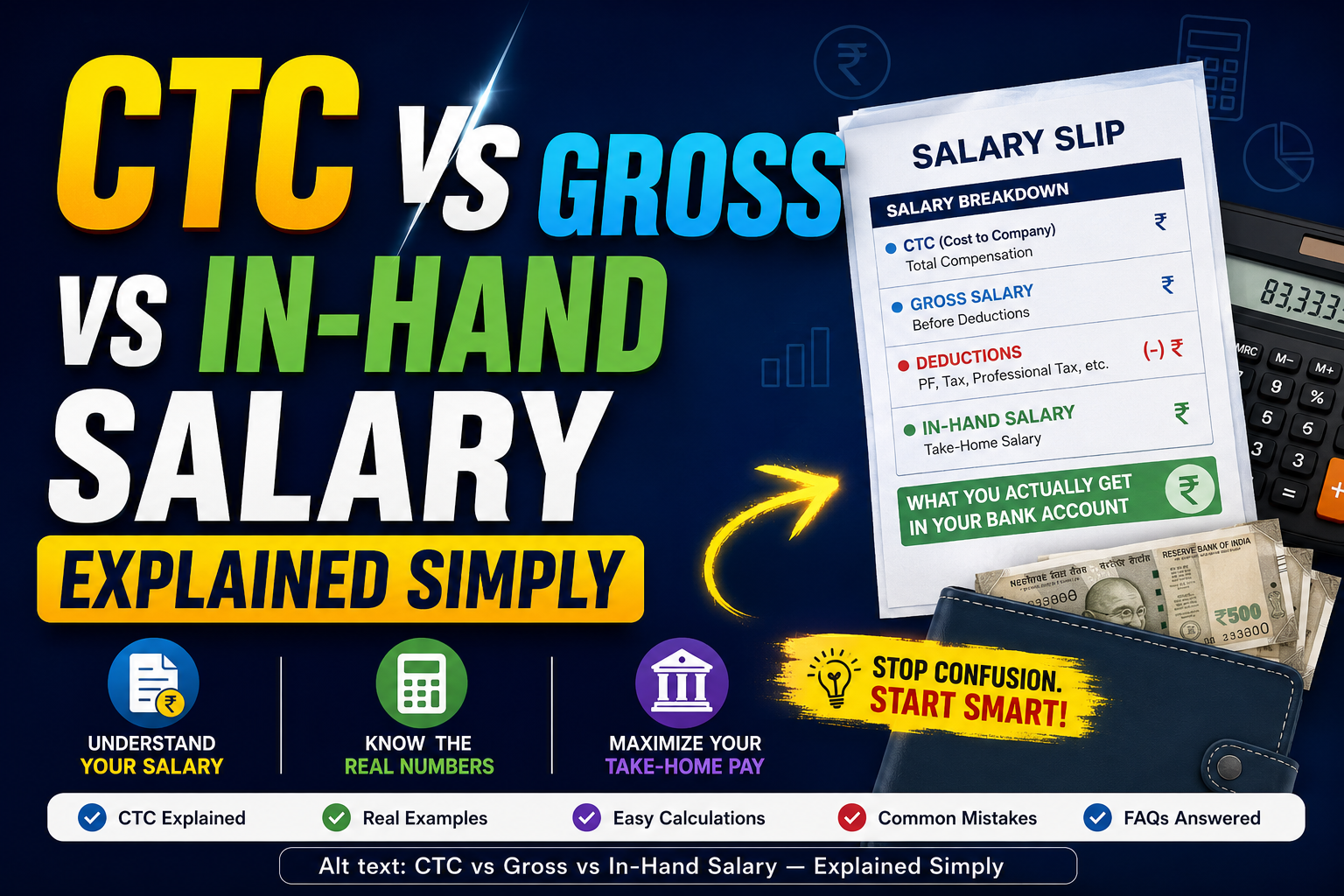
You just got your first offer letter. It says ₹6 LPA CTC. You’re excited. You quickly divide by 12 and expect ₹50,000 per month in your bank account. But when the first salary hits, it’s only ₹42,000. What just happened?
This confusion hits almost every Indian job seeker. And it’s not your fault — nobody teaches this in college.
In this article, I’ll break down what CTC, gross salary, and in-hand salary actually mean. You’ll learn exactly how your salary is calculated, what gets deducted, and how to read your salary slip like a pro.
What is CTC — Cost to Company Meaning in Simple Words
CTC stands for Cost to Company. It is the total amount your employer spends on you in a year. But here’s the catch — not all of it reaches your bank account.
CTC includes your basic salary, HRA, allowances, bonuses, and even the employer’s PF contribution. Some companies also add insurance premiums and gratuity into CTC.
Let me give you a real example. Rahul got a job at a startup in Bangalore. His offer letter said ₹6 LPA CTC. Here’s how his CTC broke down:
- Basic Salary: ₹2,40,000
- HRA: ₹1,20,000
- Special Allowance: ₹96,000
- Employer PF: ₹28,800
- Insurance: ₹15,200
- Annual Bonus: ₹60,000 (performance-based)
Total CTC: ₹6,00,000
See the problem? That ₹60,000 bonus isn’t guaranteed. The insurance money never touches his account. The employer PF goes directly to his EPF account. So his actual monthly deposit is much less than ₹50,000.
According to a 2025 Naukri survey, over 67% of Indian freshers don’t understand the difference between CTC and in-hand salary before joining their first job. You’re already ahead by reading this.
Gross Salary vs Net Salary — What Actually Lands in Your Account
Gross salary is your CTC minus the employer’s contributions. Think of it as your salary before deductions.
Net salary — also called in-hand salary or take-home salary — is what actually gets credited to your bank account every month. It’s your gross salary minus all deductions like PF, professional tax, and TDS.
Here’s a quick formula:
Gross Salary = CTC – Employer PF – Gratuity – Insurance
Net Salary = Gross Salary – Employee PF – Professional Tax – TDS
Let’s take Priya’s example. She works at an IT company in Pune with a ₹10 LPA CTC.
| Component | Annual (₹) | Monthly (₹) |
|---|---|---|
| CTC | 10,00,000 | 83,333 |
| Employer PF | 48,000 | 4,000 |
| Gratuity | 24,000 | 2,000 |
| Insurance | 12,000 | 1,000 |
| Gross Salary | 9,16,000 | 76,333 |
| Employee PF | 48,000 | 4,000 |
| Professional Tax | 2,400 | 200 |
| TDS (estimated) | 60,000 | 5,000 |
| In-Hand Salary | 8,05,600 | 67,133 |
So Priya’s 10 LPA CTC gives her roughly ₹67,000 per month in hand. That’s about 80% of her CTC. This percentage varies, but for most salaried employees in India, in-hand salary is typically 70-85% of CTC.
How to Calculate In-Hand Salary from CTC — Step by Step
You don’t need a CA for this. Follow these 5 steps and calculate your own take-home salary today.
Step 1: Find your CTC.
Check your offer letter or HR email. Look for “Annual CTC” or “Total Compensation.”
Step 2: Subtract employer-side costs.
Remove employer PF (usually 12% of basic), gratuity (4.81% of basic), and insurance. This gives you gross salary.
Step 3: Subtract employee PF.
Your PF contribution is also 12% of basic salary. This goes to your EPF account — it’s your money, but you can’t spend it now.
Step 4: Subtract professional tax.
This varies by state. In Maharashtra, it’s ₹200/month. In Karnataka, it’s ₹200/month. Some states like Rajasthan don’t charge it at all.
Step 5: Subtract TDS (income tax).
This depends on your tax slab and investments. If your taxable income is under ₹7 lakh (new regime), TDS could be zero.
Want it even simpler? Search “CTC to in-hand calculator” on Google. Websites like ClearTax and Ambition Box have free tools. Just enter your CTC and it gives you a close estimate in seconds.
Common Mistakes to Avoid When Comparing Salary Offers
Mistake 1: Comparing CTC directly across companies.
One company’s ₹8 LPA might give you ₹58,000 in hand. Another’s ₹8 LPA might give you ₹52,000. The CTC structure matters more than the number. Always ask for the full CTC breakdown before accepting.
Mistake 2: Ignoring variable pay and bonuses.
Many companies pack 10-20% of CTC into performance bonuses. This money isn’t fixed. A fresher in Delhi might see “₹5 LPA” on the offer letter, but ₹60,000 of that is a yearly bonus paid only if targets are met. Your guaranteed monthly in-hand from a 5 LPA package with variable pay could be as low as ₹30,000.
Mistake 3: Not reading the salary slip properly.
Your payslip has all the answers. It shows your basic salary, HRA, allowances, PF deduction, ESI deduction, professional tax, and TDS. Learn to read it once, and you’ll never be confused again. Search “salary slip kaise padhein” — there are good Hindi explainers on YouTube too.
Mistake 4: Forgetting about ESI deductions.
If your gross salary is under ₹21,000 per month, ESI (Employee State Insurance) gets deducted at 0.75%. It’s a small amount, but freshers in cities like Lucknow and Jaipur often get surprised by it.
Frequently Asked Questions
Q1: CTC 5 lakh means how much per month in hand?
With a ₹5 LPA CTC, your in-hand salary is usually between ₹33,000 to ₹38,000 per month. The exact amount depends on your PF structure, tax slab, and whether your company includes variable pay. Always ask HR for the monthly take-home figure before joining.
Q2: Is gross salary and CTC the same thing?
No, they are different. CTC includes everything your employer spends — including employer PF, gratuity, and insurance. Gross salary is what remains after removing these employer-side costs. Gross salary is always less than CTC.
Q3: How much is 6 LPA in hand salary per month?
A 6 LPA CTC typically gives you ₹40,000 to ₹45,000 in hand monthly. If you’re in the zero-tax bracket under the new regime, it’ll be on the higher side. If your company has a high variable component, it could be lower.
Q4: What percentage of CTC is in-hand salary?
For most Indian companies, in-hand salary is roughly 70-85% of CTC. The exact percentage depends on your basic salary ratio, PF structure, state-level professional tax, and income tax deductions. Higher CTC packages often have a lower in-hand percentage due to higher TDS.
Q5: Why is in-hand salary so much less than CTC?
Because CTC includes costs you never see in your bank — employer PF, gratuity, insurance, and sometimes meal coupons or cab allowances. On top of that, your own PF, professional tax, and income tax get deducted from the remaining amount. Both employer and employee deductions reduce the final number.
Your Next Step
Here’s the one thing to remember — CTC is what the company pays, gross is before deductions, and in-hand is what you actually get. Three different numbers, same salary.
Before you accept your next offer, ask HR for the complete salary breakup. Calculate your monthly in-hand using the steps above. Compare offers based on take-home pay, not CTC alone.
If you’re a fresher starting out in Mumbai, Delhi, or Bangalore, this one skill will save you from disappointment on salary day. Bookmark this page, use a CTC to in-hand calculator, and always know your real salary before you say yes.
You’ve got this. Go make a smart decision. 💪
