
You see a WhatsApp message — “Work from home, earn ₹5,000 daily, no experience needed.” Your heart races. You click the link. They ask for a ₹500 registration fee. You pay it. Then they ask for more. And more. Until you realize — the job never existed.
This is happening to thousands of Indians every single day. And knowing how to tell fake vs real WFH jobs can save you from losing your hard-earned money.
In this article, I’ll show you exactly how to spot fake job offers, which scams are most common, and what to do if you’ve already been scammed.
Red Flags of Fake Work From Home Job Offers
Fake job offers follow a pattern. Once you learn the signs, you’ll spot them instantly.
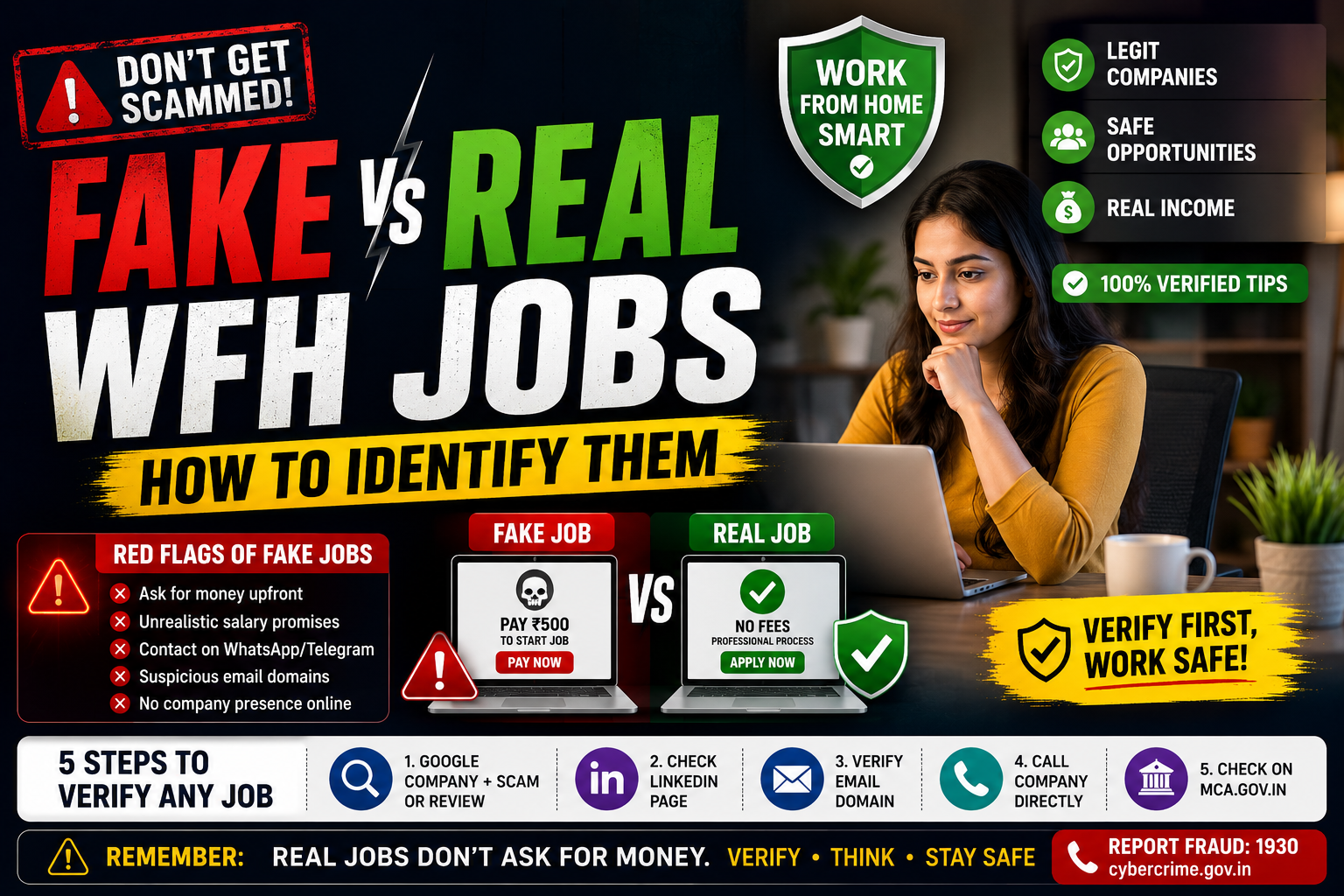
They ask for money upfront. This is the biggest red flag. A genuine company will never ask you for a registration fee, training fee, or security deposit. If a “recruiter” asks you to pay ₹299, ₹499, or ₹999 to start working — it’s a scam. No exceptions.
The salary is unrealistically high. A post says “earn ₹50,000/month doing simple typing work from home.” Think about it — companies in Noida and Bangalore pay ₹15,000-₹20,000 for entry-level full-time data entry roles. Why would someone pay ₹50,000 for easy part-time typing?
They contact you first on WhatsApp or Telegram. Real recruiters use official email IDs, LinkedIn, or job portals. If a random number messages you on WhatsApp saying “Hi, I’m from HR” — be cautious.
The email domain is suspicious. A real offer comes from @company.com. A fake one comes from @gmail.com, @yahoo.com, or something like @company-hiring-2024.com. Always check the sender’s email domain.
According to the Indian Cyber Crime Coordination Centre (I4C), over 1 lakh job fraud complaints were registered on cybercrime.gov.in in 2024 alone. That’s roughly 275 people getting scammed every day.
Most Common WFH Job Scams in India Right Now
Let me walk you through the scams I see most often. Knowing these will keep you two steps ahead.
The Telegram Task Scam. Someone adds you to a Telegram group. They give you small tasks — like reviewing hotels on Google Maps or liking YouTube videos. You earn ₹100-₹200 initially. Then they say “invest ₹5,000 for VIP tasks to earn ₹15,000 daily.” You pay, complete the task, but the withdrawal never works. A college student in Lucknow lost ₹1.2 lakh to this exact scam last year.
The Data Entry / Typing Job Scam. A website offers typing work at ₹5 per page. They ask for ₹500-₹1,000 as a “registration fee” or “software charge.” After you pay, they either disappear or send impossible tasks with penalties built in so you never earn anything.
The Fake Offer Letter Scam. You receive a professional-looking offer letter from a “well-known company” via email. It has a logo, HR name, and salary of ₹25,000/month. But the letter asks you to pay for a background check or ID card. A fresher in Delhi received a fake TCS offer letter — the email came from tcs.aborad.careers@gmail.com. The misspelling alone was a giveaway.
The WhatsApp “Like & Earn” Scam. You get a message — “Like Instagram reels and earn ₹50 per like.” The first payout is real (₹150-₹300). This builds trust. Then they push you toward “prepaid tasks” where you invest ₹3,000-₹10,000. The money never comes back.
How to Verify if a Company and Job Offer Is Genuine — Step by Step
Before you respond to any WFH job offer, run it through these 5 checks. It takes 10 minutes and can save you thousands.
Step 1: Google the company name + “scam” or “review.”
Search “XYZ Company job scam” or “XYZ Company reviews.” If others have been scammed, you’ll find complaints on Quora, Reddit, or consumer forums. No search results at all? That’s also a red flag — real companies have some online presence.
Step 2: Check their LinkedIn page.
A genuine company has a proper LinkedIn page with employees, posts, and history. If the company doesn’t exist on LinkedIn, or has a page with zero employees and was created last month — walk away.
Step 3: Verify the email domain.
The recruiter’s email should match the company’s website domain. If the company is “BrightTech Solutions” with a website brighttechsolutions.com, the email should be something@brighttechsolutions.com — not brighttech.hr@gmail.com.
Step 4: Call the company directly.
Find the company’s official phone number from their website — not from the job posting. Call them and ask if they have an open position and if this person works there. A genuine HR team will confirm.
Step 5: Check on the MCA website.
Every registered Indian company is listed on the Ministry of Corporate Affairs portal (mca.gov.in). Search the company name there. If it doesn’t exist, the company itself is fake.
Common Mistakes Job Seekers Make That Scammers Exploit
Mistake 1: Paying any amount to “start” a job.
I’ll say it again — no real employer charges you money to give you work. Not ₹99. Not ₹499. Not ₹1. If the first step of a “job” is opening your wallet, close the tab. Genuine jobs don’t ask for money. Period.
Mistake 2: Trusting a job just because it looks professional.
Scammers in 2025 use polished websites, official-looking PDFs, and even fake video calls. A good-looking offer letter means nothing. A girl in Mumbai received a beautifully designed offer from a “digital marketing company” with a ₹30,000/month salary. The company had a professional website. But it was created just 15 days before the offer — a quick WHOIS domain check revealed that.
Mistake 3: Not checking trusted job portals first.
If a job is real, it’ll likely be listed on Naukri, LinkedIn, Indeed, or the company’s own career page. If the job exists only on Telegram, WhatsApp, or a random classified website — question it.
Mistake 4: Sharing personal documents too early.
Some scammers collect your Aadhaar, PAN card, and bank details under the excuse of “onboarding.” Then they misuse it. Never share sensitive documents until you’ve verified the company AND received an official, verifiable offer.
Frequently Asked Questions
Q1: How to know if a job offer is real or fake?
Check three things — does the company exist on LinkedIn and Google? Does the recruiter use an official company email? Are they asking you for any money? If the company has no online presence and wants payment, it’s almost certainly fake. Always verify before sharing personal details.
Q2: What to do if you’ve already been scammed by a fake job?
Report it immediately on cybercrime.gov.in — India’s national cybercrime portal. You can also call the helpline 1930. File the complaint with screenshots, transaction details, and phone numbers. The sooner you report, the better your chances of recovering money.
Q3: Why do fake job offers ask for money?
Because that’s how they make profit. They send the same fake offer to thousands of people. Even if 100 people pay ₹500 each, that’s ₹50,000 earned in one day with zero effort. The “job” is just bait to collect your money.
Q4: Are all work from home jobs fake?
Not at all. Many legitimate companies offer real remote jobs — Infosys, Wipro, Amazon, Flipkart, and hundreds of startups hire for WFH roles. The key is to find them on trusted platforms like Naukri, LinkedIn, or the company’s official website. Real online jobs never need any registration fee or investment.
Q5: How to report job fraud in India?
Visit cybercrime.gov.in and register a complaint under “online financial fraud.” You can also call 1930 (national cyber helpline). Keep all evidence — screenshots, messages, emails, payment receipts. You can additionally file a police FIR at your local station under IT Act sections.
Protect Yourself, Protect Your Money
Here’s the one rule that stops 90% of job scams — never pay money to get a job. If someone asks you to invest, deposit, or pay any fee before you start earning, it’s a trap.
Real WFH jobs exist. Companies are genuinely hiring for remote roles across India. But you need to find them on the right platforms and verify every offer before you commit.
Bookmark cybercrime.gov.in — save helpline 1930 in your phone. Share this article with your friends and family who are looking for work from home jobs. One share could save someone from losing their savings.
Stay alert. Stay safe. Your right job is out there — and it won’t ask for your money. 💪
