
You’ve been working at the same company for 5 years. You finally decide to resign. HR processes your full and final settlement. Along with your last salary, you see a separate amount — ₹1,44,000 credited as “Gratuity.” You didn’t expect it. You didn’t apply for it. It just appeared.
Most Indian employees know that gratuity exists. But very few understand how it works, who’s eligible, or how much they’ll actually receive.
In this article, I’ll explain what gratuity means, the exact formula to calculate it, whether it’s taxable, and what happens if your employer refuses to pay it.
Gratuity Meaning — Who is Eligible and When Do You Get It
Gratuity is a lump sum amount your employer pays you as a reward for your long service. It’s governed by the Payment of Gratuity Act, 1972. Think of it as a “thank you” payment — the company gives you money for staying loyal over the years.
Who is eligible?
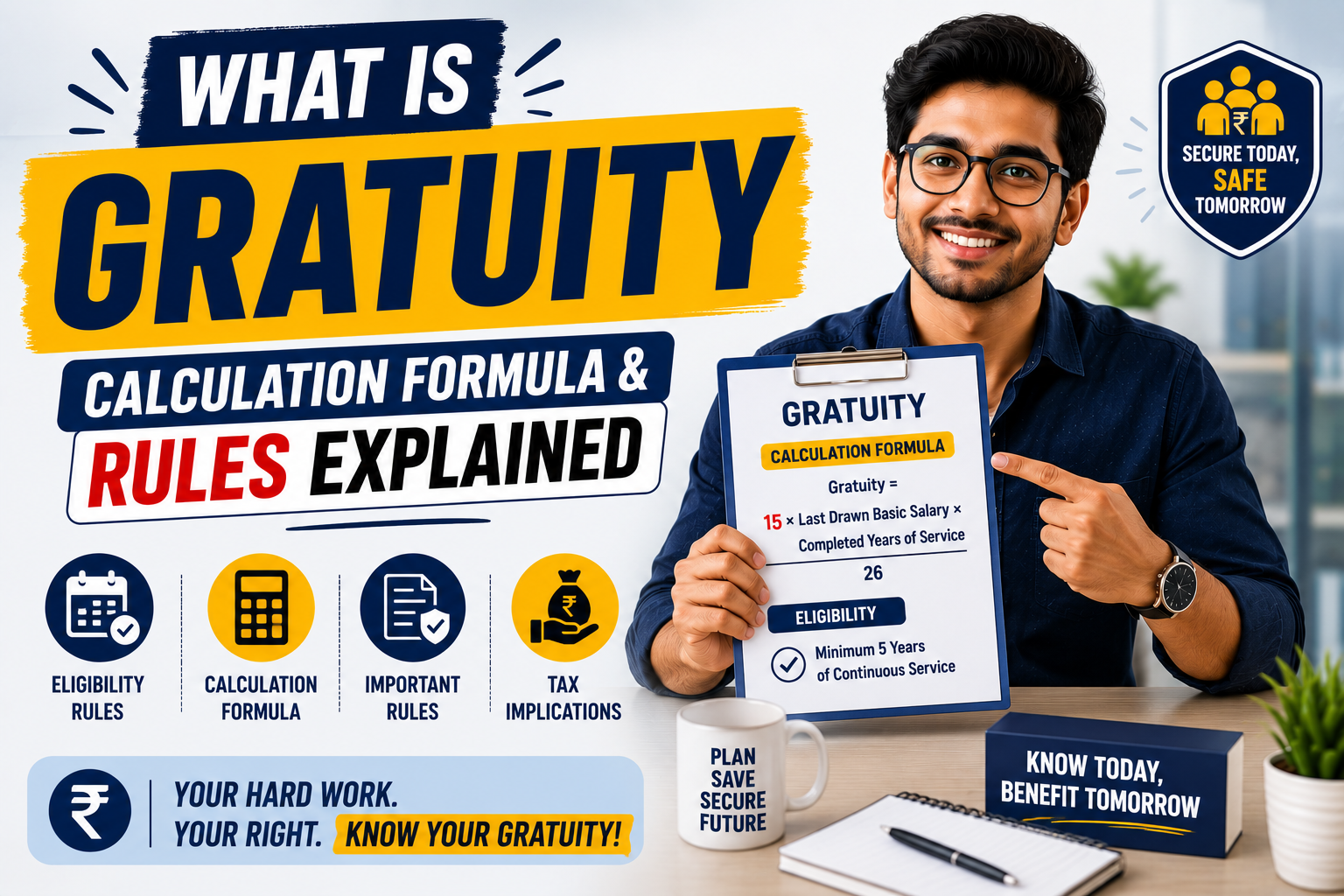
You’re eligible for gratuity if you’ve completed 5 continuous years of service with the same employer. This applies to every company with 10 or more employees — private, public, IT, manufacturing, all sectors.
There’s one exception. If an employee dies or becomes disabled, gratuity is payable even before 5 years. In this case, the amount goes to the nominee or legal heir.
Here’s what “5 years” actually means. The Supreme Court of India has ruled that 4 years and 240 days of continuous service counts as 5 years for gratuity purposes. So if you’ve worked 4 years and 8 months — you’re eligible. Many employees don’t know this and lose out.
A real example. Meera worked at a digital marketing agency in Mumbai for 4 years and 10 months. She resigned thinking she wouldn’t get gratuity because she didn’t complete “full” 5 years. She was wrong. Under the 240-day rule, she qualified. Her company initially refused, but when she quoted the Supreme Court ruling, HR processed ₹87,000 as gratuity within 2 weeks.
Does gratuity apply to private companies? Yes — 100%. If your private company has 10 or more employees, it falls under the Payment of Gratuity Act. According to EPFO data from 2024, over 90% of organized sector companies in India — including IT, BPO, retail, and manufacturing — are covered under this Act.
What about contract employees? Contract employees are eligible too — if they’ve completed 5 years of continuous service with the same employer or establishment. The key word is “continuous.” If your contracts were renewed without a break, the total duration counts.
Gratuity Calculation Formula — With Real Indian Examples and Tax Rules
The formula is straightforward. Let me show you.
Gratuity = (Last Drawn Basic Salary + DA) × 15 × Years of Service ÷ 26
Let me break this down:
- Last drawn salary = Your basic salary + dearness allowance (DA) in your final month
- 15 = You get 15 days’ salary for each year of service
- 26 = Working days in a month (as per the Act)
- Years of service = Total completed years (rounded — more than 6 months counts as a full year)
Example 1: Simple calculation
Rahul worked at an IT company in Pune for 8 years. His last drawn basic salary was ₹30,000/month. No DA.
Gratuity = ₹30,000 × 15 × 8 ÷ 26
Gratuity = ₹36,00,000 ÷ 26
Gratuity = ₹1,38,462
That’s nearly ₹1.4 lakh — tax-free (more on tax below).
Example 2: With DA and partial year
Sunita worked at a manufacturing company in Chennai for 12 years and 7 months. Her last basic salary was ₹25,000 and DA was ₹5,000.
Since 7 months is more than 6 months, her service rounds up to 13 years.
Gratuity = (₹25,000 + ₹5,000) × 15 × 13 ÷ 26
Gratuity = ₹30,000 × 15 × 13 ÷ 26
Gratuity = ₹58,50,000 ÷ 26
Gratuity = ₹2,25,000
Example 3: High salary, long tenure
Vikram worked at a bank in Delhi for 20 years. His last drawn basic + DA was ₹60,000.
Gratuity = ₹60,000 × 15 × 20 ÷ 26
Gratuity = ₹1,80,00,000 ÷ 26
Gratuity = ₹6,92,308
But wait — there’s a maximum limit.
Maximum gratuity limit: As of 2024, the maximum gratuity payable under the Act is ₹25 lakh. Even if the formula gives a higher number, you’ll receive a maximum of ₹25 lakh. Some companies voluntarily pay above this limit, but they’re not legally required to.
Is Gratuity Taxable?
This is one of the most searched questions. Here are the rules:
| Employee Type | Tax Rule |
|---|---|
| Government employees | Gratuity is fully tax-free |
| Private employees (covered under Act) | Tax-free up to ₹25 lakh |
| Private employees (not covered) | Tax-free up to ₹25 lakh (with specific calculation limits) |
For most salaried Indians, gratuity is completely tax-free because their amount rarely exceeds ₹25 lakh. If you’ve worked 8-10 years at a mid-level salary, your gratuity will typically be ₹1-₹3 lakh — well within the tax-free limit.
Only senior executives with very high salaries and 20+ years of service need to worry about the ₹25 lakh cap.
How to Claim Your Gratuity — Step by Step
Step 1: Confirm your eligibility.
Check if you’ve completed 5 years (or 4 years and 240 days) of continuous service. Count from your date of joining to your last working day. If you’re unsure, check your appointment letter for the exact joining date.
Step 2: Submit your resignation and serve notice period.
Gratuity is paid after your employment ends — whether you resign, retire, or are terminated (except for misconduct involving moral turpitude). Complete your notice period and last working day formalities.
Step 3: Submit Form I (Gratuity Application).
Your employer should process gratuity automatically as part of your full and final settlement. If they don’t, submit a written application (Form I under the Gratuity Act) to your HR department. State your name, employee ID, date of joining, last working day, and last drawn salary.
Step 4: Receive payment within 30 days.
By law, your employer must pay gratuity within 30 days of it becoming due. If they delay beyond 30 days, they must pay interest on the amount. If payment is delayed without reason, you can file a complaint with the Controlling Authority (Labour Commissioner) in your state.
Step 5: Verify the amount.
Use the formula yourself. Cross-check the amount against your last salary slip. If the company pays less than what the formula gives, raise it with HR in writing. If unresolved, approach the Labour Commissioner — the complaint process is free.
Common Mistakes Employees Make About Gratuity
Mistake 1: Thinking gratuity is a company “gift” that’s optional.
Gratuity is your legal right — not a favour. If you’ve completed 5 years and the company has 10+ employees, they must pay it. A senior developer in Hyderabad resigned after 7 years. His startup said “We don’t have a gratuity policy.” He filed a complaint with the Labour Commissioner. The company was forced to pay ₹2.1 lakh within 45 days. The law applies whether or not the company has a “policy.”
Mistake 2: Leaving at 4 years and 6 months thinking you missed it.
Remember the 240-day rule. If you’ve completed 4 years and 240 days of service, you qualify. Many employees resign just months before becoming eligible. If you’re at 4.5 years — wait a few more months. That patience could be worth ₹1-₹2 lakh.
Mistake 3: Not including DA in the calculation.
The formula uses basic salary PLUS dearness allowance. Some employees calculate using only basic salary and accept a lower amount. Always check if your salary structure includes DA — it’s common in manufacturing, government, and PSU jobs. Including DA can increase your gratuity by 15-25%.
Mistake 4: Assuming gratuity applies only to retirement.
You don’t need to retire to get gratuity. Resignation, termination (for non-misconduct reasons), superannuation, and even death or disability — all trigger gratuity payment. A content manager in Bangalore resigned after 6 years and didn’t claim gratuity because she thought “it’s only for retirees.” She lost ₹1.1 lakh she was legally owed.
Frequently Asked Questions
Q1: How is gratuity calculated in India?
The formula is — (Last drawn basic salary + DA) × 15 × years of service ÷ 26. For example, if your last basic salary is ₹20,000 and you worked 6 years, your gratuity is ₹20,000 × 15 × 6 ÷ 26 = ₹69,231. Service beyond 6 months in the final year is rounded up to the next full year.
Q2: Can I get gratuity before completing 5 years?
Generally, no — 5 years of continuous service is the minimum requirement. The only exceptions are death or permanent disability of the employee, where gratuity is paid regardless of tenure. Also, 4 years and 240 days counts as 5 years under the Supreme Court’s interpretation of the Act.
Q3: Is gratuity applicable for private company employees?
Yes. The Payment of Gratuity Act applies to every establishment with 10 or more employees — private companies, factories, shops, educational institutions, and hospitals. Your company doesn’t need a separate gratuity “policy.” If they have 10+ employees and you’ve completed 5 years, gratuity is your legal right.
Q4: What happens to gratuity if the company shuts down?
If the company closes, your gratuity is still payable. Under Indian law, gratuity is a priority payment during company liquidation — it’s paid before most other dues. If the company refuses or disappears, file a claim with the Labour Commissioner of your state. For companies under insolvency proceedings, the NCLT (National Company Law Tribunal) ensures employee dues including gratuity are settled.
Q5: Is gratuity shown in CTC?
Many companies include gratuity as a component of CTC. This means it’s factored into your annual cost to company but isn’t paid monthly. You only receive it as a lump sum after completing 5 years. If your CTC shows ₹24,000 as annual gratuity, don’t count it as monthly income — it’s a deferred benefit that pays out only when you’re eligible.
Your Loyalty Has a Price Tag — Know What It’s Worth
Here’s the one takeaway — gratuity is your earned right, backed by law. It’s not charity. It’s not a bonus. It’s money you’ve earned by showing up every day for 5+ years.
Before you resign from your next job, check two things. Have you completed 5 years (or 4 years and 240 days)? And do you know your last drawn basic salary? Run the formula. Know your number.
If your employer doesn’t pay within 30 days — don’t stay quiet. Approach the Labour Commissioner. The process is free and the law is on your side.
Every year, crores of rupees in gratuity go unclaimed in India because employees simply didn’t know they were eligible. Now you know. Claim what’s yours. 💪
